
Decocrete in Newburgh, NY
Ashlar is the cut-stone look you see on grand entryways and old courthouse floors: squared, precisely cut stones of varying sizes, laid with crisp, tight joints. In real stone, it's a mason's job. Every block is cut to size and set by hand, which makes it slow and expensive. Ashlar stamped concrete gives you that same orderly, tailored look in a single poured slab. You get the strength of concrete at roughly half the cost of natural stone.
The effect rests on two things. One is a stamp pattern that presses the rectangular blocks and tight joint lines into the wet slab. The other is color, layered to read like aged limestone or slate. Get both right, and a finished patio or driveway is hard to tell from quarried stone.
Find stamped concrete contractors near me.
What Is Ashlar-Stamped Concrete?
Stamped concrete is poured-in-place concrete that gets imprinted with patterned mats while it is still wet. For an ashlar look, those mats carry the squared blocks and shallow, regular joints of cut stone, so the slab reads as a course of separate rectangular stones rather than one flat surface. The ashlar pattern leans formal, which is why it shows up so often on porches, entryways, and pool decks where a clean, dressed look matters.
Color is what sells it. A base color goes into or onto the slab, then a darker release color settles into the joints and recesses, the way shadow and age darken the seams between real stones. A skilled contractor can blend two or three tones so the blocks vary slightly, the same way a quarry run of stone is never one flat gray.
See our guide to coloring concrete and the stamped concrete color chart for how those layers stack up. Ashlar is the most popular of the slate stamped concrete patterns, so it's worth seeing how it compares to the other slate looks.
Because it is one monolithic slab, ashlar-stamped concrete also avoids the downsides of real cut-stone pavers: individual stones that shift, settle, and let weeds creep into the joints. For the full side-by-side, see stamped concrete vs. pavers. Once it is sealed, upkeep is light. A reseal every few years keeps the color sharp, as covered in our notes on sealing stamped concrete and how to clean and maintain the surface.
What Ashlar Patterns Are Available?
Ashlar slate stamps are known for their mix of stone sizes, but they vary in scale and shape. Some patterns use smaller, closer-set stones for a tighter, more detailed look. Others use larger stones for a bolder, more open feel. The arrangement varies too, with some patterns leaning more square, others more rectangular, and many blending both shapes in the same course.
Ashlar Slate Stamped Walkways


San Jose Concrete; CamoCrete
Stamped Ashlar Driveways


Vicknair Contractors, LLC; American Concrete Strong LLC
Ashlar Slate Patios


Anything Concrete LLC; AMCON, LLC
Ashlar Entryway and Porch


Classic Crete Texas; A&W Concrete and Construction
Ashlar Pool Decks

Decocrete; Apex Concrete Designs, Inc.
Browse the full stamped concrete patterns library and more stamped concrete pictures for ideas.
Video: See How Ashlar Stamped Concrete Is Made
Watch how ashlar-pattern stamps are positioned and pressed into fresh concrete to create the look of individual cut-stone blocks.
Brickform demonstrates how ashlar-pattern stamps are used to create a realistic cut-stone look in decorative concrete.
How Much Does Ashlar-Stamped Concrete Cost?
Real ashlar stone is one of the pricier paving choices. Quarried, dressed stone runs roughly $20 to $40 per square foot installed, and the squared, hand-set blocks push labor toward the top of that range. Ashlar stamped concrete delivers the same look for about $14 to $20 per square foot for a mid-range job with a couple of colors and an ashlar slate stamp. Plain gray concrete costs less, but it will not read as stone.
What drives your final price is the detail:
- The number of colors
- Custom borders
- The size and shape of the pour
- How intricate the stamp work gets
A simple square patio in one base color and a release sits at the low end. A pool deck or driveway with banded borders and three blended tones lands higher.
When you are ready to price your own project, get quotes from decorative concrete contractors near you and compare the full cost ranges (see Stamped Concrete Cost).
See it in Action: Ashlar Stamped Concrete Projects
Here are some examples of real projects using ashlar stamps:
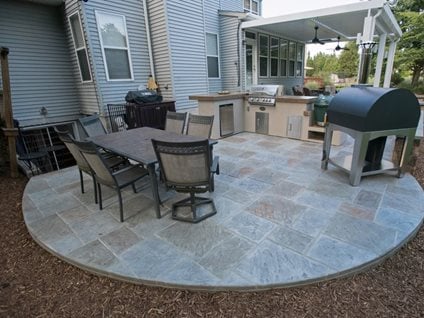
Salzano Custom Concrete in Centreville, Va.
Ashlar slate patio mimics Pennsylvania bluestone
This 800-square-foot patio was stamped with a basic ashlar slate pattern and hand colored to replicate the look of Pennsylvania bluestone. Grout was applied within the joint lines to add to the natural stone look, and the surface was sealed with a zero-shine sealer for a matte finish. Read more: Ashlar Slate Stamped Concrete in Centreville Mimics Bluestone.

Greystone Masonry in Stafford, Va.
Grand ashlar slate patio built for entertaining
A grand ashlar slate stamp gives this two-part, 2,744-square-foot patio the tailored look of cut stone. Multiple color hardeners were blended for a natural variation between blocks, and a matching ashlar slate walkway connects the main patio to a second, more secluded patio with a fire pit. Read more: Concrete Patio Is Designed for Outdoor Entertaining.

Allen Decorative Concrete in Escondido, Calif.
Ashlar travertine patio, fire pit, and countertop
Ashlar isn't limited to slate. This patio, fire pit, and outdoor kitchen countertop all used an ashlar travertine stamp paired with a hammered-edge form liner, for a stone-like texture along every edge. A buff-toned hardener and layered stains gave the concrete a realistic, weathered travertine look. Read more: Outdoor Entertaining Area Replicates Travertine.

Northwest Construction & Landscape LLC in Bremerton, Wash.
Ashlar slate courtyard patio saves on flagstone cost
This 647-square-foot courtyard patio uses an ashlar slate pattern to mimic the mortared flagstone originally planned by the landscape architect, saving the homeowner more than $5,000. The concrete was left natural gray and finished with a dark gray antiquing color for a weathered, quarried look. Read more: Formal Backyard Patio Showcases the Beauty of Natural Gray Concrete.