
- Industrial floors home
- Design & construction of commercial/industrial floors
- Floor flatness and joints
- Concrete Floor Applications
- Staining Concrete Floors
- Painted Concrete Floors
- Stenciling Concrete Floors
- Polishing Concrete Floors
- Self-Leveling Concrete Overlays
- Related Information
- Commercial Concrete: Information about concrete used in retail stores, restaurants, offices, and more
- Retail Floors
- Subgrades and subbases for concrete slabs
- Jointless slabs: How to reduce or eliminate the number of joints
Concrete Floor Specifications for Warehouses & Industrial Buildings
Understand specifications for industrial floor design, including concrete slab thickness
Residential concrete slabs often have few design requirements to get between the contractor and completion of the job. If the contractor knows what he or she is doing and knows what the customer wants, then the lack of specifications is probably a good thing. Most residential projects only specify minimum concrete compressive strength.
On commercial, industrial, or warehouse floors, though, there are typically design requirements within the contract documents (drawings and specifications). That can be good for the contractor if the specifier knows what they are doing and the specification clearly states what is required. These requirements can, however, be a problem if the specification is overly stringent or unclear or has conflicting provisions.
Industrial & Warehouse Concrete Floor Specifications
Here are some basic things that should be included in industrial concrete flooring specifications:
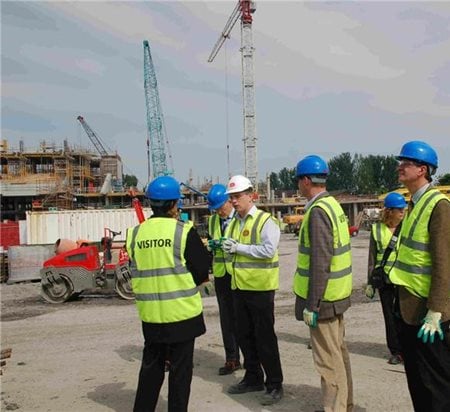
Getting everything straight in a preconstruction meeting can mean the difference between success and failure.
-
Base and subbase materials—the preparation requirements should be specified along with the location of a vapor retarder (if one is required)
-
Concrete thickness—the designer determines the thickness based on the subbase and the anticipated loads; this is one of the primary design decisions
-
Concrete compressive strength, flexural strength, or both
-
Concrete mixture proportion requirements including what materials are to be used, water-cement ratio (w/cm), slump, and any allowable admixtures
-
Reinforcement—the type and location of reinforcement should be specified, including how it is to be positioned during construction; remember that for slabs on grade or slabs on metal deck, the reinforcement's purpose is only for controlling crack width
-
Surface treatment—if more durable surfaces are needed, the designer will specify mineral or metallic surface hardeners
-
Surface finish—with commercial or industrial floors, a hard troweled surface is the most common finish but beware of air entrained concrete, when hard troweling can lead to delaminated surfaces
-
Aggregate exposure—with polished concrete there are different levels of sheen and exposure, ranging from flat to high shine, and salt and pepper to large aggregate
-
Tolerances—tolerances are typically specified by referring to ACI 117, Standard Specification for Tolerances for Concrete Construction and Materials, this includes tolerances for the subbase, the slab thickness, and surface finish including FF and FLrequirements
-
Concrete curing—the specification may include curing requirements, including how to respond to hot or cold weather conditions
-
Joint filling—material and installation techniques if joints are to be filled
-
Preconstruction meeting, quality assurance, and quality control—precon and prepour meetings can solve lots of problems with more complex floors, and documenting your compliance with the specification can mean a rigorous QA/QC program
 DAY1 Finishing Aid
Improve finish, reduce defects, enhance performance
DAY1 Finishing Aid
Improve finish, reduce defects, enhance performance
 Industrial Floor Wax
Achieve superior long term wear
Industrial Floor Wax
Achieve superior long term wear
 Crack Repair 1 Gallon Kit
from $55.15
Crack Repair 1 Gallon Kit
from $55.15
 Polishing Diamonds
Options for hard, medium, and soft concrete.
Polishing Diamonds
Options for hard, medium, and soft concrete.
 Encore Finishing Aid
Improve workability and surface quality
Encore Finishing Aid
Improve workability and surface quality
 Propane Grinding Machines
Go cordless with the LAVINA elite gtx series
Propane Grinding Machines
Go cordless with the LAVINA elite gtx series
Many of these requirements are defined by the Class of floor the owner wants—note that decorative concrete is typically a Class 1 floor. Floors are classified based on the intended use of the floor—see the table below that was adapted from ACI 302.1 R-04, Concrete Floor and Slab Construction. Each Class includes what ACI 302 calls "special considerations" and suggested finishing techniques. The designer may consider the Class when selecting the concrete properties and when specifying the placing, consolidating, finishing, and curing procedures. Note that the Class increases with increasing load and more stringent performance requirements; commercial or industrial floors may be anywhere between Class 3 and Class 9.
Chart - Classification of Concrete Floors Based on Intended Use
| Class | Anticipated Traffic Type | Use | Special Considerations | Final Finish |
|---|---|---|---|---|
| 1. Single Course | Exposed Surface - foot traffic | Offices, churches, commercial, institutional, multi-family | Uniform finish, non-slip aggregate in specific areas, curing | Normal steel troweled finish, non-slip finish where required |
| 1. Single Course--Decorative | Exposed Surface - foot traffic | Decorative concrete | Colored mineral aggregate, color pigment or exposed aggregate, stamped or inlaid patterns, artistic joint layout, curing | As required |
| 2. Single Course | Covered surface - foot traffic | Offices, churches, commercial, institutional, multi-family with floor covering | Flat and level slabs suitable for applied coverings | Light steel troweled finish |
| 3. Two course | Exposed or covered surface--foot traffic | Unbonded or bonded topping over base slab for commercial or non-industrial buildings where construction type or schedule dictates | Base Slab - gooduniform level surface, curing Unbonded topping- bondbreaker on base slab, min thickness 3 in., reinforced, curing Bonded Topping - properly sized aggregate, ¾ in. min thickness, curing |
Base slab - troweled finish under unbonded topping; clean textured surface under bonded topping Topping - for exposed surfaces, normal steel-troweled finish. For covered surface light steel-troweled finish. |
| 4. Single Course | Exposed or covered surface-foot and light vehicular traffic | Institutional or commercial | Level and flat slab suitable for applied coverings, nonslip aggregate for specific areas, curing. Coordinate joints with applied coverings | Normal steel-troweled finish |
| 5. Single Course | Exposed surface-industrial vehicular traffic-pneumatic wheels and moderately soft solid wheels | Industrial floors for manufacturing, processing, and warehousing | Good uniform subgrade, joint layout, abrasion resistance, curing | Hard steel-troweled finish |
| 6. Single Course | Exposed surface-heavy-duty industrial vehicular traffic-hard wheels and heavy wheel loads | Industrial floors subject to heavy traffic; may be subject to impact loads | Good uniform subgrade, joint layout, load transfer, abrasion resistance, curing | Special metallic or mineral aggregate surface hardener; repeated hard steel-troweling |
| 7. Two course | Exposed surface-heavy-duty industrial vehicular traffic-hard wheels and heavy wheel loads | Bonded two-course floors subject to heavy traffic and impact. | Base slab - good uniform subgrade, reinforcement, joint layout, level surface, curing Topping - composed of well-graded all mineral or all-metallic aggregate. Minimum thickness 3/4 in.; mineral or metallic aggregate surface hardener applied to high-strength plain topping to toughen, curing |
Clean, textured base slab surface suitable for subsequent bonded topping. Special power floats for topping are optional, hard steel-troweled finish |
| 8. Two course | As in Classes 4, 5, or 6 | Unbonded topping-on new or old floors where construction sequence or schedule dictates. | Bondbreaker on base slab, minimum thickness 4 in., abrasion resistance, curing | As in Classes 4, 5 or 6 |
Constructing Commercial & Industrial Floors
Construction of a commercial or industrial floor isn't all that different than a residential slab, there's just more of everything-more time spent leveling the side forms, more time spent straightening and restraightening the surface, more care taken with the curing. Commercial or industrial floors are typically placed in long alternating strips. The old practice of placing in a checkerboard pattern is not recommended. The idea with the checkerboard was that the initially placed squares could shrink and then the infilled parts would be placed, keep the joints tighter, but that proved not to really work since shrinkage takes longer than that.
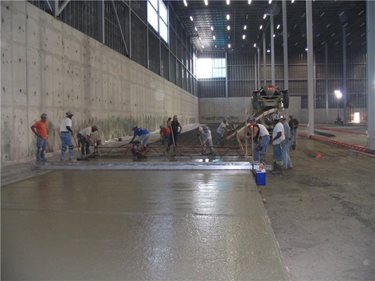
 High tolerance (superflat) floors are placed in strips. Allflat Consulting
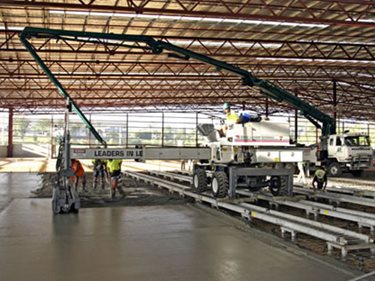
Placing concrete with a pump and striking off with a Laser Screed are common techniques with commercial or industrial floors. SAW Formwork
High tolerance (superflat) floors are placed in strips. Allflat Consulting
Placing concrete with a pump and striking off with a Laser Screed are common techniques with commercial or industrial floors. SAW Formwork
Setting the side forms and screeding has the greatest impact on floor levelness and getting the surface at the specified elevation. For very level floor requirements, like F-min floors, the side forms will be set then checked with surveyor's instruments and planed to precise elevations.
Strike-off or screeding of commercial or industrial floors is often done with a Laser Screed. This allows the concrete to be placed and leveled without the use of any sort of side forms. All Laser Screeds are manufactured by Somero Enterprises and several sizes are available today. These machines are so precise that for medium flatness requirements, placement with the Laser Screed need only be followed by troweling to achieve the desired surface finish.
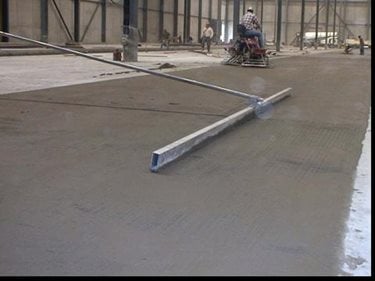
 Wide bull floats increase floor flatness. Dan Dorfmueller
Pans attached to trowel blades increase flatness. Dan Dorfmueller
Wide bull floats increase floor flatness. Dan Dorfmueller
Pans attached to trowel blades increase flatness. Dan Dorfmueller
For higher tolerance floors (higher F-number requirements), the contractor will follow up the initial strike-off with an 8- to 10-foot wide bullfloat or a highway straightedge. Simply using the wider tools can increase the flatness by 50%. The floor is often restraightened several times prior to and after power floating.
A big development with the floating operation was the pans that are slipped onto the blades of a power trowel. The pans can greatly increase flatness. This step is started after the bleedwater has evaporated and when the concrete is hard enough that footprints will be about ¼-inch deep or less.
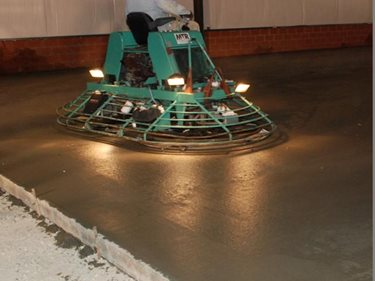
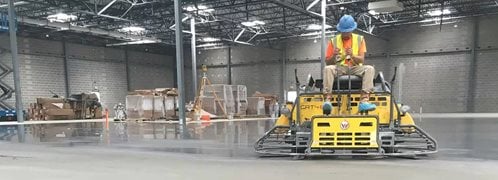
 Riding trowels greatly speed up the finishing operation. Dan Dorfmueller
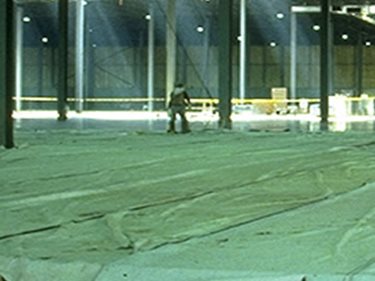
Wet curing with curing covers is critical to a strong surface. Dan Dorfmueller
Riding trowels greatly speed up the finishing operation. Dan Dorfmueller
Wet curing with curing covers is critical to a strong surface. Dan Dorfmueller
The final step with commercial or industrial floors is troweling, usually with a power trowel, either a walk-behind or a ride-on trowel. Troweling compacts the surface to provide a dense, hard, smooth surface layer. Subsequent trowel pass should be perpendicular to the previous pass.
All of this, of course, is followed by curing. The importance of curing cannot be over-emphasized. If the slab surface dries out, the concrete will lose strength and develop plastic shrinkage cracks. Learn more about curing.


