
- Concrete Curing Guide
- Curing Colored Concrete
- How Long Before You Can Drive on Concrete?
- How Long Before You Can Walk on Concrete?
- Curing Products
- Related Information:
- Proper curing techniques for concrete driveways
- How to fix common curing problems: Expert advice from Chris Sullivan
- Concrete Calculator: How much concrete do you need?
- Product Newsletter: Sign up today to receive monthly updates
Guide to Concrete Curing Time & Methods
Achieve stronger concrete by curing concrete for the proper amount of time and with the appropriate methods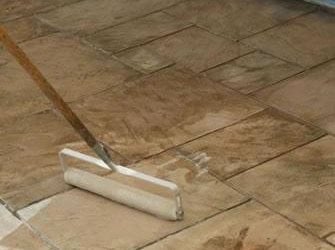
Applying concrete cure & seal.
L.M. Scofield Co.
When you place fresh concrete it's very sensitive and easily ruined. If you cure it properly it will be strong and reliable; neglect it, and you'll be sorry!
In the first week or so after concrete is poured, you must maintain the proper temperature and dampness for proper curing. Curing is easy to skip in the instant but that will have a major impact on the quality of your finished work.
While curing is important for all concrete, the problems that arise from not curing are most obvious with horizontal surfaces. An uncured slab, whether decorative or plain gray, is likely to develop a pattern of fine cracks (called crazing) and once it's in use the surface will have low strength that can result in a dusting surface that has little resistance to abrasion.
Find nearby concrete contractors that can make sure your concrete cures properly.
HOW LONG DOES IT TAKE FOR CONCRETE TO CURE?
The entire curing period of concrete takes about a month, but your concrete will be ready for use sooner. Each project will vary slightly due to differences in the weather, concrete mix and placement and finishing techniques.
When waiting for concrete to dry, keep these timeframes in mind:
- 24 to 48 hours - after inital set, forms can be removed and people can walk on the surface
- 7 days - after partial curing, traffic from vehicles and equipment is okay
- 28 days - at this point, the concrete should be fully cured
Learn more: How Long Before You Can Drive on Concrete?
WHAT IS CURING AND WHAT DOES IT DO TO THE CONCRETE?
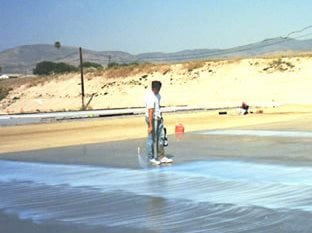
ASTM C 1315, Type II cure & seal materials have a white pigment that helps to see what's been cured and can reflect some sunlight.Nox-Crete
Curing serves these main purposes:
- It retains moisture in the slab so that the concrete continues to gain strength.
- It delays drying shrinkage until the concrete is strong enough to resist shrinkage cracking.
- Properly curing concrete improves strength, durability, water tightness, and wear resistance.
When most people think of curing, they think only of maintaining moisture on the surface of the concrete. But curing is more than that-it is giving the concrete what it needs to gain strength properly. Concrete strength depends on the growth of crystals within the matrix of the concrete. These crystals grow from a reaction between Portland cement and water-a reaction known as hydration. If there isn't enough water, the crystals can't grow and the concrete doesn't develop the strength it should. If there is enough water, the crystals grow out like tiny rock-hard fingers wrapping around the sand and gravel in the mix and intertwining with one another. Almost sounds like a horror movie-our concrete baby has turned into a monster!
The other important aspect of curing is temperature-the concrete can't be too cold or too hot. As fresh concrete gets cooler, the hydration reaction slows down. The temperature of the concrete is what's important here, not necessarily the air temperature. Below about 50 F, hydration slows down a lot; below about 40 F, it virtually stops.
Hot concrete has the opposite problem: the reaction goes too fast, and since the reaction is exothermic (produces heat), it can quickly cause temperature differentials within the concrete that can lead to cracking. And cement that reacts too quickly doesn't have time for the crystals to grow properly so it doesn't develop as much strength as it should.
So in the soon-to-be famous movie, the Cement Monster That Enveloped the World, all the puny earthlings need to do to save civilization is get the concrete too cold, too hot, or too dry and he turns into a weakling. Our objective, though, is to help him envelope the earth and to make him as strong as possible!
 TK Cure and Seal Products
Curing agents for new concrete. Non-Yellowing
TK Cure and Seal Products
Curing agents for new concrete. Non-Yellowing
 1300-CLEAR - Curing Compound
Wax based curing compound. Great for interior and exterior.
1300-CLEAR - Curing Compound
Wax based curing compound. Great for interior and exterior.
 Cures & Cure & Seals
Improved resistance to rain, the sun, freezing temperatures, stains, and more.
Cures & Cure & Seals
Improved resistance to rain, the sun, freezing temperatures, stains, and more.
 Water-based Curing Compound
VOC-Compliant. Easily applied with spray equipment.
Water-based Curing Compound
VOC-Compliant. Easily applied with spray equipment.
WHEN IS THE RIGHT TIME TO CURE CONCRETE?
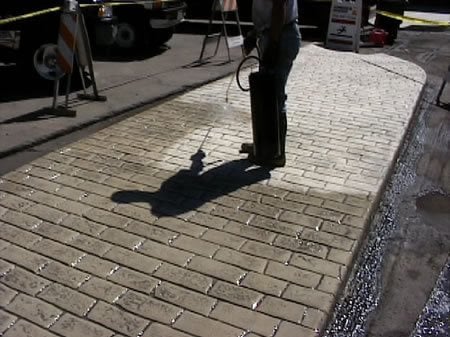
Curing must be started as soon as possible after finishing and stamping.Vexcon Chemicals
So the objective is to keep our young and impressionable concrete damp and at the right temperature (ideally between 50 and 85 F). The most frequently overlooked curing aspect is keeping exposed concrete surfaces moist while they are hydrating. Most concrete, especially most decorative concrete, will have plenty of water initially in the mix to completely hydrate the cement. The problem is that if the exposed surfaces dry out then the concrete can't hydrate and our young concrete ends up with very sensitive skin-easily scratched and sometimes actually dusty.
There are three phases of curing and the length of time each lasts depends on the concrete and the environmental conditions. Check out Figure 1.6 in ACI 308, Guide to Curing Concrete, to see how this works:
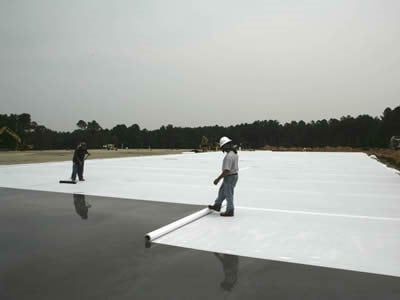
Keeping the concrete surface wet for 7 days is still the best way to cure concrete.PNA Construction Technologies
- When concrete is first placed for a slab, bleed water rises as the concrete mixture settles. During this period (initial set), if the bleed water is evaporating from the surface faster than it is rising out of the concrete then you need to do some initial curing or else you are likely to end up with plastic shrinkage cracks. To know if that's necessary, you need to know the evaporation rate (see below).
- Between initial set and final set, intermediate curing would be needed if the finishing (or stamping) is complete prior to final set.
- After final set, you need to do final curing.
During initial set, the rate at which the bleed water evaporates depends on a combination of factors: air temperature and humidity, concrete temperature, and wind velocity. The classic, and still best way to estimate the rate of evaporation is the Menzel/NRMCA nomograph-an easy-to-use chart that combines all of these factors. You can get this nomongraph out of ACI 308 or it's also available in an excellent piece in the March 2007 Concrete International, "Estimating Evaporation Rates to Prevent Plastic Shrinkage Cracking." You can also estimate evaporation rates using a free online program developed by Luke Snell and Amir Munir.
So you use these methods to figure out how fast the bleed water is evaporating--if it's greater than 0.2 pounds per square foot per hour, then initial curing is necessary because the concrete will be drying out. In the next section we'll discuss how to do initial curing.
After initial set, the concrete surface still needs moisture and now there's no bleed water. This is when you really need to cure the concrete. You need to assume that your concrete needs to be cured-it does! You don't want your perfect baby concrete to turn into a juvenile delinquent, do you?
HOW TO CURE CONCRETE
Now let's narrow this conversation down a bit. Let's talk only about horizontal concrete and only about the moisture part of curing. To learn more about working in temperature extremes get a copy of ACI 305, Hot Weather Concreting or ACI 306, Cold Weather Concreting.
Let's also narrow things down to curing of colored concrete. We'll define that as any concrete with color, whether integral or dry-shake, whether it is going to be stamped or not. First, and most importantly, colored concrete is not really different than any other concrete, it needs exactly the same treatment to end up with quality concrete. Some of the methods, though, need to be a bit different since appearance is so much more important than it is for an industrial slab.
There are three ways to cure concrete: either we add water to the surface to replace the water that is evaporating or we seal the concrete to prevent the water from evaporating in the first place or we do both. Note that adding water to the surface is NOT adding water that will be worked into the concrete mix--that would increase the water-cement ratio of the surface concrete and weaken it, ruining all our curing efforts.
You need to think about initial curing when the bleed water is evaporating too rapidly to keep the surface wet prior to initial set. Traditionally that has been specified at greater than 0.2 pounds per square foot per hour. Many mixes today bleed at much lower rates than this, so if there is less bleed water then the evaporation limit needs to be set lower-more like 0.05 to 0.1 pounds per square foot per hour. The best approach for decorative concrete is to try to alter conditions so you don't need to do initial curing: block the wind, keep the sun off the concrete, get cooler concrete. If that's not possible, fogging just enough to keep the surface damp is possible, but the simplest approach is to use evaporation retardant. This chemical can be sprayed on to form a thin membrane on the surface that prevents the water from evaporating. It completely dissipates during finishing operations. Keep some of this around for dry windy conditions.
CURING METHODS
- Water cure: The concrete is flooded, ponded, or mist sprayed. This is the most effective curing method for preventing mix water evaporation.
- Water retaining methods: Use coverings such as sand, canvas, burlap, or straw that are kept continuously wet. The material used must be kept damp during the curing period.
- Waterproof paper or plastic film seal: Are applied as soon as the concrete is hard enough to resist surface damage. Plastic films may cause discoloration of the concrete-do not apply to concrete where appearance is important.
- Chemical membranes: The chemical application should be made as soon as the concrete is finished. Note that curing compounds can effect adherence of resilient flooring, your flooring contractor and/or chemical membrane manufacturer should be consulted.
All the desirable properties of concrete are improved by proper curing!
ALLOW PROPER TIME TO WATERCURE SLABS
After concrete is placed, the concrete increases in strength very quickly for a period of 3-7 days. Concrete which is moist cured for 7 days is about 50% stronger than uncured concrete.
Water curing can be done after the slab pour by building dams with soil around the house and flooding the slab. The enclosed area is continually flooded with water. Ideally, the slab could be water cured for 7 days.Some builders on a tight schedule water cure for 3 days as this achieves approximately 80% of the benefit of water curing for 7 days.
Consider planning your job to pour at the end of the week, build berms, then flood over the weekend. You get the benefit of water curing without losing too much time in the schedule.
Related Information:
Concrete Contractors: Find Cures & Curing Supplies
More about concrete discoloration


