
- Colored Concrete Home
- Concrete Color Charts
- Ways to Color Concrete
- Concrete stains
- Integral Color
- Dry-Shake Color Hardener
- Concrete Dyes
- Concrete Paint
- Comparison Chart: Concrete Coloring Products
- Design Ideas for Colored Concrete
- Which Color Scheme is Right for Your Home?
- Creating color and texture with Stamped Concrete
- Adding Interest with Exposed Aggregate
- Creating Excitement with Color: Endless Possibilities with Polymer Stain
- Related Information:
- Problems with colored concrete: Common problems, why they occur, and how to avoid or fix them
- Guide to Buying Concrete Stains and Dyes
- Lea este artículo en español
Concrete Discoloration
Learn the common causes of concrete drying different colors or with spots and what countermeasures to take to fix the problem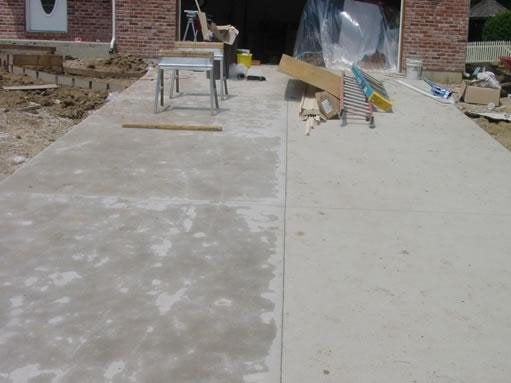
Some discoloration problems are baffling. These driveway lanes were placed on two different days with the same supplier, same mix, same crew, same subgrade, but with very different results.
Any contractor who has placed concrete that ends up being discolored knows how big of a nuisance and disappoint it can be to everyone involved. The contractor worked hard to deliver a product that reflects well on the company's image. The owner was looking forward to (and paid for) an attractive driveway, sidewalk, or patio that complements their home or commercial structure.
But when the concrete turns out to be blotchy and uneven in color, and takes away from rather than enhances a property's curb appeal, everyone wants to know why the discoloration happened and how it might be avoided or corrected.
Find concrete coloring contractors near me who can help fix discoloration.
COMMON CAUSES OF DISCOLORED CONCRETE
Discoloration is a tricky subject, since many factors can contribute to the problem (see photo). However, discoloration, whether occurring in a single placement or sequential concrete placements, generally boils down to one root cause: inconsistency. This can be an inconsistency in materials or in workmanship. Here are some of the most common causes and practices leading to discoloration and some remedies you can take to lessen the effects.
Inconsistent materials
To avoid objectionable color issues, it's important to maintain consistency throughout the project, especially in mix proportioning. Deliveries of mixes that are drastically different from batch to batch make it difficult to achieve a uniform concrete surface color.
It is the responsibility of your ready-mix producer to deliver a consistent concrete mix. But that's more complex than it sounds since concrete is made up of a number of ingredients with their own inherent variability. Cement, supplementary cementitious materials, sand, stone, water, admixtures, and possibly fibers are all blended together, and having them interact consistently from batch to batch does not happen "by accident." All concrete ingredients must comply with American Society for Testing and Materials (ASTM) standards. Concrete aggregates must be of good quality. Mix water quantities must be adjusted based on the moisture contents of the sand and stone. If not, the consequences in the field can be significant.
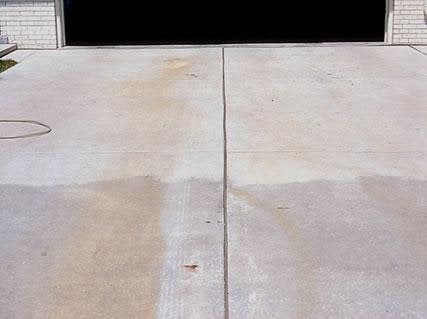
The lower portion of this driveway was placed with a mix containing calcium chloride, resulting in a darker color than the calcium-chloride-free placement near the garage door. (Photo courtesy of the Portland Cement Association)
Adding water at the jobsite
Sometimes contractors will adjust batches with inconsistent moisture contents (which translate to workability) at the jobsite to make finishing operations as easy as practical. Small variations in concrete moisture are common and typically not objectionable. But modifying mixes in the field, followed by inefficient mixing, can produce a blotchy appearance. Changes in shade become especially noticeable in side-by-side placements, when water is added in the field at the very end of one batch and then the concrete is placed next to earlier non-retempered concrete.
RELATED: Guide to Efflorescence on Concrete
Change in cement color
Cement delivered to the ready-mix plant may change slightly in color depending on the burning or grinding conditions during cement production. A concrete color change, due to a change in cement color, may be noticeable if a cement substitution takes place during an ongoing placement or this adjusted mix is placed immediately next to concrete produced with cement from a different source.
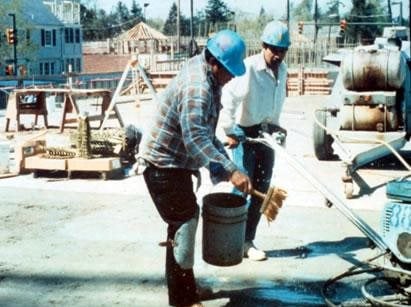
Avoid adding water to the surface as a finishing aid or finishing the bleedwater back into the surface. Higher water-cement ratios lead to lighter-colored concrete surfaces. (Photo courtesy of PCA)
Using cement replacements
To complicate the color issue, the trend to go "green" and use recycled products as partial cement replacements can produce color variations, depending on the percentage of recycled material put into the mix, the water-to-cementitious materials ratio, and how the concrete is cured. Common recycled or supplemental cementitious materials (SCM) are slag, a byproduct of the steel industry, and fly ash, a byproduct of coal combustion. Using varying quantities of fly ash can result in different hues, ranging from buff to brown. Slag use may produce an initial slight bluish or green tint that lightens with time. Generally, a slag-cement mix will be lighter than a straight-cement concrete.
Adding calcium chloride
A frequent reason behind a darkened-concrete appearance is the addition of calcium chloride to accelerate the setting time of concrete (see Photo 1), especially when calcium chloride dosages approach 2% by weight of cement. Inadequate mixing after addition of calcium chloride makes the concrete color even more irregular or blotchy.
Poor workmanship
How a contractor reacts to variables during a concrete placement, such as weather conditions that change from morning to afternoon and day to day, can have a big impact on the final results. For instance, in a dry environment, wetting down a subgrade prior to a slab placement is good practice. Placed concrete in weather producing higher rates of evaporation may also call for countermeasures such as wind breaks, evaporative retardants or similar practices (for more information, read the American Concrete Institute publication ACI 305R-20, Hot Weather Concreting). Without proper countermeasures, poor practices like "blessing" the surface with additional water (see Photo 2) or final finishing while bleedwater is still on the surface result in increased variability in the surface appearance or, worse, delamination.
HOW DO YOU FIX DISCOLORED CONCRETE?
If you do end up with discolored concrete, there are a number of remedies you can take to lessen the effects.
Check out these top color correction resources:
- Restore Faded or Discolored Concrete with Cem-Coat
- Fixing Discolored Concrete Floors
- How to Fix Concrete Color Issues
- Removing Stains from Concrete
- Concrete Sealer Issues
 Efflorescence Cleaner
Water soluble formula safe for indoor use.
Efflorescence Cleaner
Water soluble formula safe for indoor use.
 Thin Micro-Topping
Produces durable surface to color or stain
Thin Micro-Topping
Produces durable surface to color or stain
 Cleaner & Degreaser
Starting at $10.95
Cleaner & Degreaser
Starting at $10.95
Start by trying these simple solutions:
First, flush the hardened surface with hot water, followed by scrubbing with a stiff brush. This process should be repeated until discoloration disappears. Learn more about cleaning colored concrete.
For more severe discoloration, try using a mild acid solution (1% to 3% muriatic acid) Start with a mild concentration, since muriatic acid will remove concrete as the concentration increases. Use just enough to remove the discoloration. To control the depth of acid penetration, flood the hardened surface with water first, and allow it to dry. The longer you allow the concrete to dry, the deeper the acid can penetrate. Work in manageable areas, and control the depth of acid penetration according to the drying time following flooding.
After each attempt with the mild acid, flush the area completely with clean water within 15 minutes after acid application. As when using any aggressive chemical, refer to the materials safety data sheet (MSDS) and wear appropriate clothing and eye protection.
If you can't fix the discoloration with the above methods, you may have success using these:
PREVENTING UNWANTED COLOR VARIATIONS IN CONCRETE
Here are a few things contractors can do to reduce or prevent excessive or unacceptable color variations in their concrete placements:
-
Clearly communicate with the owner or their representative concerning acceptable surface appearance. Construct a mockup that is left onsite or cast in a noncritical area to serve as an onsite "referee" to settle any misunderstandings. Use the identical mix intended for the work as well as the same placement method, forms, crew and curing method for your mockup. Shortcuts here will usually cause problems later.
-
Establish early communications with the batch plant concerning mix performance to avoid the need to make less accurate adjustments in the field. If color is a priority, the mix should be delivered from the same plant for the entire placement.
-
Prepare a uniform subgrade, and moisten the subgrade uniformly prior to concrete placement (but remove any standing water).
-
For exterior flatwork, properly time final finishing operations and wait until all bleedwater has dissipated. Do not broadcast cement on the surface to accelerate this process, since this practice will commonly lead to discoloration.
-
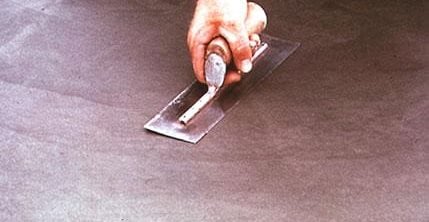
Avoid hard troweling exterior concrete. Not only can hard troweling reduce the air content of the concrete surface, making it less durable in freeze-thaw environments, it can also darken the concrete because it densifies the surface (see Photo 3).
-
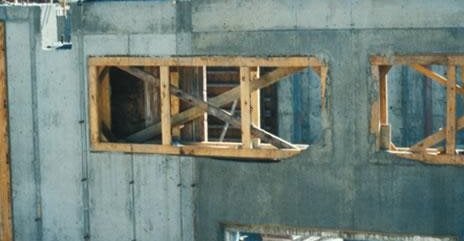
For vertical concrete work, use forms that are in good condition and won't absorb water or leak around the edges. Color differences may also occur when older forms are used immediately adjacent to concrete placed in new forms (see Photo 4). If you plan to use new forms, consult with the form manufacturer and prepare a mockup to establish standards for project acceptance.
-
Clean forms thoroughly before use, and apply an even coat of form release oil to form faces in contact with concrete.
-
Don't use calcium chloride in nonreinforced concrete when color and appearance are important.
-
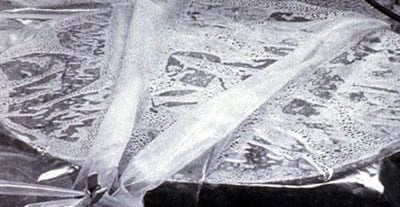
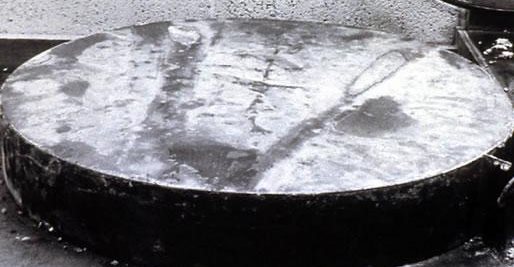
Cure the concrete uniformly over the entire surface. The best methods include wet curing with tepid water (at a temperature difference of no more than 20° F from the new concrete), proper application of a liquid curing compound, leaving forms in place, or by covering with polyethylene sheeting kept in uniform contact with the slab surface (see Photos 5 and 6).
References:
"Discoloration of Concrete, Causes and Remedies," Kosmatka, S.H., Concrete Products Magazine, April 1987.
"Effects of Substances on Concrete and Guide to Protective Treatments," Beatrix Kerkhoff, Publication IS 001.11, Portland Cement Association, 2007.


