
- Concrete Pumps Home
- Buyer's guide to concrete trailer pumps: Questions to ask before you buy
- Removing blockages: Possible causes, locating and clearing blockages
- Safety Considerations: Pump maintenance, truck positioning and hose selection
- Pumping tips for insulating concrete forms (ICFs)
- Related Information:
- Pumping equipment and materials for slabjacking
- Concrete Admixtures
Section Sponsor

Packaged Admixtures
Trailer Mounted Concrete Pumps
To find the best concrete pump for your specific job requirements without breaking your budget, ask these questions before you buy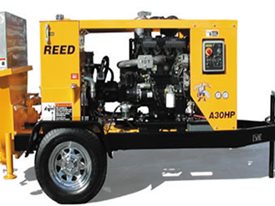
A30 Rockmaster Concrete Pump from Reed Concrete Pumps in Chino, CA
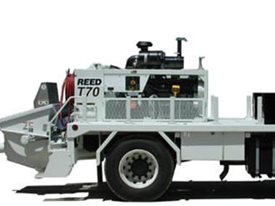
T Series truck-mounted concrete pump from Reed Concrete Pumps in Chino, CA
For conveying concrete to restricted sites such as fenced backyards or interior floors, a trailer-mounted small-line pump is often the ideal solution. Not only are these compact pumps convenient for small residential pours, they can also serve as an alternative to high-volume boom pumps on large decorative pours that require slower output rates, such as intricate stamped concrete projects. Most models can reach hundreds of feet and offer placement rates ranging anywhere from 5 to over 100 cubic yards per hour.
In today's construction equipment marketplace, you can find a trailer-mounted pump for almost any application, from pressure grouting and shotcreting to placing cement-based overlays and structural concrete.
Own or Rent Equipment - Which is more economical?Unless you plan to use a pump frequently, buying your own machine may not pay off in the long run—especially if you factor in the costs and time required for pump maintenance, repair, and clean-up. Instead, it may make more sense to rent a pump (assuming you have a trained operator on your crew) or hire the services of a pumping contractor. Figure out how many hours you typically use a pump annually and then crunch the numbers, comparing the cost of buying a pump to the average hourly rental rates in your area.
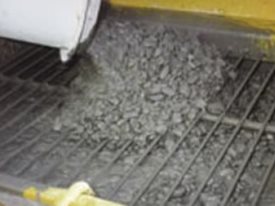
Concrete mixes with larger aggregates may be too coarse for some pumps to handle. Proper mixture consistencies are essential. Multiquip in Carson, CA.
Can the pump handle your concrete mix?Many decorative concrete contractors have preferred no-fail concrete mixes they rely on for the majority of their projects. If you have your own gold-standard mix designs, you'll need a pump built to handle them.
Some pumps are multipurpose machines that can accommodate a variety of mixes while others are engineered for specific mix types. Generally, the maximum aggregate size the pump can accept will govern the type of material it can churn out efficiently. Pea-rock pumps, for example, are designed to pump cement-based mixtures containing a 1/2-inch top aggregate size, such as repair grouts, shotcrete, and self-leveling overlays. Other line pumps can handle higher-slump concretes containing larger coarse aggregate (3/4- to 1 1/2-inch rock). These models are better suited for placing concrete slabs and other structural elements.
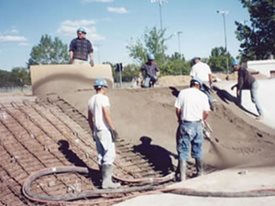
Multiquip in Carson, CA.
Output Rate: How far and how fast?Look at the pump manufacturer's spec sheets for the machine's output rate (usually given in cubic yards per hour) and maximum horizontal and vertical pumping distances. Some models are capable of delivering concrete at rates topping 125 cubic yards per hour and distances as far as 1,500 feet horizontally and 400 feet vertically.
However, don't waste money buying more pump capacity than you need—or can feasibly handle. A high-capacity pump usually isn't necessary for placing thin cement-based overlays. And to take advantage of a pump with super-fast delivery rates, you must have enough workers on hand during the placement to keep up with the pace. This is especially critical on decorative stamped concrete jobs because you have a limited window of opportunity for finishing and stamping after the concrete hits the ground. For decorative work, consider going with a pump equipped with variable volume control, which lets you adjust the pump output to suit the tempo of the job. This will permit you to slow down concrete delivery if the finishing or stamping crew falls behind.
Also keep in mind that the maximum volume output and conveying distances touted by pump manufacturers are only theoretical. These capacities will vary depending on such factors as the mix design, job conditions, and diameter and length of the pipeline used.
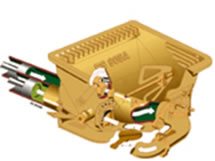
S-Valve with Large Capacity Hopper from Putzmeister's in Portland, OR.
What type of valve is used?When shopping around for a small-line trailer pump, you'll encounter a variety of terms describing the type of piston or valve system used to draw the concrete from the hopper and propel it through the delivery line, such as a ball valve, rock valve, S-valve, or swing tube. Some of these systems are proprietary to a particular pump while others are more generic. Ask the pump manufacturer to provide details about the performance capabilities and advantages of the system they use.
Can you tow the pump using your existing vehicle?Although most trailer pumps are small enough to be towed by a standard pickup truck, make sure the cart you buy can be pulled by your horse. The spec sheets for a pump will give machine dimensions and towing weights.
For towing safety and convenience, look for a pump mounted on a highway-rated trailer equipped with such features as an adjustable-height hitch, hydraulic surge brakes, durable fenders, stop/directional tail lights, and a heavy-duty frame with torsion bar suspension.
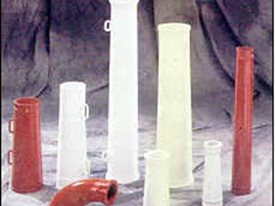
United Equipment Sales, Inc in Portland, OR.
How easy is the pump to maintain?The effort required to keep a particular pump in top running condition will depend on a number of factors, including the simplicity of the piston/valve design, the number of wear parts, and ease of accessibility to components that require regular servicing or cleaning.
Shop for concrete pump parts on Amazon
Some manufacturers simplify servicing by equipping the pump with a central lubrication system that enables the operator to quickly grease every critical service point. For ease of cleaning, look for a hinged or removable hopper and a hinged discharge manifold that doesn't require special tools for disassembly. To be assured of long equipment life, ask the manufacturer if the pump components are made of high-quality long-wearing materials, such as hard-chromed pump cylinders and forged-steel pistons.
What options are available?Many trailer-mounted pumps are available with a wide assortment of bells and whistles. This gives you more versatility to match the machine's capabilities to your specific needs. Options available on some models include:
- Electric motor, in lieu of a gas or diesel engine
- Wireless remote control
- Hydraulic outriggers
- Hopper remixer or agitator
- High-pressure water washout pump
- Chemical additive pump


