J&H Decorative Concrete LLC in Uniontown, OH
Although stamped concrete is often faster and more convenient to install than brick or stone, it's still a complicated process requiring the right tools, materials, expertise and jobsite conditions to ensure a successful outcome. A lot of steps are involved in stamping concrete, and crews only have a short window of time to complete them before the fresh concrete begins to harden.
Find stamped concrete contractors near me.
HOW IS STAMPED CONCRETE INSTALLED?
When having stamped concrete installed, here's what to expect:
- Site preparation and formwork
- Concrete pouring, placement and initial finishing
- Application of hardener and release agent
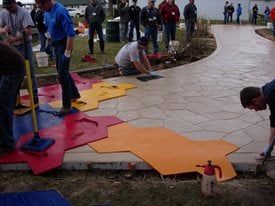
- Stamping the texture into the concrete
- Additional coloring, detail work, touch ups and jointing
- Curing and sealing the concrete
In addition to placing and impressing each stamp, contractors broadcast color hardener over the surface and apply a release agent to the stamps so they won’t stick. After the concrete sets, more work must be done, including installing joints, doing detail work, and applying a sealer. (See this step-by-step overview of the stamping process.)
CAN I INSTALL STAMPED CONCRETE MYSELF?
We don’t recommend installing stamped concrete as a DIY project. If you think you'll save money by not hiring a professional to do the work, you're only talking about the cost of labor. You still must buy all the stamping tools and materials. Expect to pay $300-$500 for a basic set of stamping mats. Plus, you'll bear the entire expense of replacing the concrete if you're unhappy with the results.
Read 9 reasons stamping concrete is not for do-it-yourselfers or find out what you'll pay to have a pro install stamped concrete.
Stamped Concrete Do's & Don'ts
Time: 00:48
Watch an overview of the five critical factors affecting a successful stamped concrete job.
Even before the work begins, good planning and preparation are necessary to make sure everything goes smoothly. This is particularly important on large stamped concrete projects. Here are some important dos and don'ts to adhere to on every job:
Stamping dos:
- Do make sure stamped concrete pavements are properly jointed to control cracking. To be effective, joints must be cut to a depth of at least one-quarter the slab thickness. (For more details, read Be Active in Deciding Where Control Joints Will Be Placed.) If you're worried that the joints will detract from the appearance of the stamped surface, ask your contractor to hide the joints by integrating them into the pattern lines wherever possible.
- Do insist on the use of a concrete mix that can stand up to the anticipated exposure conditions, such as freezing and thawing and deicing chemicals in northern climates and wear and tear from foot or vehicle traffic. Pay special attention to the water-cement ratio, or the amount of water in proportion to the cement. Adding too much water dilutes and weakens the cement paste, making it less durable and more porous. (For more information on water-cement ratio and concrete performance, read Primary Issue Affecting Concrete Quality.)
- Do use a dry-shake color hardener, which will produce a denser, more impermeable surface.
Stamping don'ts:
- Don't overlook proper subgrade preparation. A well-compacted subgrade is essential to the structural integrity of the concrete slab. It also helps drainage and can prevent soil erosion under the concrete.
- Don't skimp on reinforcement. For many slabs on grade, reinforcement (in the form of steel bars or welded wire mesh) is necessary to augment strength and help to control cracking. This is especially true for driveways and other surfaces that will support vehicle traffic.