Sustainable Kitchen Countertops
Time: 04:33
In addition to their versatility and distinctive beauty, concrete countertops have another virtue that appeals to many people, especially the ecologically aware: They are more environmentally friendly, or "greener," than most other types of countertops.
"Solid surface materials are made of plastic, engineered quartz materials contain a synthetic resin binder, and granite and marble are nonrenewable mined resources. Concrete contains mostly just good old sand, rock and cement," says Jeff Girard, president of The Concrete Countertop Institute and one of the Concrete Network's technical experts.
But concrete isn't completely eco-friendly, Girard admits. Portland cement production uses up a lot of energy, and mining of aggregate and sand can be environmentally disruptive. Some of the sealers applied to concrete countertops to protect them may also contain toxic volatile organic compounds, or VOCs, he adds.
The good news is that you can take a number of simple steps to reduce the ecological footprint of your countertops, such as replacing some of the virgin materials in concrete with recycled waste materials and using a nontoxic water-based finish. Here are some strategies for making your concrete countertops as green as possible.
Go With a Functional, Timeless Countertop DesignIn his video on Sustainable Kitchen Countertops (above), Fu-Tung Cheng says the sustainability of concrete countertops depends on good, timeless design. "In countertop making, design is one of your most important tools," he explains. "Good design is sustainable. It means people will appreciate something over a long period of time."
When you combine timeless design with the inherent durability of concrete, your countertops will serve you well for decades--both functionally and aesthetically-and thus are unlikely to need replacement. This not only conserves materials and eliminates waste, it saves you the expense and hassle of ripping out worn, outdated countertops.
In his Berkeley, Calif., home, Cheng still has the same concrete countertops that he built over 25 years ago. "Everything is still working and functioning well. It is timeworn, but in a way that is elegant," he says.
Use an Eco-Friendly Concrete Mix
Just how green and environmentally responsible your concrete countertops are depends largely on what goes into the mix. Portland cement, which constitutes about 12% of most concrete, is highly energy-intensive to produce. You can reduce this environmental liability by using a countertop mix that replaces some of the cement with materials such as fly ash, slag cement and silica fume-all industrial waste byproducts from coal-fired power plants, steel mills and other manufacturing facilities.
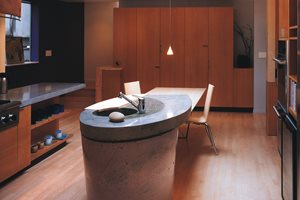
Cheng Design Products Inc. in Berkeley, CA
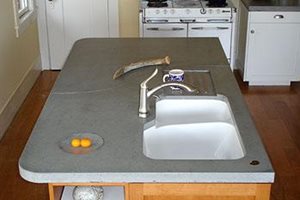
Buddy Rhodes Concrete Products LLC