
- Concrete Overlays Home
- Get the Look - Interior Overlay Pictures
- When to Use a Polymer Overlay
- Comparison Chart of Overlay Systems: Which is best for your project?
- Five Factors to Consider when Choosing a Resurfacing System
- Concrete Overlay Reviews
- Types of Overlays
- Epoxy Coatings
- Microtoppings & Skim Coats
- Self-Leveling Overlays
- Spray-Down Toppings
- Polishable Overlays
- Stamped Concrete Overlays
- Preparing Concrete for Resurfacing
- Concrete Resurfacing
- Reducing Bond Failures Caused by Moisture-Vapor Transmission
- Don't Let Water Vapor Delaminate Your Overlay: How to seal concrete before an overlay
- How-To Tips for Installing Concrete Overlays
- Answers to Common Questions About Concrete Overlays: Advice from expert Chris Sullivan
- How to Add Color to Concrete Overlays
- How to Protect and Maintain Resurfaced Concrete
- Overlay Tools: Seven essential tools for concrete resurfacing
- Related Information
- Concrete Overlay Videos, with Bob Harris
- Decorative Concrete Overlays: A primer of the various overlay types and the decorative possibilities with each
- Vertical Concrete Overlays: Lightweight cement-based overlays mimic stone, brick, and other wall textures
Comparison Chart of Overlay Systems
Concrete RefinishingThere are a wide variety of overlay systems available for refinishing concrete flatwork, ranging from ultra-thin systems (also called "microtoppings" or "skim coats") that can be applied in layers as thin as a credit card to floor underlayments that go on at thicknesses of up to an inch or more in one lift. Each overlay type offers different decorative options and performance attributes (see table below).
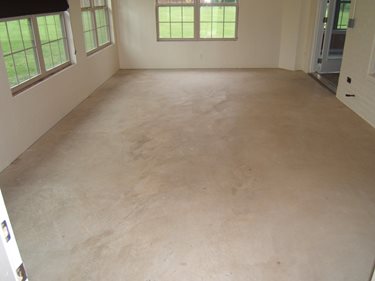 Hawkeye Custom Concrete in Sand Springs, OK (Before)
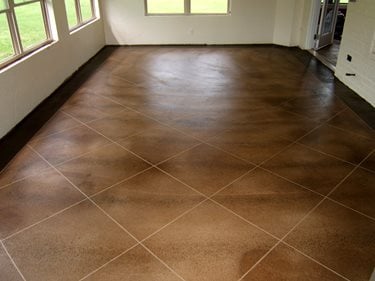 Hawkeye Custom Concrete in Sand Springs, OK (After)
Although the type of overlay you choose will depend primarily on the final look you want to achieve, it's equally important to consider the conditions the overlay will be exposed to (see Concrete Resurfacing). Generally, higher-build systems will stand up better to wear and tear and hide flaws more effectively than ultra-thin toppings. They will also permit the use of deeper patterns and textures.
| Concrete Refinishing System | Application Thickness | Decorative Options | Performance Attributes |
|---|---|---|---|
| Microtoppings or skim coats | Featheredge to 1/8 inch | Can be troweled to a texture or troweled silky smooth. You can incorporate color into the mix, broadcast dry pigments onto the surface while troweling for a marbleized appearance, or accent with stains and dyes. | These polymer-based systems are applied super-thin, giving them the ability to flex, unlike other systems. May also be applied to wall surfaces. |
| Spray-down systems | 1/8 inch | Usually applied as a splatter coat or a knock-down (troweled) finish, and are ideal for use with paper or plastic stencils. Available precolored or can be integrally colored during mixing. Stains, dyes or tints may be applied for accent color. | The textured finish is durable and skid-resistant, making it well suited for surfaces such as pool decks, sidewalks, and driveways. |
| Stampable overlays | 1/4 to 3/4 inch | Can be stamped and textured (similar to conventional stamped concrete) to mimic brick, slate, natural stone and other materials. Color options include broadcast pigments, colored liquid or powdered releases, stains, dyes and tinted sealers. | Are applied thickly enough to accept texture and cover minor imperfections in the concrete substrate. |
| Self-leveling overlays | 1/4 to 1 inch (in one lift) | Can be left seamless (except at joints) or used as a canvas for sawcut or engraved designs. For color, mix in integral pigments or apply stains, dyes or tints. | Restores structurally sound yet worn concrete surfaces and can be used to level uneven floors. |
| Underlayments | Up to 1 1/2 inch | Removal of weeds and moss that grow in the joints; refilling joints with sand as needed. | Restores structurally sound yet worn concrete in preparation for floor coverings. Provides a smooth, level base. |
Find a Resurfacing Concrete Contractor
Return to Decorative Concrete Overlays
 Rapid Set Skim Coat
Repairs, levels, and smooths concrete for applications.
Rapid Set Skim Coat
Repairs, levels, and smooths concrete for applications.
 Thin Micro-Topping
Produces durable surface to color or stain
Thin Micro-Topping
Produces durable surface to color or stain
 Self Leveling Overlay
Find the overlay to meet your project's needs
Self Leveling Overlay
Find the overlay to meet your project's needs
 T1000 Stampable Overlay
For use with resurfacing concrete floors and hardscapes.
T1000 Stampable Overlay
For use with resurfacing concrete floors and hardscapes.
 Stamped Concrete Overlay
Warm weather and cold weather formulas
Stamped Concrete Overlay
Warm weather and cold weather formulas
 HellFire® Concrete Coating
Chemical & heat resistance
HellFire® Concrete Coating
Chemical & heat resistance
 Imprinta Stampable Overlay
2-component system
Imprinta Stampable Overlay
2-component system


