
- Concrete Sealer
- Comparison Chart of Concrete Sealers
- Buying Tips for Concrete Sealer Products
- Concrete Sealer Reviews: Sealer products other contractors use and recommend
- Common Questions about Concrete Sealers
- How to Remove Concrete Sealer
- Types of Sealers
- Acrylic Sealers
- Epoxy Sealers
- Penetrating Sealers
- Polyurethane Sealers
- Polyaspartic Sealers
- Application Surface
- Driveway Sealer
- Patio Sealer
- Pool Deck Sealer
- Sealers for Stamped Concrete
- Concrete Floor Sealers
- Concrete Countertop Sealers
- Pool Deck Sealer
- Exposed Aggregate Sealer
Avoiding Moisture-Related Problems with Concrete Sealers
WHY DOES WATER MIGRATE THROUGH AN ACRYLIC SEALER?
Question:
We applied a dry-shake color hardener to a concrete floor slab and then sealed with a solvent-based acrylic sealer. Why does water when left on the surface of the floor seep through the sealer?
Answer:
This is actually a good thing as long as the wet spot disappears completely. It indicates that the sealer was applied properly. Most thin-build acrylic sealers (under 2 mils thick) are chemically designed to be breathable, which means they have permeability. This allows gas and water to move both ways through the sealer. As can be seen in this photo of the floor, the sealer initially causes the water to puddle, and then over time the water migrates through the sealer. This is the process of osmosis - the movement of material from an area of high concentration to an area of low concentration through a permeable membrane. Once equilibrium is reached, the process stops. Evaporation then begins and the water, in gas form, eventually evaporates back out of the concrete through the sealer.
Acrylic sealers, when applied properly, provide a good barrier of protection and allow time for spills to be cleaned up. If left on the surface, the spilled material will migrate through the sealer. This is not an issue with water, but oil and organic material can permanently stain the underlying substrate, which can be a bad thing. Acrylics provide a great cost-to-performance ratio, which is why we see them used so often. Do not make the common mistake of applying more sealer than needed. This is counterproductive when it comes to acrylics and diminishes performance.
If you are looking for better resistance to water migration, consider waxing the surface to help reduce the permeability or apply a high-performance coating (polyurethane, polyaspartic, epoxy or polyurea) that is 100%-impermeable to start with.
Need professional help with your sealer problems? Find concrete contractors near me.
PREVENTING MOISTURE PROBLEMS IN CONCRETE SEALERS
Question:
I am doing a stained concrete project using an acetone-based stain. I plan on sealing the stained concrete with a water-based urethane. This is a large 8,000-square-foot floor in the cafeteria of a local manufacturer, and it receives heavy traffic. I just completed a moisture test (using a calcium-chloride test). I did three tests, with results that ranged from 6.13 to 6.58 pounds. But I understand the recommendation is no more than 4 pounds. This floor is on grade, and the concrete is over two months old with a vapor barrier under the slab. The interior humidity has been high (around 70%) due, I think, to rainy weather and wet drywall mud.
Here is my question: Because of the high moisture readings, should I do this job? Is 4 pounds a strict guide, or are there some tolerances? For example, is 6.58 pounds acceptable but something higher, like 12 pounds, too high? This is the first time I have done a test like this.
Answer:
According to the ASTM standard for conducting a calcium-chloride test (ASTM F 1869), a reading above 4 pounds-the amount of moisture flow in pounds per 1,000 square feet over a 24-hour period-is considered a no-go for sealing. This is especially true for nonbreathable coatings, like the polyurethane you plan to use. That being said, you have a slab that should eventually drop below 4 pounds because of the vapor barrier.
You hit the nail on the head in regard to humidity. This is a very real environmental factor often missed when contractors prepare to seal, especially interior floors. Concrete is a sponge, and if conditions are right it will absorb and hold moisture, both in liquid and gas forms. The process of osmosis now comes into play-the movement of a liquid or gas from an area of high concentration to low concentration until balance is achieved. If the air above your floor has a high concentration of water vapor, or humidity, then the concrete will absorb moisture until it contains water equal to what is in the air. The practice of closing doors and windows to "dry-in" a room or building can actually trap moisture and create a steam room of sorts, making the problem worse or creating a problem where one didn't exist. Drywall mud, paint and rainy or hot, humid weather can cause high moisture contents indoors, which will cause concrete to absorb moisture. This moisture will stay in the concrete until the moisture content of the air above the slab abates. Whether the humidity is manmade or natural, it can cause short-term high moisture readings, especially in the spring and fall, when days are warm and nights are cool.
Wait for a dry spell, open as many windows and doors as possible, use a fan to move air across the floor, and take another test after 24 to 36 hours of drying. If the HVAC system in the building is operational, run the air conditioner to help remove moisture. When the moisture readings drop low enough for you to seal the concrete (at or below 4 pounds), apply the sealer in the afternoon or evening, when humidity is lowest.
SEALERS FOR UNDERWATER EXPOSURE
Question:
We are installing a concrete garden fountain, and I plan to stain it myself. What are the best stain and sealer products for this type of project, and what maintenance is required?
Answer:
I am not a fan of stain and sealer on surfaces that are often wet or come in continuous contact with water. Unless you use a sealer designed specifically for constant water contact, you will have performance issues like haze and whitening and eventual failure. Sealers that can handle constant water contact are usually high-end epoxies, polyurethanes and polyureas. Before using one of these products, make sure it's designed to be used in conjunction with a stain or tint.
We have seen concrete in continuously wet or underwater conditions colored successfully with just an acid stain or UV-stable tint or dye, with no sealer. If you go this route, make sure to use a product that is not water-soluble. Otherwise, the water will leach out the color over time, leaving you with plain gray concrete.
No matter what route you take, annual maintenance will probably be needed. This will include resealing (if you use a sealer) or at least removing white mineral deposits left on the concrete from hard water. A standard over-the-counter household bath scum and mineral remover works well in this situation.
 D-One Penetrating Sealer
Non-yellowing, low sheen, good adhesion
D-One Penetrating Sealer
Non-yellowing, low sheen, good adhesion
 Deep Penetrating Sealer
RadonSeal - Waterproofs & strengthens.
Deep Penetrating Sealer
RadonSeal - Waterproofs & strengthens.
 Clear-Seal by Increte Systems
Seals and protects decorative surfaces.
Clear-Seal by Increte Systems
Seals and protects decorative surfaces.
 Gem-Guard SB
Penetrating sealer that protects against salt damage
Gem-Guard SB
Penetrating sealer that protects against salt damage
 Decorative Sealers
Reactive and penetrating formulas in various levels of gloss.
Decorative Sealers
Reactive and penetrating formulas in various levels of gloss.
 Water Repellent Penetrating
Sealer for driveways, parking structures, plazas, walkways & more.
Water Repellent Penetrating
Sealer for driveways, parking structures, plazas, walkways & more.
 Colored Concrete Sealer X-4
High gloss finish available in 20 colors
Colored Concrete Sealer X-4
High gloss finish available in 20 colors
MAXIMUM MOISTURE VAPOR TRANSMISSION RATE
Question:
What is the standard allowable moisture vapor transmission (MVT) rate when applying sealers?
Answer:
ASTM states that a moisture vapor transmission rate of 4 pounds per 1,000 square feet over 24 hours is the maximum allowable for concrete to be covered with a coating, sealer, or adhesive. You can determine the MVT rate by performing a calcium chloride test (ASTM F 1869). This simple test involves placing a preweighed tablet of unhydrated calcium chloride on the concrete surface and then covering it with a sealed, domed plastic lid. After 72 hours, the tablet is weighed again to determine how much moisture left the concrete and was absorbed by the calcium chloride. A simple math calculation provides an extrapolation of the MVT rate in a 1,000 square foot area over 24 hours.
A new trend in moisture testing, which has been used in Europe for years, is in-situ relative humidity testing (ASTM F 2420). This test can be completed in minutes and provides a more realistic moisture reading from within the concrete. The downside: It requires drilling a 1/2-inch-diameter hole into the concrete for insertion of the probe that takes the humidity reading. The maximum relative humidity reading allowable by ASTM is 75%.
What happens if you apply a sealer, coating, or adhesive to a slab with an MVT rate exceeding 4 pounds per 1,000 square feet or 75% relative humidity? Chances are good that the application will fail, turn white, or peel. You can find more information on moisture testing and moisture vapor transmission on the Internet. Simply conduct a search using the terms "concrete moisture vapor transmission" or "concrete moisture testing."
EFFECTS OF CONDENSATION AND DEW POINT ON SEALER PERFORMANCE
Question:
How do humidity levels and dew points affect sealer application over architectural concrete?
Answer:
A great way to get a handle on the concepts of humidity, dew point, and condensation is to look at your bathroom mirror the next time you shower. Run a hot shower for 10 minutes, and the bathroom will fill up with steam (water as a gas) due to high humidity. When that hot steam hits a cold mirror, it condenses as a liquid (dew point) on the mirror's surface.
This same process can happen with cold concrete, whether indoors or outdoors. But unlike a mirror, concrete acts like a sponge and the condensed water will soak in. If the surface has been sitting open to the air for hours or days, the concrete may look dry and show no outward signs of moisture. However, if applicators go ahead and apply a sealer, they will trap in all that moisture, causing the sealer to turn white or hazy.
The accompanying chart uses air temperature and relative humidity to determine the dew point of a concrete surface. Sealing or applying overlays is not recommended any time the concrete surface temperature is within 5 degrees F above the dew point at a given air temperature and humidity level.
When sealing exterior concrete surfaces, remember that humidity and condensation are most often higher in the morning. Consider applying the sealer in the late afternoon or evening. When sealing interior surfaces, make sure there is enough air movement through the room or building to allow the floor to give up its moisture. Damp or enclosed environments obviously will hold more moisture, and pose a bigger potential sealing issue. Bring the floor up to temperature slowly before sealing.
POLYURETHANE SEALER REACTS WITH WATER
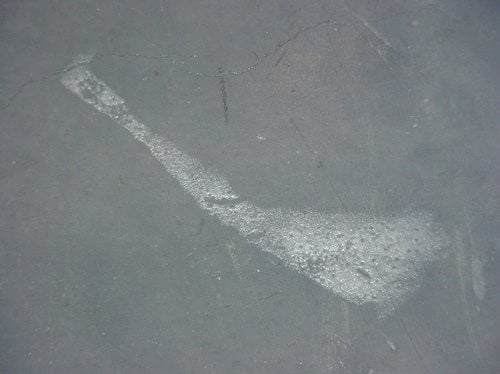
When freshly applied polyurethane sealer comes in contact with water, the interaction produces a frothy white foam.
Question:
I applied a two-part solvent-based polyurethane sealer over stained concrete. In certain random areas, the sealer foamed and bubbled. What caused this foaming, and how do I fix it?
Answer:
Two-part polyurethanes are higher-end sealers for decorative concrete. Not only are they nearly twice as thick as an acrylic sealer (3 to 5 mils), but they also produce a very durable and chemical-resistant non-yellowing coating. The two components are made up of a resin (Part A) and a hardener (Part B). When these two parts are mixed at the proper ratio, they get very hard, with the time of hardening depending on temperature and other environmental factors.
One thing a lot of applicators aren't aware of is that the polymer in the Part A resin reacts vigorously with water. The reaction creates bubbles in the sealer, which results in a frothy foam, as shown in the picture. (As a side note, this is how foam for mattresses, car seats, and foam insulation is made). In this case, water must have been present in this area when the sealer was applied.
The fix involves using a strong chemical stripper to remove the affected area. Remember that polyurethane sealers have good chemical resistance, so a typical solvent- or water-based stripper will have little or no affect. Once you strip away the foamed sealer, slightly sand the area and its borders to prepare for sealer reapplication. Then clean the entire area with alcohol or acetone to remove any residual stripper, dust, and dirt. Reapply the same sealer to the prepared area, taking care to blend the new sealer in at the edges. Finally, wax the entire floor to help blend the repaired area with the rest of the floor.
CAUSE OF BUBBLES IN POLYURETHANE SEALER
Question:
In the basement of our 1950s house, we stained the concrete floor and then applied a water-based acrylic urethane sealer the next day, after the washing step. The sealer manufacturer recommended using an airless sprayer, but the local Home Depot did not have an appropriate sprayer to rent. As I was talking about the issue, another Home Depot customer overheard me and said he had success applying sealer to decorative concrete using a basic plunger sprayer, similar to what you would use to apply garden chemicals. My wife and I decided to try it out, but the first coat was full of bubbles. My wife quickly rubbed the area with rubber gloves to smooth it out. She then applied a second sealer coat in a similar fashion, but achieved better results. Can you explain what caused the bubbles and recommend the best type of sprayer to use on future projects?
Answer:
Polyurethane sealers require more TLC when applying compared with single-component sealers, such as acrylics. As evidenced by your experience, the method of application is very important, as is surface preparation.
Two factors could have caused the bubbling. First, applying a water-based polyurethane with a garden-type pump-up sprayer is trouble. These sprayers do not reach the level of pressure needed to achieve a thin, even spray pattern. If the sealer is applied too heavily, a surface skinning effect can occur, causing gas and air to be trapped in the sealer.
Second, the concrete surface must be dry at the time of sealer application. If a polyurethane sealer comes in contact with moisture, a chemical reaction takes place, causing bubbles and foam. When I hear basement, I think damp, little air movement, slow drying and trapped moisture. I always recommend doubling the dry time on all below-grade floors that are going to be sealed. To speed the dry time, open up all doors and windows in the room and use a fan to generate good air movement.
As far as sprayers are concerned, the higher the pressure, the better the results. If an airless sprayer is not available, I would recommend applying the sealer with a micro-fiber mop, using a push-and-pull motion to get thin, even, streak-free coverage. This method often provides the best coverage and film thickness for water-based sealers. In a pinch, back rolling after spraying with a pump-up sprayer might have helped vs. using a gloved hand.
In general, I am not a fan of spraying water-based sealers. But if the sealer manufacturer's application guidelines recommend specific equipment, use it! Specific sealer types (water-based, solvent-based, polyurethane, epoxy, etc.) perform best with a specific method of application. Always refer to the product application guidelines for the best equipment and methods to use.
RAIN BLISTERS ON FRESHLY PLACED SEALER
Question:
My new (35 days old) concrete deck is stamped, and my wife and I acid stained it this weekend. I washed it with high pressure and light brooming, per the stain manufacturer's recommendations, and rolled on a solvent-based acrylic sealer. I sealed it less than 12 hours after washing, and I know now that was not a good idea. I used a ¾-inch-nap roller to apply the sealer, per my concrete installer's recommendation. I aggressively worked it in the grooves to ensure everything was sealed.
An hour after I finished applying the sealer, it rained. So now I have a bunch of blisters and rain spots, and plenty of roller marks to address. I used a 5-gallon pail of sealer for the job, so I don't think I applied too much, and the manufacturer said that I didn't overdo it by using that amount on 1,600 to 1,700 feet of textured surface.
Should I spray or roll xylene all over the deck and see what happens? I plan to spray another thin layer of sealer when done, so it's OK if it strips some of the existing sealer. I just ordered a sprayer, which was also recommended by the sealer manufacturer. I want to add some SharkGrip to the sealer as well for slip resistance, and I have read that if the proper amounts are mixed, and mixed well, it will spray fine through the sprayer.
Answer:
The good news is that the fix is actually pretty straightforward. As long as you are OK with the stain color and appearance, the sealer is your only issue. This can be fixed with the next coat of sealer or using a solvent bath. You are good on your application rate, so no issues there. Your best bet is to spray apply the next coat of sealer at the same rate, and then have someone else back roll right next to you. The second coat of sealer will melt the first coat, then the back rolling while the sealer is wet will help lay it down and get rid of the bubbles and blisters. Only one or two roll passes are necessary. Maintain a wet edge, and don't overwork it. This should also get rid of the water marks from the rain.
Be sure to apply the sealer when it will remain rain-free for 24 hours after sealing. Using the grit additive in your second coat is not an issue, as long as you follow the manufacturer's recommendations and mix well.
Return to Concrete Sealer Q&As


