
- Concrete mix design
- Materials: What goes into the mix
- Concrete Slump
- Concrete mixes for hot weather
- Concrete mixes for cold weather
- Mix Designs for Different Types of Decorative Work
- Mixes for stamped concrete
- Mixes for stained concrete
- Mixes for concrete driveways
- Related Information:
- Concrete admixtures: Tips for using in the concrete mix
- Ordering concrete from ready-mix suppliers
- Concrete Mix Design in Southeast Asia
Stamped Concrete Mix Recipe
Experts share advice on how to get the best concrete mix for stamping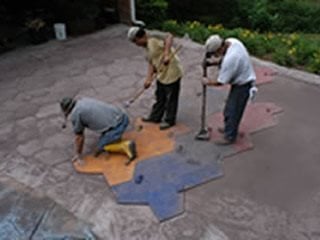
To get sharp stamped patterns, you need some paste at the surface. Decorative Concrete Institute.
Most of the basics of mix design also apply to stamped concrete, although there are some nuances to understand. Decorative concrete experts don't always agree, so we'll give you the various arguments for you to decide.
AGGREGATE
Bob Harris stresses the need for fines and cement paste to get a crisp stamped pattern. "I like a mix that has lots of paste—that's fatty." He recommends a 5 ½- to 6-sack mix. As mentioned in the section on materials, aggregate size is important in controlling shrinkage and the larger the aggregate the better. For stamped concrete though, large aggregate interferes with the stamping. Try some sample panels to determine the largest aggregate size that allows you to get a good stamped pattern. Harris recommends ¾ inch if possible but notes that for deeper patterns you might need to reduce that to ½ inch. "It's rare that we go less than ½ inch because of the shrinkage concern."
Looking for a contractor? Get quotes for concrete stamping near me.
Doug Bannister, founder of The Stamp Store, though, advocates using bigger aggregate to reduce shrinkage (up to 1 inch) and working around the problems. "I like to use the largest rock possible," he says, "because I understand that the more aggregate sizes I get, the less paste I need and the fewer shrinkage problems. Other stampers like to have small rock so they don't have to work so hard and they aren't pushing big rocks around. When we use bigger rocks it shortens the window because we have to catch the material when it's malleable, but I know it results in a better product. My standard is ¾-inch even with a deep stamp."
SLUMP AND PLACEABILITY
Bannister says, "We modify slump with superplasticizer so we maintain a good water-cement ratio and still have the concrete placeable at the end of the discharge hose. We would never order more than a 4-inch slump but we would increase it with a super so that if it was 6 at the pump we knew we would get 5 at the hose. There's never a need to place concrete at a slump greater than 5 inches."
Harris demurs somewhat from this, because the vast majority of his stamping jobs use color hardener. "I like color hardeners for the abrasion resistance and the range of colors. We specify a 4 ½ inch slump. Specifying agencies are concerned about performance and strength and they will specify a 3-inch or 3 ½-inch slump but we are stamping with color hardeners and they need some moisture on the surface, especially in windy conditions. You're going to fight like hell to get enough bleed water to get the color hardener working at the lower slump."
FLY ASH
Fly ash is good to include in a stamping mix to improve the concrete's durability and because the added fines improve finishability. Some will say that it can reduce color intensity, but Bannister disagrees. "There's a myth about fly ash that you can't add integral color, but my experience is that it doesn't change the color. On a multiple-pour project, you just have to make sure you stick with the same mix design in every batch to avoid color variations."
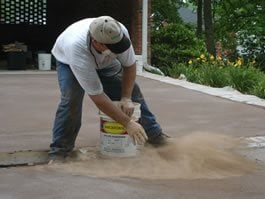
Enough bleed water needs to come to the surface to wet the color hardener. Decorative Concrete Institute.
DURABILITY AND ENTRAINED AIR
For exterior concrete, you simply must have proper entrained air in the concrete when it is placed. Even with a color hardened surface, water will penetrate into the concrete and if there is not a good air bubble matrix, when it freezes the concrete will begin to break up. Concrete's strong, but it's no match for the force created by freezing water.
Here again, there is some disagreement. "With a color hardener I won't go over 4% air," says Harris, "so that we get some bleeding. With integral, I would go up to the 5% to 6% range."
Bannister, on the other hand, says, "We keep the air at 5% to 7%. I know some guys using color hardeners will reduce the air a little so they would get more bleed water. I think that's a big mistake."
In his book, Guide to Stamped Concrete, Bob Harris emphasizes "the importance of partnering with your ready-mix supplier," who can help you get the mix you need for a given application and condition. You can find a ready mix supplier in your area to assist you in getting the right mix. He also notes that trial and error is, unfortunately, often the best teacher.
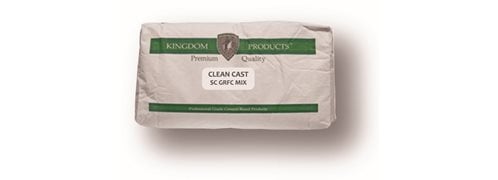 Clean Cast GFRC Mix
Available in white or gray, in 50lb bags
Clean Cast GFRC Mix
Available in white or gray, in 50lb bags
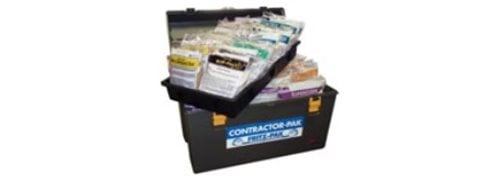 Contractor-Pak
Contains six of our most effective admixtures
Contractor-Pak
Contains six of our most effective admixtures
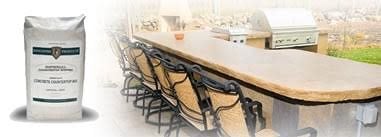 Imperial Countertop Mix
Engineered to be lightweight and strong. Minimal shrinkage.
Imperial Countertop Mix
Engineered to be lightweight and strong. Minimal shrinkage.
 Butterfield Cantera Wall Mix
Just Add Water
Butterfield Cantera Wall Mix
Just Add Water
 Integral Color + Fiber
Brickform Ultra-M1x blends pigments and reinforcement fibers
Integral Color + Fiber
Brickform Ultra-M1x blends pigments and reinforcement fibers
 NCA (Non-Chloride Accelerator)
All weather admixture
NCA (Non-Chloride Accelerator)
All weather admixture


