
- Countertop Supplies Home
- Concrete Countertop Molds
- Concrete Countertop Mix
- Pigments & Custom Options: Color additives, special effects & decorative add-ins
- Countertop Reinforcement
- Casting Equipment: Tables, mixers, vibrators & curing covers
- Countertop Finishing & Installation
- How to Polish Concrete Countertops
- Sealers for Concrete Countertops
- Delivery and Installation
- Related Reading
- Problems with Concrete Countertops
- Countertop Product Reviews
- Concrete Countertop Basics: Pricing, colors, edge details, and more
Concrete Countertop Mix
What is the best concrete for countertops? Compare bagged mixes vs. from-scratch recipes
Trueform Concrete in Flanders, NJ
Many concrete countertop pros have experimented with their mixes over the years, fine-tuning them to perfection so they can achieve consistent, reproducible results time and again. Some of them have even patented their field-proven mixes and sell them in packaged form to fellow concrete countertop makers. (Be sure to thank these guys for making your life easier!) You can often buy these bagged mixes directly from the contractor or through a local materials supplier or home-improvement retailer. Some major manufacturers of bagged concrete and mortar mixes now also offer formulas developed specifically for countertops.
If you haven't yet fine-tuned your own mix to your satisfaction or you are new to concrete countertop making, you can avoid all the trial and error by using one of these prepackaged blends. As the demand for concrete countertops grows, more and more of these mixes are entering the marketplace, giving you a broader array of options to choose from to meet your specific project requirements.
A good mix for concrete countertops should:
- Have a low water-cement ratio to prevent shrinkage cracks
- Provide sufficient compressive strength
- Be easy to work with
- Result in an aesthetically pleasing surface
When choosing a mix, also think about any special effects you want to achieve. For example, Rhodes uses a mix that is thick enough to press into molds, so he can achieve his signature veined look. The mix is also white, so it takes colors easily, with white aggregates that polish to a high shine.
Rather hire a pro? Find concrete countertop contractors near me.
Buying tips: Ask about the yield of the mix per package so you buy the right amount for your project. And be sure to get a copy of the technical datasheet to get information on mixing procedures, setting and curing times, compressive strength, and other pertinent details.
Minimum-Fuss Mixes
Although prepackaged countertop mixes are easier to use and more foolproof than a mix made from scratch, some products are designed to be especially user friendly and are intended for use by do-it-yourselfers and pros alike.
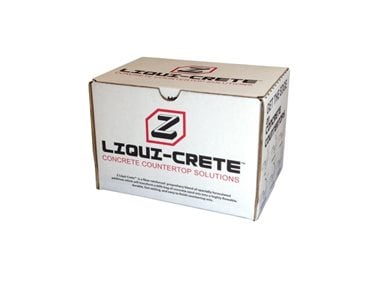
One such mix is Z Liqui-Crete from Concrete Countertop Solutions. It’s described as an exclusive blend of additives and ultra fine fibers that will transform a 60 lb. bag of standard concrete into a high strength flowable mix. Designed for cast-in-place countertops, it yields a mix that is easy to trowel smooth and results in a high strength fiber reinforced countertop. It can be used in conjunction with dyes, stains or integral colors as well as various decorative edge forms to get a one-of-a-kind look.
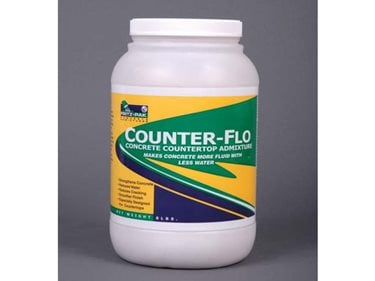
Counter-Flo, from Fritz-Pak, is a mixture of water reducers and mineral admixtures specially designed for use in the making of concrete countertops. You simply add 1 level scoop of Counter-Flo per each 80-lb bag of concrete. Counter-Flo modifies normal concrete, making it easier to place, reducing the water, increasing its strength, and reducing shrinkage cracks to produce a smoother finish.
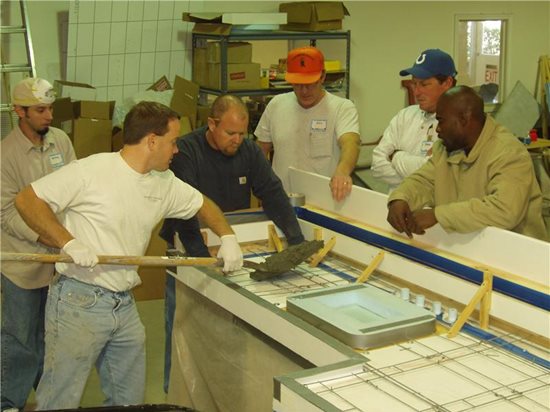
Pouring a Mardi Gras colored concrete countertop.
Bagged vs. From-Scratch Mixes
Pros: Clearly, convenience and ease of use are the most compelling reasons to use a bagged concrete countertop mix. All the necessary ingredients are preblended-all you do is mix in the specified amount of water and a pigment, if desired. (Some mixes may also require the addition of a polymer admixture, which is sold along with the dry ingredients.) You don't have to worry about obtaining and batching all the ingredients separately and storing the raw materials.
Consistency is another big plus of using a bagged mix. Most of the variables have been removed from the equation, as long as you follow the manufacturer's mixing and placing instructions. That means you don't need to be knowledgeable about mix design or worry about troubleshooting a mix that's not cooperating. With a bagged mix, your concrete will be identical from job to job.
Cons: If having complete control over your countertop mix is important, you are probably better off starting from scratch, says Jeff Girard of the Concrete Countertop Institute. He notes that when making your own mix, you can tinker with accelerators, superplasticizers, pozzolans, pigments and decorative aggregates to tweak the performance and appearance, allowing you to strike the best balance between aesthetics, workability and physical performance. This degree of flexibility isn't possible with a preblended product. Often you don't really know what's in the bag or the exact proportions, Girard adds, so you have to adhere to the manufacturer's instructions to get the best results.
You may be limited in terms of decorative versatility as well. Although nearly all bagged mixes can be integrally colored, you might be required to use the manufacturer's pigments, which could limit your color palette. Usually, you are also stuck with the aggregate blend used in the mix, limiting the possibility of using another type of aggregate.
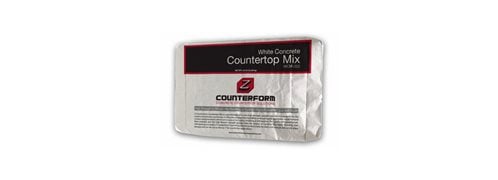 White Countertop Mix
Pre-blended, all in one, high strength castable concrete mix.
White Countertop Mix
Pre-blended, all in one, high strength castable concrete mix.
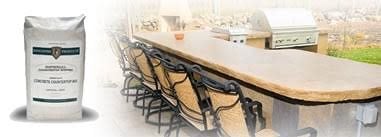 Imperial Countertop Mix
Engineered to be lightweight and strong. Minimal shrinkage.
Imperial Countertop Mix
Engineered to be lightweight and strong. Minimal shrinkage.
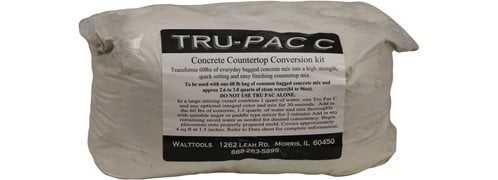 Tru-Pac C Admixture
Countertop conversion kit for use with standard bagged concrete.
Tru-Pac C Admixture
Countertop conversion kit for use with standard bagged concrete.
 Counter-Flo Admix
Makes concrete more flowable, stronger and denser.
Counter-Flo Admix
Makes concrete more flowable, stronger and denser.
 Super Reinforced Admix
Requires no rebar or other reinforcing, can be poured as thin as 1/2".
Super Reinforced Admix
Requires no rebar or other reinforcing, can be poured as thin as 1/2".
High-Performance Mixes
Some prepackaged mixes are formulated to produce countertops with exceptional performance features, such as high strengths of 5500 psi or greater, minimal cracking and shrinking, lighter weights, faster setting times, greater workability and the ability to be poured into thinner slabs. These qualities can enhance the durability of your countertops, help prevent damage during shipping and installation, and improve productivity.
Moon Decorative's enCounter mix blends white limestone rock, well-graded aggregates, cement, and performance-enhancing admixtures to minimize shrinkage and cracking, improve finishability, and achieve strengths topping 8000 psi after 28 days. Stamp Store owner Doug Bannister says enCounter is more flexible and structurally stronger than other countertop materials, which allows the material to take any shape and be cast in long unsupported spans, making it ideal for cantilevered countertops (see Bending the Rules in Concrete Countertop Mix Design). Packaged in 50 pound bags, the mix is available in white or gray and can be integrally colored with a choice of nine liquid pigments. For additional decorative effect, the surface can be polished after it cures to expose the white limestone rock.
 enCOUNTER in Oklahoma City, OK
 SureCrete Design in Dade City, FL
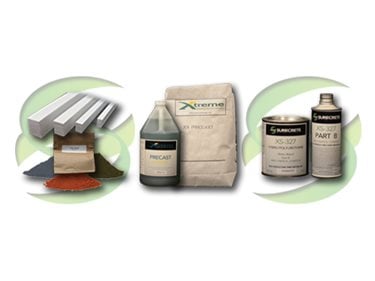
As the name implies, Xtreme Countertop from SureCrete Design achieves super-high compressive strengths exceeding 10,500 psi and flexural strengths greater than 1,400 psi. The cementitious composite material is suitable for both cast-in-place or precast projects and permits you to pour countertops as thin as ½ inch with no rebar and wire mesh. The mix is also fast setting and can be removed from the mold after 4 hours and polished with diamond abrasives after 8 hours. The product is packaged in 50-pound bags to which you add a gallon of liquid modifier and SureCrete's Color Pack for an integral tint, if desired.
Customization Options

Concrete Countertop Insitute
Even though prepackaged countertop mixes are carefully formulated and precisely proportioned to ensure foolproof results, many products allow you to add a few of your own embellishments or enhance the performance with optional modifiers.
For example, many countertop mixes can be seeded with decorative aggregates or other decorative embedments, such as pieces of recycled glass or metal shavings. However, you will need to grind the surface after it sets to expose the aggregate. Both companies also sell acid-based stains that can be applied to the cured countertop to create a variegated stonelike finish in a variety of earth-toned shades.
To produce countertops with an extremely smooth, abrasion-resistant surface, you can enhance The Stamp Store's enCounter mix with enForce, a heavy-duty nonmetallic fiber that is said to boost long-term durability without changing the appearance. The product is packaged in premeasured water-dispersible bags that are added directly to the mix.
Learn more about specialty mixes that can be used to achieve decorative effects
Bagged Mix Tips
-
Match the mix to your casting techniques. Make sure the mix is right for the specific casting, forming and finishing methods you plan to use. Many can accommodate both precast and cast-in-place operations, but not all. Likewise, some mixes are stiffer and may require mechanical vibration while others have higher slumps and can simply be poured into the forms with minimal vibration.
-
Consider your performance requirements. Since bagged mixes are proprietary products, they will all perform somewhat differently in terms of compressive strength, workability, setting and curing times, weight, texture and other variables. Use a product that provides the best combination of characteristics for your needs.
-
Mix up a trial batch first. Because they are touted for their consistency, you might assume that a bagged mix will always yield the same results, since most products require the addition of water only. But external factors such as temperature and even your geographical region can have an impact on water requirements. For example, instructions for the Buddy Rhodes countertop mix note that water requirements can vary by as much as 3 quarts per bag. Mixing up a trial batch or two will get you acquainted with the proper "feel" and consistency of the mix. Be sure to add water gradually until the desired stiffness is achieved.
-
Check the yield. An advantage of using a bagged mix is that the manufacturer can tell you the exact volume of concrete each bag will produce. Some bags will provide the yield of concrete in cubic feet; others may tell you how many square feet of countertop you can produce at a specified thickness. This data will help you determine how much of the product to buy and mix up for each job. Even if you miscalculate, unopened bags of mix can be stored for future use, so it's a good idea to purchase a little extra to make sure you have enough on hand.
-
Be ready to relinquish some control. Bagged mixes are certainly more user-friendly than from-scratch mixes, but they won't permit much tweaking if you want to modify the workability, physical performance or setting time of the concrete. If absolute control over these factors is important, you may be better off mixing up your own materials in the desired proportions.
-
Don't be afraid to experiment a bit. Even though the modifications you can make to bagged mixes are limited, you can customize many of them to some degree to achieve different looks, such as seeding them with decorative aggregates.
-
Know what you're doing. No prepackaged mix-no matter how reliable or easy to use-can make up for poor workmanship. You still need the proper equipment, skills and training to achieve great results.
RELATED:
Countertop Resurfacing


