
- Countertop Supplies Home
- Concrete Countertop Molds
- Concrete Countertop Mix
- Pigments & Custom Options: Color additives, special effects & decorative add-ins
- Countertop Reinforcement
- Casting Equipment: Tables, mixers, vibrators & curing covers
- Countertop Finishing & Installation
- How to Polish Concrete Countertops
- Sealers for Concrete Countertops
- Delivery and Installation
- Related Reading
- Problems with Concrete Countertops
- Countertop Product Reviews
- Concrete Countertop Basics: Pricing, colors, edge details, and more
Concrete Countertop Vibrators, Casting Tables and Other Equipment
Compare casting equipment for concrete countertopsJust like you wouldn’t play baseball with a hockey stick, having the right equipment is crucial to casting high-quality concrete countertops. If you are doing a one-time small-scale project, you may be able to forgo some of these, but for the professional who is casting multiple counters of considerable size they are a must.
On this page: Mixers | Casting Tables | Vibrators | Curing Covers
Mortar Mixer
Although you can mix the small batches of concrete required for countertops in buckets or a wheelbarrow, a portable mortar mixer is more convenient and will blend ingredients more thoroughly.
Buying tip: "Be aware that the typical mortar mixer doesn't hold the same volume of concrete as the rated barrel capacity. For example, a 9-cubic-foot mixer may only be able to hold about 6 cubic feet of concrete. Also, the stiffer the mix the less material the mixer can effectively blend," notes Girard. Consider buying (or renting) a capacity larger than you think you'll need.
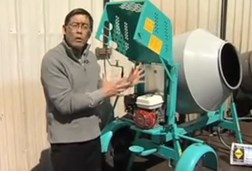
Concrete Mixers for Making Countertops
Time: 04:20
Learn what features to look for in concrete mixers, or mortar mixers.

Casting Tables for Concrete Countertops
Time: 03:08
Get tips on buying or building casting tables for concrete countertops.
Casting Table
A strong, level casting table is essential to properly support the mold and the heavy wet concrete until it cures. Some fabricators save money by building their own casting tables. But if you plan to buy a table, make sure its rigid enough not to sag under the weight of the concrete and large enough to accommodate the average countertop slab. For a standard 25-inch-wide countertop, a 5x10-foot or 5x12-foot casting table works well, says Girard.
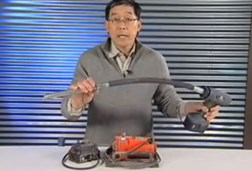
Vibrators for Making Concrete Counters
Time: 05:34
Learn how to build concrete countertops using table vibrators and pencil vibrators.
Concrete Vibrators
After pouring the fresh concrete into the countertop mold, you may need to use a vibrator to help consolidate and level the concrete and remove air bubbles that could leave unattractive holes or pits in the surface. Not all countertop mixes require vibration. It all depends on the stiffness of the mix you're using and the effects you want to achieve.
Buying tips: "Makita makes a cordless insertion-type vibrator that works well for small projects," says Rhodes. However, since this tool must be plunged into the wet concrete, it tends to disturb reinforcing materials and decorative insets. You can avoid this problem by using table-mounted external vibrators, choosing a size and power level appropriate for the size and weight of your casting table. Even the vibration from a simple jitterbug sander may be adequate, says Rhodes.
Another option to consider when choosing a compaction tool is a table vibrator. This type of vibrator attaches to the casting table with screws and vibrates the entire concrete countertop. One of the key benefits of using a table vibrator is that you avoid disturbing any inlays that are set in your countertops as well as the edge forms. With a insertion-type vibrator (or pencil vibrator) you run the risk knocking your decorative peices out of place.
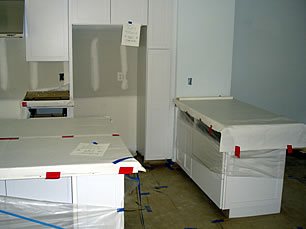
Cast in place job with curing blankets taped in place. Concrete Countertop Institute in Raleigh, NC.
Curing Covers
If you plan to cast the countertop in place rather than precast the countertop in a shop, proper curing is essential because it's more difficult to control environmental conditions. Curing covers or blankets will help to keep the concrete moist so it cures slowly and evenly.
Buying tip: Look for a material that won't stain the concrete and is reusable to save costs. Girard recommends HydraCure M5 blankets from PNA Construction Technologies. The reusable nonwoven fabric is inorganic so it won't mildew or stick to the concrete surface, and it can be used in indoor environments.
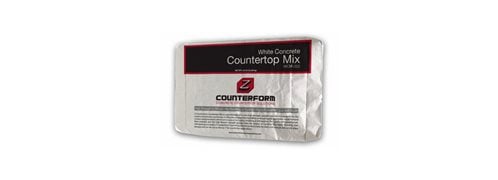 White Countertop Mix
Pre-blended, all in one, high strength castable concrete mix.
White Countertop Mix
Pre-blended, all in one, high strength castable concrete mix.
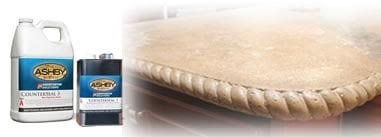 Topcoat Sealer
Produces a scratch and stain resistant top coating.
Topcoat Sealer
Produces a scratch and stain resistant top coating.
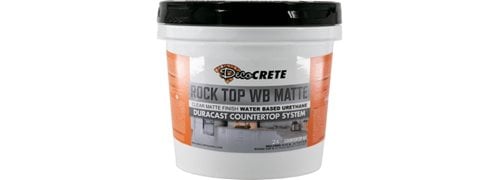 Rock Top Sealer
Clear matte finish, water-based urethane
Rock Top Sealer
Clear matte finish, water-based urethane
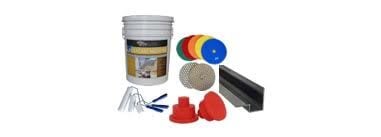 Countertop Products
All the supplies needed for great countertops.
Countertop Products
All the supplies needed for great countertops.
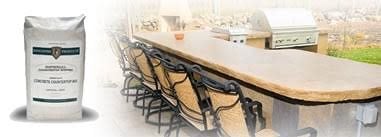 Imperial Countertop Mix
Engineered to be lightweight and strong. Minimal shrinkage.
Imperial Countertop Mix
Engineered to be lightweight and strong. Minimal shrinkage.


