
- Concrete Repair Home
- Surface Repairs
- Structural Repairs
- Slab Repairs
- Concrete Crack Repair
- Common Concrete Repairs
- Stamped Concrete Repair
- Driveway Repair
- Pool Deck Repair
- Garage Floor Crack Repair
- Fix Spalling Concrete
- Make New Concrete Match Old
- How to Fix Pitted Concrete
- Concrete Repair Methods & Systems
- Concrete Crack Injection for Basements
- Why Concrete Cracks
- Sunken Concrete Foundations
- Repairing Bowed Basement Walls Using a Carbon-Fiber-Reinforced Grid
Concrete Crack Injection for Basement Walls
With low-pressure crack injection, you can permanently repair a basement leak and foundation crack without high cost and disruptive excavation.Concrete Contractors: Find Epoxy and Polyurethane Products and Suppliers
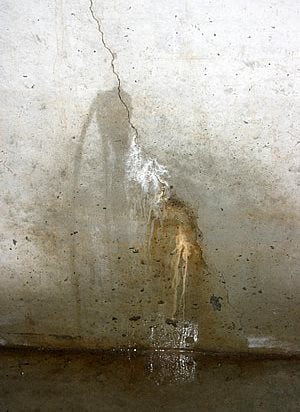
While concrete cracks appear to be typical, it is not recommended that they remain ignored. Most homeowners best identify concrete cracks in their basement, either on the foundation wall or on the floor. They may also recognize cracks on the garage floor, patio or in-ground pool.
These cracks typically due to drying shrinkage, thermal movement or other causes usually are minor and result in few problems. More often than not, a foundation crack will widen over time and result in water seepage or possibly the loss of structural integrity. Foundation and slab cracks are not only an eyesore, but they may hinder the value of the home.
Fortunately, there is an easy way to permanently repair such cracks without the need for costly and disruptive excavation or drain tile. Poured foundation cracks may be repaired by using low-pressure injection of an epoxy or polyurethane foam material. For the repair of concrete floor cracks, certain epoxies and polyurea materials exists, suitable for such slab repairs.
The application of such materials may be completed by a basement waterproofing contractor or a do-it-yourself homeowner. Either way, the repair of concrete cracks in either the foundation or the slab may efficiently and effectively be completed in as little as an hour or more.
HOW CRACK INJECTION WORKS
Most basements eventually leak. "Even if a crack is not leaking now, eventually water will find it," says Lou Cole, president of Emecole Inc., Romeoville, Ill., a manufacturer of epoxies and polyurethane foams for all types of foundation crack repair. Cole says that in the Midwest, crack injection has been an accepted way of tackling these repairs for many years, and more and more foundation repair contractors around the country are adopting the technique because it is cost-effective, reliable, and permanent.
"Emecole's customers, primarily residential waterproofing contractors, have less than a 1% callback rate for crack repair work. More than 99% of the time, crack injection will fix the problem," says Cole. "Most contractors in the Chicago area (as well as other parts of the country) warranty the injection repair for the life of the structure," he adds.
Cole launched his company in 1987, after coming up with the concept of dual-cartridge dispensing of two-component materials using a spring-assisted dispensing tool similar to a caulking gun. The application that seemed to show the most promise for his dual-cartridge system was low-pressure injection of cracks in concrete. That gave him the impetus to develop a line of epoxies and polyurethane foams specifically formulated for those types of repairs.
The whole purpose is to fill the crack, from front to back, with epoxy or polyurethane. "For basement walls, low-pressure injection is the best way to ensure that the crack is completely filled," Cole maintains. This method is effective for filling cracks 0.002 to 1 inch wide in walls up to 12 inches thick. It can also be used to fill cracks in concrete floors and ceilings.
EPOXIES VS. POLYURETHANES
So which material is better for repairing concrete cracks: epoxy or polyurethane foam? The answer isn't always clear-cut. In many cases, either material can accomplish the task, and applicators may simply choose the material they have the most experience with. But here are some general guidelines: If the crack needs to be structurally repaired and the area needs to be as strong or stronger than the concrete around it, use an epoxy. If the crack needs to be repaired only to prevent water leakage or the crack is actively leaking, a polyurethane is usually the best choice. Here's a look at the advantages and limitations of each material.
Epoxies
Epoxies for crack injection are available in a range of viscosities, from ultra-thin to paste-like, to accommodate cracks of different widths. Coles advice is to use whatever viscosity is needed to inject a given crack at pressures less than 40 psi. The wider the crack, the thicker the material required.
The main advantage of epoxies is their amazing compressive strength, which at 12,000 psi or greater exceeds that of most concrete. That's why epoxies are the only choice for cracks requiring structural repair. However, epoxies cure very slowly, generally taking hours to harden. This can be an advantage because it allows time for the epoxy to flow into even the smallest crevices. On the other hand, its also possible for the epoxy to flow out of the backside of the crack before it has hardened if the backfill outside the wall has separated from the foundation.
"Often there are voids behind cracks due to soil erosion or poor compaction," explains Cole. That's why the crack is leaking in the first place; its easy for water to enter.
Polyurethanes
If there is concern about material leaking out the back of a crack, polyurethane foams should be used. These elastomeric, fast-setting foams are effective alternatives for applications involving only crack sealing (waterproofing) and not structural repair. Because of their elastomeric nature, they are able to accommodate slight concrete movement so the seal stays intact. They also begin to harden and foam within minutes of injection. This reduces the chances of the material flowing out of an injected crack while still in liquid form, and even if some does leak out, the foam will fill the void.
"Urethanes are great for basic crack filling. They add practically zero compressive strength, but in most residential applications, you don't need it," says Cole.
Concrete Contractors: Find Epoxy and Polyurethane Products and Suppliers
DO IT YOURSELF CRACK INJECTION KITS
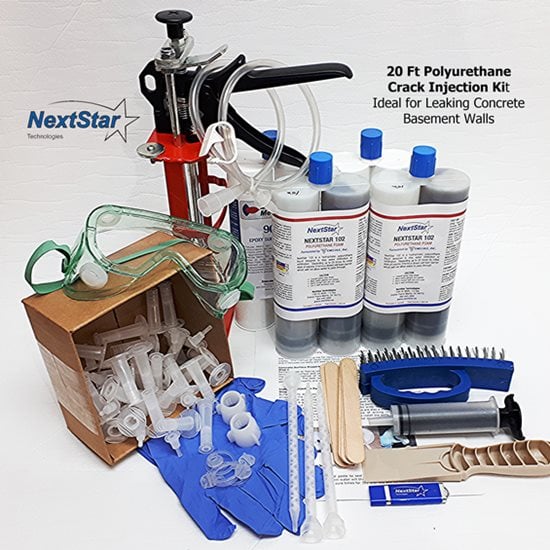
NextStar Crack Repair Kits are a top choice for pros and do-it-yourselfers.
Using low-pressure crack injection, foundation and basement crack repair kits seal basement cracks from the inside, eliminating the need to excavate the soil from around the outside of the foundation. The kits are available with all the tools and materials needed to treat cracks ranging from 10 to 60 feet in length and include step-by-step written instructions as well as a video tutorial.
You can choose from crack repair kits that use either an injectable polyurethane foam or an epoxy, depending on the type of cracks you have. Polyurethane crack injection kits are recommended for non-structural leaking cracks resulting from concrete shrinkage or minor settlement while epoxy injection kits are designed to treat more severe cracks that compromise the structural integrity of the wall.
Here's how to decide which foundation crack repair kit to use:
- Determine the total length of the crack(s) needing repair and select the appropriate kit size (10, 30, or 60 feet).
- Determine whether you need to repair the crack with epoxy or polyurethane foam. Use a polyurethane foam kit for repairing leaking non-structural cracks and an epoxy kit for repairing structural foundation cracks wider than a quarter of an inch or large areas of multiple cracks.
BASIC STEPS IN THE INJECTION PROCESS
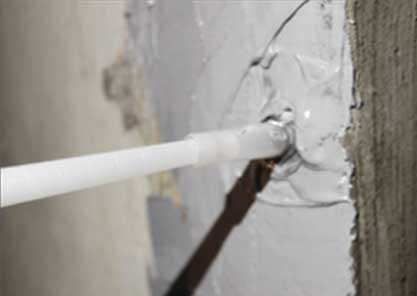
An epoxy resin is injected into the crack via special ports. Rhino Carbon Fiber.
Here are the basic steps for successful low-pressure crack injection. Keep in mind, however, that the type of epoxy or polyurethane used and the time required for injection will vary with each job depending on the crack width, wall thickness, and other conditions. These can also be bought as as crack repair kits that some with all the tools and supplies needed for the project.
Install injection ports: Surface Ports (short rigid-plastic tubes with a flat base) serve as handy entryways for getting the repair material into the crack. They eliminate the need to drill into the concrete, reducing labor time and cleanup. The base of the port is placed directly over the crack and bonded to the surface with an epoxy paste. A general rule-of-thumb is to space the ports an inch apart for each inch of wall thickness.
Seal the surface: Use an epoxy adhesive to seal over the surface ports and exposed cracks. The paste cures in about 20 to 45 minutes to provide a surface seal with excellent bond characteristics that holds up under injection pressures. The entire exposed crack is covered with the paste, leaving only the port holes uncovered.
Inject the crack: Begin injecting at the lowest port on the wall and continue until the epoxy or urethane begins to ooze out of the port above it. That's the visual sign that the crack has been filled to that level. Plug the first port with the cap provided and move up to the next port, repeating this procedure until the entire crack has been filled with epoxy or urethane. Let the compression spring on the dispensing tool push the material into the crack using slow, constant pressure. This will reduce the possibility of leaks or blow-outs and allow time for the repair material to fully penetrate the crack.
Remove the ports: Allow 24 to 48 hours at room temperature for the epoxy or polyurethane to cure and penetrate into the cracks. The injection ports can then be removed by striking them with a trowel or hammer. If appearance is an issue, the epoxy surface seal can be chipped away or ground off with a sanding disk. Another option is to use a surface seal that can simply be peeled off the wall after the repair is fully cured.
WHY LOW-PRESSURE INJECTION?
The secret to effective crack injection, whether using epoxies or polyurethane foams, is gradual introduction of the liquid polymer into the crack at low pressures (20 to 40 psi). This method requires some patience, but it allows the applicator to monitor the injection process and ensure that the crack is completely filled. Incomplete injection of a crack is the most common reason for crack repair failure.
To fill a typical crack in a residential foundation wall, injecting at pressures above 40 psi may not be effective. At higher pressures, the liquid has enough force to overcome gravity and rise up the crack without filling the backside, which is typically narrower than the front of the crack. High-pressure injection is better suited for repairing cracks in very thick-walled structures or where a high volume of water flow must be stopped (such as dam repairs).
Concrete Repair and Troubleshooting
ADVANTAGES OF DUAL-CARTRIDGE DISPENSING
Dual-cartridge dispensing, using disposable or reusable cartridges or containers, is a cost-effective completely portable method of injecting two-component polymers. The equipment also requires minimal maintenance and virtually no cleanup. At the end of the day, you simply discard the spent cartridges or reseal a partially used cartridge for reuse on another job. Each cartridge contains 16 to 22 ounces of material.
Automated proportioning equipment that dispenses bulk quantities of material also is available and may be the best choice on jobs requiring higher injection pressures or large volumes of material. But this equipment is expensive and cumbersome, and typically overkill for smaller residential jobs requiring only a few gallons of epoxy.
A spring-assisted dispensing tool allows complete control of injection pressures to keep them between 20 to 40 psithe best range for complete crack filling. The user simply changes the spring tension to adjust the force generated. Manual tools using a drive rod rather than a spring are difficult to control and may result in injecting at pressures much higher than desired. Air-powered tools are also available for dual-cartridge dispensing and allow control of injection pressure.
Because the epoxies and polyurethane foams used for crack injection are two-component materials, it is critical to mix them at the correct ratios to avoid problems with unreacted polymers. The dual-cartridge dispenser also acts as a proportioning device by using a static mixer, available in various sizes, to accurately mix the two components.
"The cartridges and static mixer eliminate a lot of problems," says Cole. "You don't have to be a chemist onsite. You just put the static mixer on the dispensing tool to achieve the right ratio and to properly mix the two components."
LIMITATIONS OF LOW-PRESSURE INJECTION
Low-pressure injection is ideal for fixing cracks in most poured-in-place residential basements. But in some cases you may need to pursue other remedial measures, along with crack sealing, to guarantee a complete fix.
If the foundation has settled due to compressible or improperly compacted soil, poor drainage, or uneven moisture conditions, use of hydraulically driven piles or piers may be required to lift the foundation and prevent future settlement. However, piering won't seal existing cracks, which may still need to be injected to prevent leaks after the foundation has been stabilized.
Similarly, crack injection can work hand in hand with carbon fiber reinforcement to stabilize and reinforce poured foundation basement walls that have bowed and cracked. "We often recommend the use of carbon fiber stitching in conjunction with crack injection repairs," says Cole. "It's better than stitching the crack with rebar and improves the chances that the crack will not reopen if there's ongoing, unforeseeable movement of the wall."
Cole says that crack injection is not a solution for fixing cracks in masonry block foundation walls. It also can't be used if water is leaking from a crack between the seam of the wall and the slab, which indicates a water table problem.
 High Performance Concrete Repair
Fast setting mix for structural repairs
High Performance Concrete Repair
Fast setting mix for structural repairs
 Divot Patch - Concrete Repair
15-minute set time
Divot Patch - Concrete Repair
15-minute set time
 Crack-Weld
5-minute set time
Crack-Weld
5-minute set time


