
- Vapor Barriers for Concrete Slabs
- Concrete Moisture Problems
- Vapor Barrier Installation
- Related Information:
- Avoiding moisture-related problems with concrete sealers: Advice from expert Chris Sullivan
- Reducing bond failures caused by moisture- vapor transmission
- Don't let water vapor delaminate your overlay
- W. R. MEADOWS White Paper - Tips on Choosing Vapor Barriers
- Are concrete floors cold and damp?
- Product Newsletter: Sign up today to receive monthly updates
- Free Vapor Barrier Catalog & Info
Section Sponsor

W. R. MEADOWS
Vapor Barrier Installation
Tips for installing vapor barriers under a concrete slab to prevent vapor transmission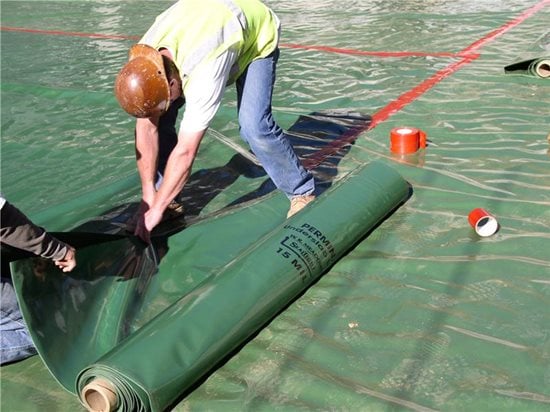
W. R. MEADOWS
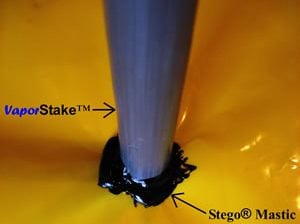
Form stakes sealed to the barrier prevent vapor intrusion. VaporStake in Chino Hills, CA
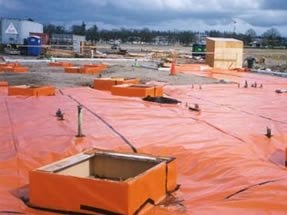
Install boots around all penetrations and blockouts. Fortifiber in Reno, NV
To be effective, a vapor barrier must be installed in a way that prevents any water vapor from getting to the slab.
Find out where to buy vapor barriers and other problem solving products.
ASTM E 1643, "Standard Practice for Installation of Vapor Retarders Used in Contact with Earth or Granular Fill Under Concrete Slabs," provides details, but here are a few tips:
- Most exterior slabs do not need a vapor barrier. If you are going to seal an exterior slab, find a sealer that transmits water vapor (breathes). For some tips on this, see Sullivan's Corner.
- In general, place the concrete slab directly on top of the vapor barrier, with the subbase below. If the subbase is sharp angular gravel, a thin layer of sand can be placed on top of the gravel subbase next to the vapor barrier. See below for more discussion on this.
- The vapor barrier can be placed under the subbase, if the building is closed in when the dry subbase material is placed.
- Never punch holes in the vapor barrier to allow bleedwater to escape.
- Do not pound form stakes through the vapor barrier. Some supports come with wide bearing pads. Another solution is the new VaporStake that seals to the vapor barrier and is then cut off and left in the slab.
- Seal all vapor barrier seams with the tape provided by the barrier manufacturer. Seams should overlap 6 inches.
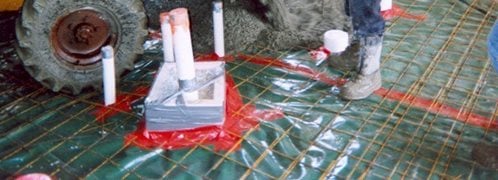
- Seal around all pipe penetrations and blockouts; Howard Kanare's book (available from the Portland Cement Association) provides more details.
- Run the vapor barrier up onto the footing or seal it to the foundation wall—or both.
- Protect the vapor barrier as much as possible during construction and repair any damaged spots with the manufacturer's tape.
Where to position the vapor barrier has been argued about for years. For a time in the 1980s and 1990s, ACI recommended using a "blotter" layer, on top of the vapor barrier. In 2001, the recommendation changed to typically placing the concrete directly on the vapor barrier. The argument is that putting the concrete directly on top of the vapor barrier prevents water from leaving through the bottom, which leads to longer bleed times and to slab curling. While this is true, we've shown in other parts of this article that the subbase will end up damp and a continuous source of water vapor into the slab. Today, most slabs experts recommend placing the slab directly on the vapor barrier unless the subbase is protected and can be assured of staying dry. Curling can be controlled with well-graded aggregate and a little more reinforcement in the lower part of the slab.
 PERMINATOR 15 mil Vapor Barrier
Toughest product on the market with superior puncture resistance
PERMINATOR 15 mil Vapor Barrier
Toughest product on the market with superior puncture resistance
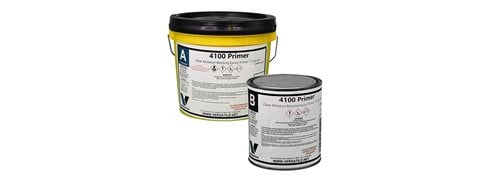 Moisture Blocking Epoxy
4100 clear primer
Moisture Blocking Epoxy
4100 clear primer
 Moisture Vapor Barrier Epoxy
Seals above-grade and below-grade walls and floors.
Moisture Vapor Barrier Epoxy
Seals above-grade and below-grade walls and floors.


