
- Concrete Stain Home
- Get the Look - Stained Floor Pictures
- Color Chart: Concrete stain colors
- Comparison Chart: Compare acid stains, water-based stains and dyes
- Stain Buying Tips: Questions to ask before you buy
- How to Stain Concrete
- Types of Stains and Coloring Options
- Acid-Based Stains
- Water-Based Penetrating Stains
- Concrete Dyes
- Concrete Paint
- Exterior Concrete Stain: Click through images of outdoor stained concrete projects
- Stains and Equipment Product Reviews
- Troubleshooting Concrete Stains
- Common Staining Issues: Tips from expert Chris Sullivan
- Removing Stains from Concrete
Preparing Floors Before Concrete Staining
Surface preparation and cleaning tips from stained concrete pros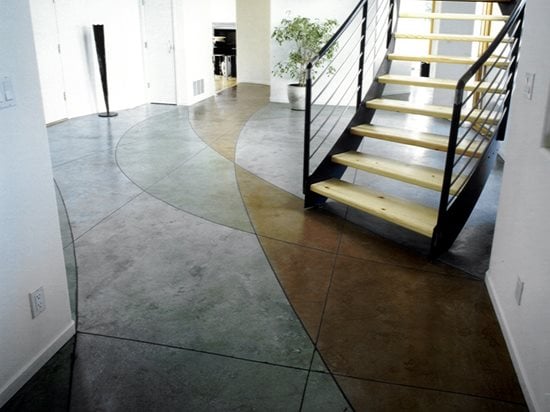
Proper floor preparation is the first step in creating beautiful concrete floors like this one. Diamond D Company in Capitola, CA
Once homeowners see how beautiful and easy to maintain decorative stained concrete floors can be, they often are eager to rip up their grungy carpets and yellowed vinyl tiles to expose the concrete underneath. These enlightened homeowners have become a significant market segment for stain applicators. But those newly naked floors often need extreme cleaning before they can be adorned with chemical stains.
"We're seeing a lot of remodeling going on, and that's a lot different from new floor staining projects," says Barbara Sargent of Kemiko Concrete Products, Leonard, Texas. "When you pull up carpet or tile, you never know what you might run into. Carpet glue, tile mastics, water and urine stains, chalk marks, caulk, grease stains, paint drips, and rust spots are just a few of the contaminants that staining contractors have encountered," she notes.
Need help with your project? Find contractors that specialize in concrete staining near me.
The Importance of a Clean Surface
With chemically stained floors, the consequences of substandard cleaning can be difficult to remedy. Unlike paints and coatings for concrete, which are opaque and can disguise many evils, acid stains are transparent. Any unwanted residue remaining on the floor is likely to show through the newly applied stain.
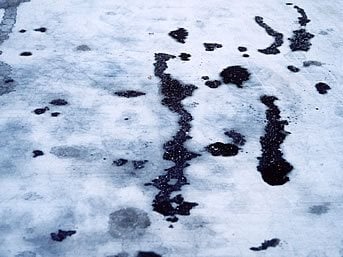
Any materials that inhibit concrete stain penetration, such as grease, oil, or curing membranes, will prevent the color from taking.
"If you are negligent in the cleaning process, it can literally change the entire end effect. A substandard cleaning job will really show up once the final sealer or wax is applied," says Sargent.
Related: How to Remove Glue from Concrete
"Chemical stains also need to penetrate into the concrete surface to react with the lime in the concrete. Any materials that inhibit concrete stain penetration, such as grease and oil, or curing membranes, will prevent the color from taking, says Tom Schmidt of Jagger Scored/Stained Concrete, Plano, Texas, a company specializing in decorative staining of residential and commercial concrete floors.
Curing membranes, which he encounters more on commercial projects than on residential jobs, are especially difficult to remove. "Even after you clean the surface, the curing compound may have migrated down into the pores of the concrete and the stain will react minimally. You may get marks that look like water spots," he says.
Schmidt also warns against acid etching of floors before staining. A lot of people think they need to acid etch the concrete like they do before applying a paint or coating, to get the paint to adhere. But acid washing depletes the lime content, which is what the minerals in the acid stain react with.
 All-Purpose Concrete Cleaner
Removes sealers and coatings.
All-Purpose Concrete Cleaner
Removes sealers and coatings.
 Cleaner & Degreaser
Starting at $11.95
Cleaner & Degreaser
Starting at $11.95
 Brickform Neutra Clean
A pH neutral cleaner that combines cleaning and light degreasing
Brickform Neutra Clean
A pH neutral cleaner that combines cleaning and light degreasing
 Commercial Surface Cleaners
Cuts through grease and grime. Environmentally friendly
Commercial Surface Cleaners
Cuts through grease and grime. Environmentally friendly
Trial and Error
Kemiko, which has been selling acid-based chemical stains for more than 30 years, has an extensive list of concrete cleaning products posted on its web site as a handy reference for contractors and do-it-yourselfers. "We have a lot of professional applicators of our chemical stains, and as they discover new cleaning products, they call us and we try them out," says Sargent, explaining how the list was compiled.
Questions to Ask When Selecting a Remover or Cleaner
- What substances will it remove?
- What are the recommended applications?
- Is it environmentally safe?
- Does it emit fumes or noxious odors?
- Is it compatible with the chemical stain you will be applying?
- Is it safe for indoor use?
However, finding the right cleaning product is often a trial-and-error proposition, she admits. You can't always tell what a stain on concrete is by appearance alone. What you may assume is an oil-based stain may be something else. We recommend that contractors test products first to verify their effectiveness.
Also be sure to read the label on the container to find out what substances the product can remove. A solution formulated to strip latex paint may be ineffective at removing grease or oil. The label can also provide other valuable information you'll need to know in order to choose the best product for the job (see Questions to Ask When Selecting a Remover or Cleaner).
While Kemiko doesn't endorse any particular cleaning product, it does favor those that are safe for the environment, people, and pets. There are some really good products out there that are environmentally safe, says Sargent. We've tested a mastic remover made from soy beans, for example, that absolutely emulsifies even the oldest mastic residue.
Sargent also recommends that stain applicators check environmental restrictions in their area to find out what products they are permitted to use. She advises contractors to be extremely cautious when using petroleum-based strippers, which tend to be high in volatile organic compounds (VOCs) and can be highly flammable (see Precautions When Using Chemical Strippers.)
But on some jobs, contractors may have to resort to strong medicine to remove certain contaminants. For example, Schmidt sometimes uses lacquer thinner or xylene to take up curing compounds.
Precautions When Using Chemical Strippers
Some chemical strippers can be extremely hazardous to breathe and apply, especially if you're working in an enclosed environment. Be sure to read the Material Safety Data Sheet (MSDS) for the product to check for potential hazards and health effects. Products containing petroleum also are flammable and can be dangerous to use around floor scrubbing machines, warns Schmidt, because electrical sparks could ignite a fire or explosion.
If the chemical stripper you're using is not environmentally safe, it must be disposed of properly. We retain the product in plastic buckets and then take the buckets back to our warehouse, where we put them into a hazardous waste container for disposal, says Schmidt.
Patching Floors Before Staining
If a slab needs patching, use an acrylic-modified, low-shrinkage product that will accept stains. Be aware that these patches will likely show through the finished floor, and the homeowner should be warned in advance.
Cleaning Techniques
The methods you use to clean the floor are equally as important as the products you choose.
For general-purpose cleaning and degreasing, Schmidt sweeps the floor and then scrubs it thoroughly using trisodium phosphate (TSP). For scrubbing, he recommends using a rotary floor scrubber with a green Nylo-Grit pad designed for aggressive scrubbing of concrete. If he must remove glue, mastic, or paint from the floor, he uses nonflammable chemical strippers, which he finds at Home Depot, Lowes, or Sherwin-Williams.
Bob Harris, president of the Decorative Concrete Institute and author of Bob Harris Guide to Stained Concrete Interior Floors, says caulking compound and mastic are two of the most difficult substances to remove. He scrapes off as much material as possible using a putty knife or floor scrapper and then applies a poultice to remove the remainder. For a poultice, he recommends mixing an inert fine powder, such as fly ash or hydrated lime, with denatured alcohol to make a smooth paste. Once the poultice dries, the caulk or mastic residue usually is brittle enough to remove with a stiff-bristle brush.
After using degreasers, chemical strippers, or other cleaning compounds, it's necessary to clean the floor again to remove all residue. Schmidt scrubs the surface once again with TSP followed by a thorough rinsing with clean water.
After the final rinsing, Schmidt often uses an industrial wet vacuum to remove all water and debris. If you just use a mop for the final wash, you're simply moving the residue around. he says, adding that using a wet vac also helps the floor dry out much faster.
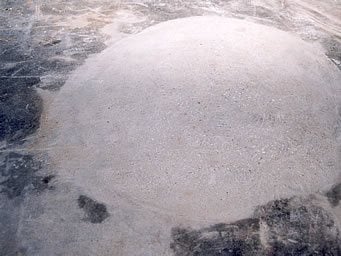
Mechanical abrasion can also remove a layer of the cement paste from the surface, which will cause the stain to react differently. Grinding can also leave swirl marks in the slab if you're overly aggressive.
When All Else Fails
Occasionally you may encounter deposits that refuse to surrender to your best cleaning efforts. If scraping or chemical stripping are ineffective at removing glues, caulk, mastics, or other heavy contaminants, Harris says that you may need to resort to mechanical removal methods, such as grinding. However, be aware that mechanical abrasion can also remove a layer of the cement paste from the surface, which will cause the stain to react differently. Grinding can also leave swirl marks in the slab if you're overly aggressive.
When Schmidt is unable to completely eradicate stubborn discolorations, he camouflages them. After we get done staining and sealing the floor, we go back and faux paint any objectionable spots and apply another coat of sealer. He also uses this method to remedy any areas where the chemical stain doesn't take completely.


