
- Concrete Sealers
- Comparison Chart of Concrete Sealers
- Buying Tips for Concrete Sealer Products
- Concrete Sealer Reviews: Sealer products other contractors use and recommend
- Common Questions about Concrete Sealers
- How to Remove Concrete Sealer
- Types of Sealers
- Acrylic Sealers
- Epoxy Sealers
- Penetrating Sealers
- Polyurethane Sealers
- Polyaspartic Sealers
- Application Surface
- Driveway Sealer
- Sealers for Stamped Concrete
- Concrete Floor Sealers
- Concrete Countertop Sealers
- Pool Deck Sealer
- Exposed Aggregate Sealer
Soda Blasting: A New Way to Remove Sealers and Coatings from Decorative Concrete
Gentler and safer than chemical strippers, soda blasting preserves the underlying concrete and won't harm the environmentJust the mention of chemically stripping sealers or coatings from concrete is enough to send most professional installers running for the nearest exit. Even the new "green" environmentally friendly strippers require a host of preventive measures to ensure against contaminating other surfaces, not to mention that you have to deal with the goopy mess that remains on the surface after the chemicals have done their thing. Well, I am pleased to report that there is a cost effective and cleaner answer to sealer and coating removal, and chances are someone in your area is already offering this service.
Soda blasting is a new twist on the tried and true practice of media blasting. "The twist lies in replacing common blasting media, such as sand, carborundum or crushed walnut, with #5 grade baking soda (sodium bicarbonate)," says Bob Marsh, owner of Western Soda Blasting, a Denver based company that has been specializing in soda blasting for six years.
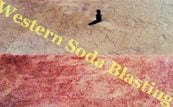
The owner of this stamped concrete was unhappy with the color. Soda blasting was able to remove the color without damaging the concrete.
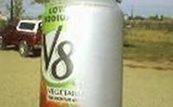
An aluminum beverage can where the logo and lettering has been removed without damaging or profiling the surface is a testament to the "gentle power" of soda blasting.
How soda blasting worksIn the early 1980s, engineers from New Jersey and New York were faced with a dilemma: How to clean the Statue of Liberty without damaging the thin copper panels and, just as important, without contaminating the Hudson River and surrounding ecologically sensitive regions. The answer was soda blasting.
The process of propelling the media via high-pressure air remains the same today, but the results are where the concrete community really benefits. Traditional blasting media is typically very hard and destructive. Not only does it remove the coating or contamination being targeted, it also profiles and scars the underlying substrate in the process. This poses a serious problem for decorative concrete applications, since destroying the concrete surface along with the sealer or coating is counterproductive.
"With soda blasting, the softer baking soda explodes when it makes contact with the sealer or coating," says Marsh. All the energy is consumed in the process of removing the coating, which means the underlying substrate remains intact and is not scarred. Even if plain unprotected concrete is soda blasted, the hard concrete surface is not affected because the baking soda doesn't have enough energy to profile the surface.
Another benefit is the lack of spent media. With traditional blasting, literally tons of spent media goes everywhere. Even with sophisticated vacuum and recycling systems, spent media is a major cost and environmental contaminant. With soda blasting, the soft media turns to harmless powder as soon as it makes impact with the surface. The powder is inert, for the most part, and poses very little environmental threat. It's also much easier to control and vacuum than sand or hard media.
LimitationsThe only negative with soda blasting is that baking soda is an alkaline material, and in large amounts it can change the pH of soil and waterways. While it's a much cleaner and safer way to remove sealers and coatings, precautions still need to be taken to control and collect the spent media.
"Soda blasting will remove most all coatings," says Marsh, but he admits that extra passes may be necessary for thicker or more durable high-performance coatings, such as epoxies and polyurethanes. Thinner sealers, like acrylics, come off quickly and in one pass in most cases.
A better alternativeSoda blasting is a great alternative to all other methods of sealer or coating removal for decorative surfaces. The biggest benefit is how quickly coatings are removed, without any damage to the concrete surface. It is especially appealing for stamped or textured surfaces that are very difficult to chemically strip.
Safety is another area where soda blasting is a better option. Most chemical strippers pose some type of safety issue, both to the applicator and the surrounding environment. With soda blasting, controlling residual baking soda is the only concern.
When you compare the cost of soda blasting to chemical sealer removal, they are almost a wash. While the cost of chemical strippers is less per square foot, soda blasting makes up the difference by the savings in labor requirements, reduced cleanup and time.
Where do you find local soda blasting companies or equipment dealers? An Internet search, using the keywords "baking soda blasting" or "soda blasting," is the quickest way.
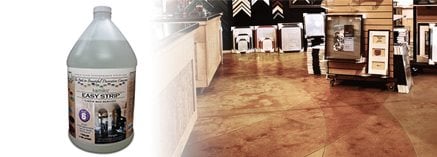 Easy Strip™ Wax Stripper
Water base, low VOC, Biodegradable, easy cleanup
Easy Strip™ Wax Stripper
Water base, low VOC, Biodegradable, easy cleanup
 Eco Paint & Sealer Stripper
VOC compliant in all 50 states
Eco Paint & Sealer Stripper
VOC compliant in all 50 states
 Coating Removal - Brickfrom Strip-It
Environmentally sound and user-safe stripper
Coating Removal - Brickfrom Strip-It
Environmentally sound and user-safe stripper
 600 GL Coatings Remover
Removes multiple layers in single application.
600 GL Coatings Remover
Removes multiple layers in single application.
 Nock-Off
Biodegradable coatings stripper.
Nock-Off
Biodegradable coatings stripper.


