
- Radiant Floor Heating Home
- More FAQs: How much does it cost? Can the floor get too hot? Can the tubing leak?
- Lower Heating Costs
- Installing Radiant Floor Heating Systems
- Installing Radiant Heat
- Retrofitting a Concrete Floor with Radiant Heat
- Other Resources
- Common Questions about Concrete Floors: Are they cold? Are they loud? Are they expensive?
FAQs about Concrete Floor Radiant Heating
How do you cool a house with radiant heat?
Although some radiant floor systems are capable of cooling by circulating cool water through the tubing, most homes will need a separate system to provide the cooling. The reason is that heating is ideally delivered from the ground up, while cooling is best delivered through ductwork located near the ceiling.
Radiant cooling also won't remove humidity from the air, which can be a disadvantage in sticky climates. In addition, it can result in condensation of moisture on the cool concrete floor surface.
Ulitmately, trying to do both functions with one system will render one or the other less effective. Plus, a separate system to deliver just cooling will not be as expensive as a combination heating/cooling system.

Find concrete floor contractors to install radiant heating.
What are the best thermostat settings for radiant floor heating?
Radiant floor heating produces room temperatures very close to ideal: about 75 F at floor level, declining to 68 F at eye level, then to 61 F at the ceiling.
According to the Radiant Panel Association, a radiant-heated floor normally feels "neutral," with a surface temperature usually lower than normal body temperature, although the overall sensation is one of comfort. Only on very cold days, when the radiant heating system is called on for maximum output, will the floor actually "feel" warm.
Radiant floor temperatures are far more pleasant than being buffeted by hot-then-cool breezes, which are often associated with forced air furnaces.
Can radiant floor heating be zoned?
Yes. In fact most hydronic systems have zoning controls that can regulate the level of heat delivered to a particular room or area of the floor, either by controlling the volume of water flow through each tubing loop, the temperature of the water, duration of pulses of flow, or a combination of all three. Electric systems are usually controlled with programmable dual-sensing thermostats that combine input from a floor sensor with a room-temperature thermostat.
Areas of the floor plan can have different heating needs due to what a room is used for, how often a room is used, and even what floor covering is used. A qualified radiant floor-heating contractor will handle "zoning" issues in the design phase of the project.
A recent innovation is a wireless climate-control zoning system that allows you to separately control every room of a home or building. Designed for use with hydronic radiant heating, the wireless control also eliminates the need to run thermostat wires through walls, which can significantly cut installation time.
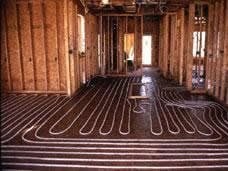
How much does it cost to install radiant in-floor heat?
The costs for equipment and installation can vary widely, depending on factors such as the type of system (electric vs. hydronic), the size of the area to be heated, the type of flooring, zoning and control requirements, and the cost of labor. Your best strategy when comparing costs is to get estimates from several radiant heating installers in your area. In general:
- Installations in newly poured concrete floors are usually less expensive than retrofitting or tearing up and replacing an existing floor.
- Hydronic systems typically have higher initial costs because you have to buy more equipment, including a boiler and pump. But if you intend to heat a large area or an entire house, hydronic systems may be more cost-effective to operate in the long run.
- Electric radiant heat, on the other hand, is often more cost-effective for heating small areas, depending on the utility costs in your area. According to WarmlyYours, an electric system for an average-size bathroom costs anywhere from $400 to $700 to install (for an electric mat installed in thin-set cement).
The bottom line on cost: In a home requiring a cooling system, the net cost of getting radiant floor heating will be the cost of the radiant floor heating system, less the amount saved by not having a heating unit on your forced air cooling system.
How does radiant floor heating work?
Think of how nice it feels to walk on a sandy beach that's been soaking up the rays of the sun all day. Even at night, when the air is cool and the sun has set, the sand will continue to emanate warmth.
Radiant Panel Association
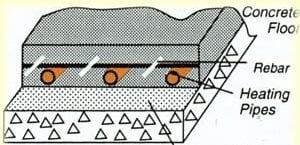
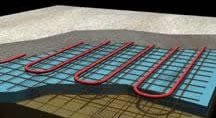
Like sand, concrete is an ideal carrier of radiant heat because of its inherent thermal mass. As warm water circulates through the tubing (or as electricity warms the heating elements), the concrete flooring turns into an efficient, inconspicuous radiator. Typically, radiant heating systems warm floors to temperatures of 75 to 80 degrees F. The warm surface then slowly radiates heat upward into the living space, rather than blowing around the heated air. This natural heat transfer is both more comfortable and energy efficient.
For concrete floor radiant heating systems, the warm-water tubing or electric heating elements can either be embedded within the slab-on-grade (anywhere from the bottom of the slab to within 2 inches of the surface, depending on the design and installation technique) or fastened to the top of a concrete subfloor and then covered with an overlay. Radiant heating can also be installed in thin concrete slabs placed over plywood, with a layer of decorative concrete placed on top (see One Contractor's Method for Installing Radiant Heat).
Can the tubing leak in a hydronic system?
Leaks are not a concern when the system is properly installed. PEX tubing has a life expectancy of more than 100 years, and all the tubing is thoroughly inspected before it leaves the manufacturing plant.
What is thermal mass?
"Thermal Mass" refers to the ability of a material to retain heat. For instance, a heated stone will remain warm much longer than a block of wood. This is because the stone is denser, thereby containing more mass. The mass of the earth can be used as a flywheel when it is heated under a radiant concrete slab. This storage of heat can carry a building through a time when energy is not available. Where "off peak" electrical rates are offered, using a radiant floor in conjunction with the thermal storage of the earth beneath the slab can produce some very low electric bills.
Thermal mass in a heated shop or hangar floor responds rapidly to the change or air temperature when a big overhead door is opened. All the heat that has been "trickled" into the slab over time is released quickly to combat the cold air rolling over the floor. This happens because of the sudden, dramatic increase in temperature difference between the slab and the air. Once the door is closed the building returns to its normal comfort setting almost immediately.
The key to any radiant panel system is to provide an even surface temperature so some mass is required to spread the heat across the panel. This mass may be in the form of gypsum or other cementitious material or metal plates in the panel construction.
Some under floor systems simply rely on air currents within the joist space and the mass of the wood sub floor to spread the heat. When properly designed, these systems are a good alternative for retrofitting an existing building.
Information courtesy of the Radiant Panel Association.


