
- Radiant Floor Heating Home
- More FAQs: How much does it cost? Can the floor get too hot? Can the tubing leak?
- Lower Heating Costs
- Installing Radiant Floor Heating Systems
- Installing Radiant Heat
- Retrofitting a Concrete Floor with Radiant Heat
- Other Resources
- Common Questions about Concrete Floors: Are they cold? Are they loud? Are they expensive?
How Radiant Heating Can Lower Energy Costs
Benefit of In-Floor Radiant Heating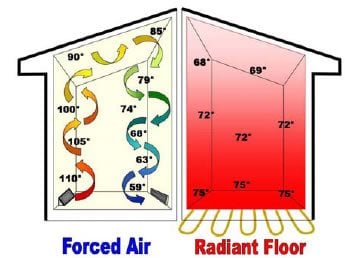
www.heatizon.com
Radiant heat systems often cost more to install initially than forced-air systems, but they also run more economically and retain heat better, say proponents. The cost savings will depend on the region where you live, the severity of the winters, how well insulated your home is, the fuel source and the layout of the system. According to the Radiant Panel Association, most homeowners can accrue energy savings of 10% to 30%; for commercial installations, savings of up to 60% or greater are possible.
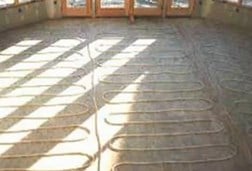
Radiant Floor Heating
Time: 01:04
Watch an overview of the benefits of installing a radiant floor heating system in concrete floors.
Other ways concrete in-floor radiant heating saves energy:
- Studies conducted by the American Society of Heating, Refrigeration and Air Conditioning Engineers (ASHRAE) indicate that with radiant heating systems people can be comfortable at temperatures 6 to 8 degrees F lower than with convective systems that use air as the primary heat-transfer medium, such as forced-air and baseboard heat.
- Heat loss is greatest in the top half of rooms. You lose more heat with forced air heating systems since the heat concentrates in the top half of the room. Radiant floor heating concentrates the heat in the lower half of the room where the human body needs it most. This can allow you to set your thermostat 2-4° lower and still be comfortable-thus lower heating bills. Check with the local area utility in your area on how much a 2-4° lower thermostat setting would save in heating cost on an annual basis. 10-30% is the often quoted range of savings. Homes and buildings with high ceilings will save even more in heating costs as heat generated by forced air systems quickly rises to the top of these structures, where it is of little use.
- According to the Hydronic Heating Association, a given volume of water can hold almost 3,500 times as much heat as the same volume of air for the same temperature rise. This means you can operate a hydronic radiant system at a lower thermostat setting than a forced-air system, resulting in lower energy bills. To equal the amount of heat that could be carried by water running through 1-inch-diameter hydronic tubing, you would need a 10 x 18-inch duct for forced-air heat.
- To optimize energy-efficiency, radiant heating systems can work in zones, allowing you to heat different areas of a home at different temperatures. This lets you direct more heat to typically chilly rooms or high-use areas, such as bathrooms, bedrooms, basements and entryways, while lowering the thermostat in rooms with less traffic, such as a formal dining room.
- With an electric radiant floor system, you can save operating costs by taking advantage of lower rates for off-peak usage, if your electric utility company offers them. Here's how: Heat up your concrete floor during off-peak hours (typically at night) and then turn the heat off during the day. Once a concrete floor warms up, it will retain the heat and release it gradually, even if you shut off the system or the power goes out. The retained heat can keep your house comfortable for hours.
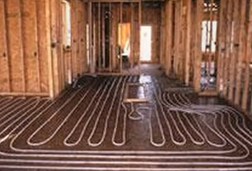
Saving Energy with Radiant Floor Heating
Time: 02:17
Are you concerned that your concrete floors will be too cold in the winter? Harris explains how embedding a radiant heating system within the floor slab can save energy costs and provide other benefits, such as eliminating the circulation of dust or dirt throughout your home-a drawback of forced-air heat.
It's important to note that while thick concrete slabs have a high heat storage capacity, they also have a slow thermal response time, which means they can take many hours to heat up if the floor is allowed to cool down. Because of this, you are limited in how long you can set back or turn off the system to save operating costs. Most experts recommend maintaining a constant temperature. For concrete slabs-on-grade, there's also the potential for heat loss into the ground without adequate insulation under the slab, such as 2 inches or more of high-density expanded polystyrene.


