
- Countertop Supplies Home
- Concrete Countertop Molds
- Concrete Countertop Mix
- Pigments & Custom Options: Color additives, special effects & decorative add-ins
- Countertop Reinforcement
- Casting Equipment: Tables, mixers, vibrators & curing covers
- Countertop Finishing & Installation
- How to Polish Concrete Countertops
- Sealers for Concrete Countertops
- Delivery and Installation
- Related Reading
- Problems with Concrete Countertops
- Countertop Product Reviews
- Concrete Countertop Basics: Pricing, colors, edge details, and more
Concrete Countertop Sealers
Tips for sealing concrete countertops to protect them from food stains, scratches and water absorption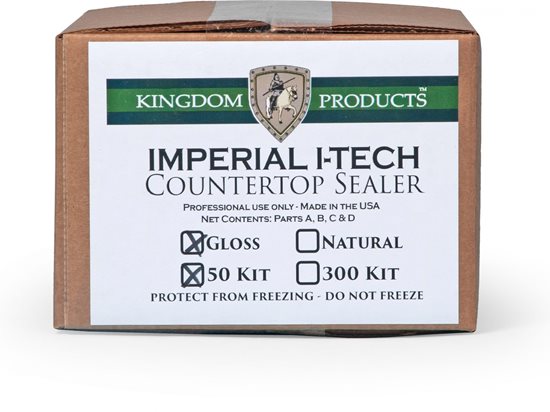
Imperial I-TECH sealer protects concrete countertops from accidental spills of food products, household cleaners and many industrial chemicals.
Because concrete is naturally porous, concrete countertops should always be sealed to protect them from food stains, scratches and water absorption. The right sealer will not only protect the countertop surface, but also enhance its color and sheen. There are many factors to consider when choosing a countertop sealer. Following are some tips for selecting a product appropriate for the function and design intent of your countertop.
Find countertop sealers & supplies
Hire a contractor to seal your concrete counters
CHOOSING THE BEST CONCRETE COUNTERTOP SEALER
With so many countertop sealers to choose from, it's important to understand what's available, how they work, and what each type is best suited for. "There are a multitude of concrete sealers on the market, but it's important to choose a product that meets the unique performance requirements for countertops as opposed to floors or exterior flatwork," says Jeff Girard of the Concrete Countertop Institute. Here are the most important factors to consider:
- For countertops, be sure to choose a heavy-duty sealer that is food-safe, colorless, non-yellowing, and heat and scratch resistant. They should also resist heat and be impervious to lemon juice and red wine.
- In most cases (with the exception of outdoor countertops), you’ll be applying the sealer indoors. Use a product that is safe for indoor application, one that contains no VOCs or harmful chemicals and is low in odor.
- Countertop sealers are available in a range of sheen levels. For a more natural look, you’ll get the best results using a sealer with a low-sheen matte finish. If you want a shinier porcelain-like finish, choose a high-gloss sealing product.
- Most countertop sealers can take hours to become tack-free and several days to reach full cure. If you want to speed up the process, fast-curing sealers are available that cure almost instantly upon exposure to a special ultraviolet light.
- Be sure to test any sealing product you’re considering before you apply it. Testing is the most accurate way to verify that a countertop sealer will deliver what you expect in terms of both appearance and performance. See this procedure for testing sealers for concrete countertops.
 Topcoat Sealer
Produces a scratch and stain resistant top coating.
Topcoat Sealer
Produces a scratch and stain resistant top coating.
 Stain Resistor
Water-based, penetrating stain repellent
Stain Resistor
Water-based, penetrating stain repellent
 Water Based Penetrating Sealer
Low luster finish with a natural look.
Water Based Penetrating Sealer
Low luster finish with a natural look.
HOW TO SEAL CONCRETE COUNTERTOPS
How a sealer is applied can significantly affect the final appearance and performance. Using the right tools is critical to achieving the best coverage rate and sealer thickness. While there are some general guidelines for applying sealer, you should always refer to the manufacturer's installation instructions regarding the tools and procedures they recommend. The most important rule to remember is that less is more. You should apply sealer in multiple thin coats vs. one thick heavy coat. Get more tips for sealer application: Choosing the Best Applicator.
For additional protection and luster, some countertop installers will also apply a food-safe finishing wax over the sealer. This sacrificial protectant will help to preserve the sealer but requires regular reapplication to maintain its effectiveness.
FIXING SCRATCHES IN COUNTERTOP SURFACES
Minor scratches can occur in concrete countertops by cutting directly on the surface. If scratches do appear, they are usually in the sealer and not in the concrete itself, making them easy to repair (see How to Fix Scratches in Topical Sealer).
Minor scuffs and shallow scratches in countertop sealers can usually be buffed out. If the scratch is deep, however, you may need to fix it by filling the scratch with more sealer. For information on the best tools to use to apply touchup sealer, see Touching Up Minor Surface Scratches.


