
- Concrete Repair Home
- Surface Repairs
- Structural Repairs
- Slab Repairs
- Concrete Crack Repair
- Common Concrete Repairs
- Stamped Concrete Repair
- Driveway Repair
- Pool Deck Repair
- Garage Floor Crack Repair
- Fix Spalling Concrete
- Make New Concrete Match Old
- How to Fix Pitted Concrete
- Concrete Repair Methods & Systems
- Concrete Crack Injection for Basements
- Why Concrete Cracks
- Sunken Concrete Foundations
- Repairing Bowed Basement Walls Using a Carbon-Fiber-Reinforced Grid
Repairing Stamped Concrete Problems
From cracks to discoloration, find answers to user submitted questions about stamped concrete repair
Select Your Problem
Fixing Cracks in Stamped Concrete
Adding Color to a Liquid Release
Stamped Concrete Driveway Scaling Problems
Removing Rough Spots After Stamped Concrete Cures
Repairing Stamped Concrete Overlays
Shrinkage Cracking on Stamped Concrete
Stampable Overlay Efflorescence
Eliminating Ridges in Stamped Concrete Seams
The Mystery of the Sticky Gray Oooze
FIXING CRACKS IN STAMPED CONCRETE
- Question:
-
How do I deal with small cracks and fractures that occur along the edges and corners of the stone imprints in some of my stamped concrete work? They are random and do not occur on all my projects. They seem to happen with deeper, more aggressive stone patterns. How do I fix these cracks, and how do I keep them from happening in the future?
- Answer:
-
These are shrinkage cracks caused by pushing stamping tools into the concrete after the surface has become too hard. This surface hardening, known as "crusting," can be caused by exposure to sun and wind, overfinishing, the concrete mix design, and even the concrete color (darker colors more readily absorb heat from the sun).
Need repair work? Contact nearby concrete contractors.
A good analogy is what happens when you cook pudding. When the pudding comes off the stove, it's a viscous liquid, similar to concrete when it comes out of the truck. The pudding then goes into the fridge to cool. If it cools too quickly, the rapid temperature drop causes a skin to form on the surface. The pudding then thickens and hardens from the top down. The same thing occurs when concrete dries too fast from the top down. Remedies for reducing surface crusting include using admixtures to slow the concrete set time, using surface evaporation retarders, avoiding darker colors, and scheduling the concrete pour for the coolest time of the day. Using stamping tools with deep grout lines, such as random stone and large slate patterns, can aggravate the cracking problem.
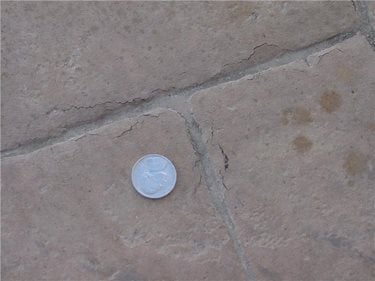
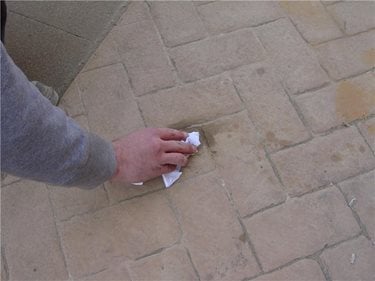
One way to repair these small cracks is to use a colored cement paste, or color patch. Some color hardener manufacturers offer these patches in their standard color palette for use in filling and repairing these types of cracks and small popouts. Some contractors will sift the sand out of the color hardener they are using on the project and use this to make a color patching material. I recommend wetting color patch materials with a 50:50 blend of concrete bonding polymer and water. Use a wooden tongue depressor or gloved finger to smear the color patch into the cracks. Soften the edges with a damp rag or sponge to blend the patch and color into the slab. Let these repairs cure for 24 hours.
ADDING COLOR TO A LIQUID RELEASE
- Question:
-
Can I tint a clear liquid release agent to add color when stamping concrete? If so, how is it done?
- Answer:
-
You will be hard pressed to find any official written guidelines on tinting a liquid release, but that doesn't mean it can't be done. Most manufacturers of liquid release don't publish any guidelines because the process is more art than science, and each job will present different conditions and color requirements. Achieving success requires practice, experience, and some experimentation.
The most common tinting method is to add a colored release powder to the liquid release and then shake the mixture well to disperse the color. (A ratio that has worked well for me is 2 to 4 ounces of dry color for every 64 ounces of liquid release.) Although many applicators have had success with this method, it takes practice to know just the right amount of tinted release to apply to prevent the stamping tools from sticking to the concrete. Apply too much release, and you get a puckered, spongy mess. Apply too little, and you get pulling and tearing of the surface. Some applicators have better success stamping the surface first using a clear liquid release and then applying a tinted liquid release immediately afterwards to highlight the texture of the surface. This method tends to work better with more porous surfaces, like stampable overlays.
STAMPED CONCRETE DRIVEWAY SCALING PROBLEMS
- Question:
-
My 3 ½-year-old stamped concrete driveway is scaling and much of the design is flaking off. How do I identify the cause for this? I live in eastern Pennsylvania, and we've had typical winter weather.
- Answer:
-
Surface failure of concrete is usually caused by one of two reasons: The concrete was placed or allowed to cure during freezing temperatures or the concrete was finished improperly.
If concrete freezes during the curing process, the chemical process that develops strength is stopped and you end up with soft, crumbling concrete. There is no fix for this; the concrete needs to be removed and replaced.
UNDERSTANDING SPALLED CONCRETE
Length: 05:56
Find out why concrete spalls and how to avoid it in the future. Get tips on dealing with spalled concrete in patios, driveways and other concrete surfaces.
REPAIR SPALLED CONCRETE
Length: 05:24
Tips on how to repair spalled concrete. Expert advice on why spalled concrete occurs and how to fix it. See a demo on the repair process.Overfinishing or adding excess water to the concrete during finishing is more common, and often weakens the top ¼ to 1 inch of the concrete. This weak surface is more susceptible to typical winter freeze-thaw cycles that can cause surface failure like spalling. Deicing salts applied to the driveway or dripping from vehicles parked on the driveway only speed the process of freeze- thaw destruction. Applying a good sealer will help prevent or minimize these issues, but only to a point. If the integrity of the concrete is suspect, there's not much you can do to stop the surface destruction.
Once the top of the concrete is exposed, you have "opened the lid" so to speak, and year after year exposure to the elements will continue to eat into your concrete. An overlay to cap the concrete or removal and replacement may be the best remedies. Did you get a warranty on your concrete? If so, talk with the installer about your options.
REMOVING ROUGH SPOTS AFTER STAMPED CONCRETE CURES
- Question:
-
We just got a new swimming pool installed, along with a stamped concrete deck. But the stamping created painful ridges, making the surface so abrasive to walk on that I have to wear shoes just to get to the pool. It even tore off two pads from my dog's feet. I was expecting the texture to be like other concrete walkways, but it's like sandpaper. Now I have 1,000 square feet of walkway that I can't really walk on in bare feet. How can this pool deck be smoothed so I can walk on it comfortably? Would grinding, polishing or sealing work with a stamped pattern?
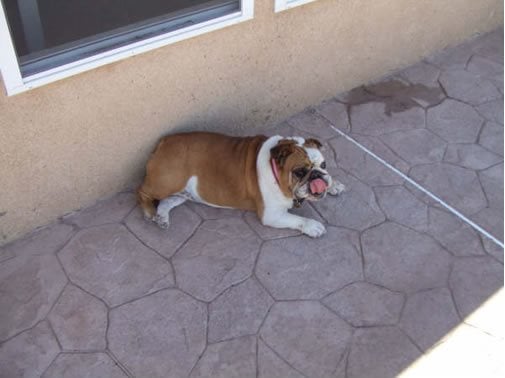
Too "ruff" for me! When a new stamped surface is abrasive on bare feet,it may need to be ground prior to sealing.
- Answer:
-
The pattern used (random stone) is one of the most aggressive available. The picture does not show enough detail, but depending on surface smoothness prior to stamping, you can get different levels of roughness.
You have a very new slab, so I suspect that a sealer hasn't been applied yet. (A period of 28 days should pass before application of a decorative sealer.) Applying a couple of light coats of a low-solids acrylic sealer will help alleviate a bit of the roughness, as well as bring out the color. Test this in a small area first. If a sealer doesn't do the trick, a walk-behind sander or buffing machine with a black rough-bristle pad will take off the rough edges and soften the surface. Again, test this method first in a small area.
Nature and traffic will also diminish the roughness, but this will take time.
Learn more about sealing stamped concrete.
 High Performance Concrete Repair
Fast setting mix for structural repairs
High Performance Concrete Repair
Fast setting mix for structural repairs
 Divot Patch - Concrete Repair
15-minute set time
Divot Patch - Concrete Repair
15-minute set time
 Crack-Weld
5-minute set time
Crack-Weld
5-minute set time
OVERLAY FAILURE - REPAIRING STAMPED CONCRETE OVERLAYS
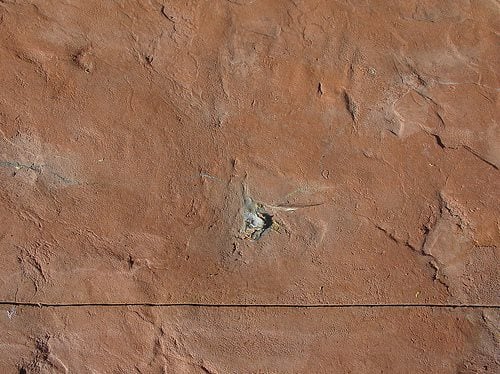
Stamp overlay failure
- Question:
-
What caused this stamped overlay on a patio to fail?
- Answer:
-
While this is quite a devastating situation, and will cost both time and money to repair, the cause is quite simple and direct. Lack of surface preparation causes 90% or more of overlay failures, and is without a doubt what caused this failure.
In most decorative overlay projects, surface preparation should cost more and take longer to perform then the actual overlay installation itself. Creating a profile (or degree of roughness) of at least #6 on the International Concrete Repair Institute (ICRI) surface preparation scale is mandatory for successful adhesion. The surface needs sufficient "bite" for the overlay to bond, otherwise delaminating failure can result. As can be seen in the picture, the surface under this overlay is smooth, with little to no profile.
Unfortunately, not much can be done to save this patio overlay. The remedy involves removal of the entire overlay, proper surface profiling using a mechanical scabbler or scarifier, and re-application of the overlay. To find out more about surface profile, contact the International Concrete Repair Institute.
SHRINKAGE CRACKING ON STAMPED CONCRETE
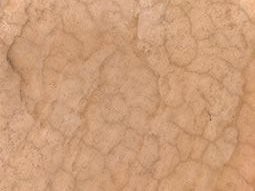
Water highlights the shrinkage cracks on this colored concrete surface.
- Question:
-
I have a recently poured stamped concrete pool deck that shows hairline cracks all over the surface when it becomes wet. When the surface dries, though, it has a nice finish. The contractor sealed the surface a couple of days after concrete placement with a solvent-based product. Is this a sign of a poorly sealed surface? Since it's a pool deck, is premature failing a concern if it gets wet too often? Will applying an extra coat of sealer correct the problem?
- Answer:
-
This issue has nothing to do with sealer. Those cracks you see are shrinkage cracks. They are caused when the surface of the concrete shrinks rapidly during the initial curing phase. When the concrete surface dries, or cures, too rapidly, the surface contracts (shrinks) and you end up with these small hairline cracks. (For more information, read Why Concrete Cracks.) Typically, shrinkage cracking is only an aesthetic issue and does not affect the structural integrity of the concrete. As you noted, you don't see the cracks unless the surface is wet.
Do not apply additional sealer. The sealer you have down now appears to be doing its job, so I suggest you reseal only when the original sealer has worn off. Overapplication of sealer will only lead to other issues, and will do nothing to eliminate the cracks.
STAMPABLE OVERLAY EFFLORESCENCE - HOW IS IT REMOVED?
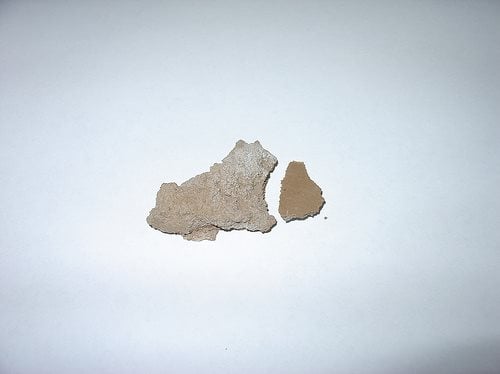
These two samples come from the same bucket of overlay mix. Yet only the one on the left shows efflorescence.
- Question:
-
A few days after placing a stamped overlay, I noticed that the overlay was covered with efflorescence. The picture shows two small samples of the overlay taken from material left in the mixing bucket. The sample on the left side shows material that was exposed to the air, and the sample on the right shows material that was up against the side of the bucket. Why is the sample exposed to the air loaded with efflorescence while the other sample has no effloresce and is the proper color?
- Answer:
-
This is a great example of how efflorescence works. It also shows just how many variables decorative concrete installers deal with on any given project.
Efflorescence is a natural phenomenon that occurs in any material that contains cement (lime) and comes in contact with water. The process involves natural salts migrating out of the concrete (or mortar, block, or brick), in a. chain reaction triggered by water and carbon dioxide. In an attempt to escape from the concrete, efflorescence will take the path of least resistance. The concrete's surface profile, color, water-cement ratio, and porosity all play a big part in the process.
The sample on the left side of the picture has a rough, open surface and is very porous, which allows for easy water migration. The sample on the right shows the backside of the piece that was up against the bucket, which was made of non-permeable plastic. This sample also has a smoother, denser surface that inhibits water migration. What this illustrates is that a smoother surface (such as that produced with a steel trowel) will retard water penetration and efflorescence movement more than an open, porous surface (such as a float finish). In addition, materials that are darker in color will show efflorescence more readily than lighter-colored materials. In fact, I have seen decorative concrete and concrete overlays that have severe efflorescence but are light in color, so the efflorescence is barely noticeable. When it comes to the water-cement ratio, less water is always better. And never add water to the surface. Apply an evaporation retarder instead.
While you can never eliminate efflorescence, controlling the factors outlined above will help minimize its effects.
ELIMINATING RIDGES IN STAMPED CONCRETE SEAMS
- Question:
-
When we are stamping, we sometimes end up with a lot of crusting that we try to roll out or hammer away the next day. Do you have any tricks or suggestions for dealing with this type of problem?
- Answer:
-
I assume you are talking about the material that pushes up between stamp imprints. If so, this is usually referred to as "squeeze." You will always have some squeeze, but it should not be overwhelming. If you are getting too much, here are a few things to look at:
Is the surface too wet? A wet surface can create more squeeze. Wait until the surface is a bit stiffer.
Are you using imprinting tools with lots of edges and angles? Tools with multiple edges (random stone patterns are the worst) tend to create more squeeze because it's harder to hold multiple edges tight during stamping vs. one or two edges.
How old are your tools, and do the edges fit together tightly? Not all tools are built the same way, and if the edges don't come together tight, you will get more material pushing up between them.
To get rid of squeeze, the easiest method is to roll it out with a touch-up wheel or chisel while the concrete is still green. If you wait and come back after the concrete is hard, you can remove the squeeze with a good set of straight-edge metal chisels. The problem with waiting until the next day is that the areas exposed after breaking off the hardened material are now usually a different color and will need to be touched up with a tint, stain or colored sealer.
THE MYSTERY OF THE STICKY GRAY OOZE
- Question:
-
Why did this stamped overlay crack, and what is the sticky gray material oozing from the crack?
An "off-ratio" epoxy emerges up through a crack in a stamped overlay.
- Answer:
-
The crack in this stamped overlay is caused by a crack in the underlying concrete that reflected through to the overlay. The sticky gray material is the epoxy that was used to repair the original crack.
The original colored and stamped concrete slab had developed cracks running through about 30% of the slab. The contractor decided to use a stampable overlay to cover the slab instead of removing and repouring the concrete. After preparing the surface, the contractor used a two-part epoxy to fill and bridge the cracks. But the epoxy was not mixed in the proper proportions (referred to as "off ratio") and thus never fully hardened. The soft, sticky material has no ability to bridge cracks. Instead, the crack reflects through to the overlay and the epoxy then oozes through the surface crack.
The repair involves using a strong chemical stripper to remove the sticky ooze and then filling the crack with a caulk or grout in a color matching the overlay. Chances are the crack will always show, but a good color match can minimize its appearance. Tape off the repair area to reduce cleanup and protect the adjacent surface. After the caulk or grout has cured, seal the entire area as normal.
Always read the directions carefully when working with any two-part epoxy compound. These chemicals are designed with tight tolerances and ratios. Failing to properly mix the correct amounts of material can lead to failure.
AVOIDING A DUSTY MESS WHEN REMOVING RELEASE POWDER
- Question:
-
Cleaning release powder from concrete surfaces after stamping is always a dusty and dirty mess. How can this be avoided?
- Answer:
-
During one of my seminars on troubleshooting decorative concrete at the World of Concrete in Las Vegas, an audience member shared the following trick for removing release powder without the mess. I was so intrigued by the method he shared that I tried it, and can report that it works great! I never caught the gentleman's name, so I can't give him the proper credit for such a creative and helpful hint. Whoever you are, thanks!
Take any fine-grade silica sand, and mix with water to create a heavy, stiff paste. Apply this paste randomly to the stamped surface. Then with a stiff broom or walk-behind scrubber, scrub the surface with the sand paste. The wet sand grabs the release powder, eliminating any dust, and also acts as a grit to help scrub the surface while removing the release powder. Depending on the color and amount of release on the surface, the process may need to be repeated several times to achieve the desired look. When I tried this method, one pass was all that was necessary to obtain a clean stamped surface. The sand containing the release powder can easily be washed off with a hose or power washer or left to dry and vacuumed up with a wet/dry vac.
PREVENTING WATER STAINS WHEN USING CURING BLANKETS
- Question:
-
Is there any way to cure stamped concrete in cold weather without using blankets? I want to avoid permanent water spots created by condensation that might build up underneath the blankets.
- Answer:
-
Using curing blankets is the only accepted method I'm aware of for curing stamped concrete in cold weather. Some contractors use high-early-strength concrete (which has been chemically accelerated) to achieve faster setting times and to avoid the use of blankets. But I don't recommend these rapid-set mixes for stamped concrete applications because the concrete will begin to set before the stampers can complete their work.
You are right about the downside to blankets. No matter how hard you try to pull them tight and smooth over the concrete surface, you always end up with wrinkles and creases that can trap moisture, resulting in permanent water stains. These stains are barely noticeable on plain gray concrete, but can be major eyesores on stamped and colored concrete. A trick that has worked well on past projects is to use a powdered release agent to create a waterproof shield over the concrete surface. After completing all the stamping and detail work, and right before placing the blankets over the concrete, apply a medium to heavy dusting of release powder over the entire surface. Release powder has hydrophobic properties, so it repels water. However, the powder acts as a one-way water shield: It will allow the warm water vapor rising out of the curing concrete to pass through, but once the vapor condenses into a liquid, it won't be able to pass back through the layer of release powder. This eliminates or greatly reduces water stains created from curing with blankets (or from using plastic sheets to protect the freshly placed concrete).
If you prefer to stamp with a liquid release agent, you can still use this method. Wait until the liquid release has evaporated, and then liberally dust the surface with a colorless release powder right before putting down the blankets. For best results, remove any condensed water that forms underneath the blankets after 12 to 24 hours. Reapply release powder and blankets as needed until the concrete has cured or the temperature warms up. After a minimum of 72 hours, remove the release powder by scrubbing it off with a broom and a simple soap and water solution. A power washer, at low pressure, can also be used.
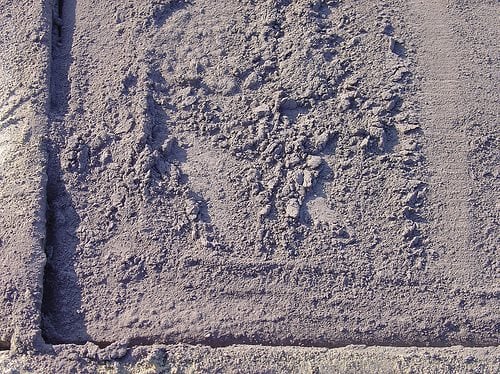
Powdered release agent applied liberally to curing concrete acts as a water shield against condensation.
RELATED READING:
Stamped Concrete DIY


