
Vertical Concrete Mix for Resurfacing Walls
Discover the best vertical mixes for skim coating a concrete wall
Bag of vertical concrete mix from Flex-C-Ment.
Some contractors who specialize in vertical work have developed their own wall mixes based on tried-and-true formulas. But a number of companies now sell convenient, ready-to-use prepackaged mixes that are simply mixed onsite with water.
Most vertical mixes are composed of a blend of cement, graded lightweight aggregates, polymers and admixtures. Some are also fiber-reinforced. They are mixed with a paddle or mortar mixer and then applied with a hand trowel, similar to plaster, or even with a shotcrete gun, depending on the size of the area to be resurfaced. Application thicknesses can range from 1/4 inch to 2 inches or more, depending on whether the overlay will be imprinted with a shallow or deep texture.
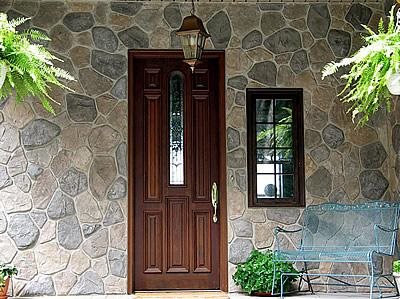
Bag of vertical concrete mix from Flex-C-Ment.
Because of their high polymer content, vertical mixes require no curing. Most products are also water resistant and unaffected by freeze-thaw conditions, permitting outdoor use in most climates. Usually the mixes come in two colors: gray or white. But many manufacturers also sell colorants that can be mixed in with their products to achieve nearly any hue desired.
Features to look for in a vertical concrete mix
The backbone of any vertical stamp project is the base vertical stamp mix. These materials are highly engineered overlays that are able to be applied in thicknesses ranging from ¼ inch to 5 inches or more and stay pliable for hours to permit stamping and carving.
“The most critical feature when selecting a vertical stamp mix is the workability. I want a mix that is flexible -- something that can be carved, stamped and colored with ease,”says Brain Farnsworth, director of technical services for Bomanite Group International. As someone who has developed and installed vertical stamp mixes, he is looking for specific criteria when working with these types of mixes. “I want to be able to have plenty of time to work with the material. I don't want to worry about shrinkage cracks when stamping, or rapid setting that limits a custom hand carved piece,” he says. Farnsworth also prefers mixes where you just add water, mix well, and the product is ready to go. For better aesthetics, the sand gradation of the mix is also important. “I don't want to see large sand when working with the material. Larger sand in the mix only detracts from the finished piece when hand carving.”
The other key factor Farnsworth looks for is how well the material holds to the wall. It has to exhibit thixotropic properties. “You should be able to throw the product on the wall without it sagging or falling off, but it needs to have plasticity. I want this stuff to be like butter, creamy and easy to carve when you work with it,” he says.
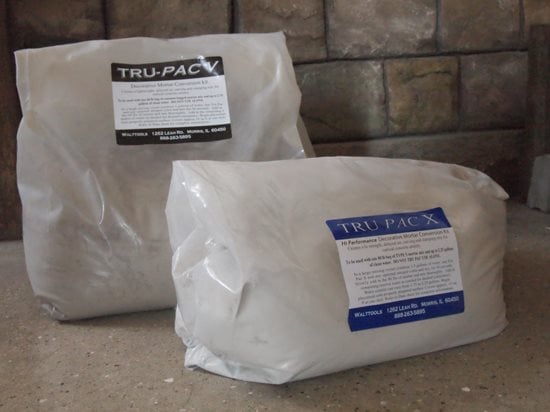
Tru Pac conversion kits use a combination of lightweight components, extended-range flow modifiers and proprietary cementitious materials to produce vertical concrete that retains its moisture and workability at overlay applications ranging from thin to thick.
How to apply vertical stamp mixes
Proper application of the stamp mix is critical to long-term durability and success. The good news is that modern vertical stamp mixes are pretty forgiving and easy to work with. As when applying horizontal decorative overlays, the most important aspect is a stable, clean, and well-prepared subbase. For vertical applications, this usually involves installing some type of metal lath or wire reinforcement for the vertical stamp mix to adhere to. The actual application is pretty straightforward, and involves troweling material onto the subbase at the desired thickness. Once the material has been applied, stamping, texturing or hand carving is performed to make the material look like stone, rock or wood, depending on the look desired. Once the material has set, the coloring takes place. This involves applying different stains, dyes and tints using a sprayer, rag or brush. In most cases, the colors are applied in multiple light applications to achieve the greatest realism.
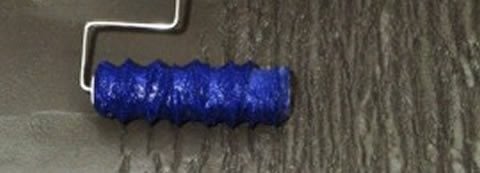 Vertical Overlay Texture Tools
by Butterfield Color
Vertical Overlay Texture Tools
by Butterfield Color
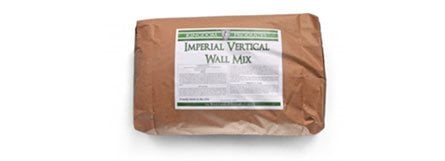 Vertical Wall Mix
40 lb Bag
Vertical Wall Mix
40 lb Bag
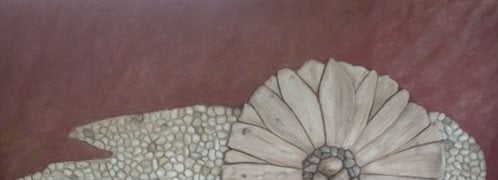 Brickform Vertical Mix
Great for Carving or Stamping
Brickform Vertical Mix
Great for Carving or Stamping
 Butterfield Cantera Wall Mix
Just Add Water
Butterfield Cantera Wall Mix
Just Add Water
Coloring options for vertical overlays
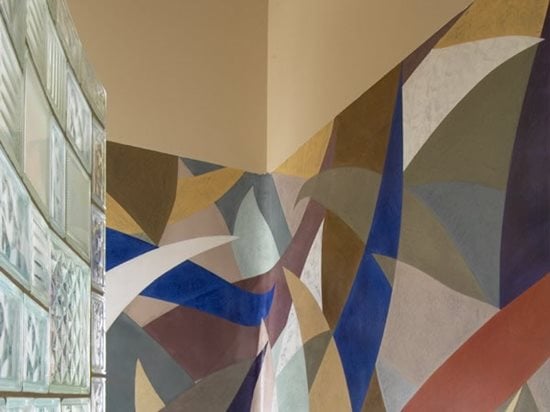
Patène Artectura stains were used to add color to this concrete shower wall. Everlast Concrete in Steger, IL
There are numerous ways to enhance vertical overlays with color. One of the easiest methods is to add a liquid or powdered pigment to the overlay material during mixing. Many overlay manufacturers offer pigments formulated for use with their products.
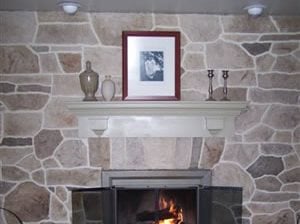
Acrylic stains from H & C were used to create the look of natural stone. Custom DesignCrete in Crescent, PA
If you want to achieve multi-tonal effects (to mimic natural stone, for example) or introduce accent shades, the overlay can be colored topically after it dries with acid- or water-based stains, dyes and tinted sealers. Because vertical overlays don't receive foot traffic, they can also be painted and faux finished with acrylic- or latex-based paints, similar to plaster walls.
Nathan Giffin of VerticalArtisans.com likes to use a variety of techniques and systems for his faux finishes. "I'll use acid stains, acrylic or water-based stains, and latex paints all on one job," he says. "And I use various methods for applying the color-brushing, spraying, sponging, spritzing-to get different effects. I also use powder release, not for the dominant color, but for setting off and creating depth."
Other coloring techniques include:
- Hand painting of individual "stones."
- Applying an accent stain by spray and then immediately wiping or blotting the stain off of high areas with a sponge, lamb's wool pad or terry cloth rag.
- Spraying the overlay with a tinted sealer and then dabbing and rubbing the surface with a dampened cellulose sponge to produce an antiqued look.
- Adding highlights by applying water-based stain using a dry-brush technique.


