
- Installing Industrial Floors
- Polished Concrete
- Commercial Flooring Design Ideas: Using concrete in restaurants, offices and retail spaces
- Terrazzo Flooring
- Other Commercial Applications
- Commercial Stamped Concrete
- Concrete Parking Lots
- Precast Concrete
- Post-Tensioned Concrete
- Tilt-Up Concrete
- Self-Consolidating Concrete
- Pervious Concrete
- Related Information
- Concrete and LEED
- Power Trowels & Screeds
Self-Consolidating Concrete
Learn about the special qualities of self-consolidating concrete and its applications for decorative concrete work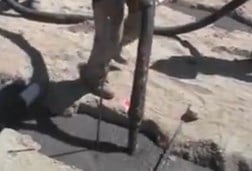
SCC - Footing
Time: 00:21
This video shows SCC being placed for a footing. Note how easily it flows, even around corners, without segregation. Thanks to BASF for video footage.
Self-consolidating concrete (SCC) is recognized as one of the greatest advances in the concrete industry. Using new admixtures and some mix modifications, we can now produce concrete that flows easily without segregating (where the coarse aggregate separates from the cement paste). Concrete that segregates loses strength and results in honeycombed areas next to the formwork. It is the self-consolidating nature of SCC that makes it so valuable in construction. SCC can flow into very intricate forms or forms that have a lot of reinforcing bars (rebar congestion) and still leave no voids. Normal concrete would have to be heavily vibrated in those applications to work out all the entrapped air bubbles next to the forms and reinforcing and get the concrete to move in.
WHAT IS SELF-CONSOLIDATING CONCRETE?
Let's start with the simple definition and then kick it up a notch. SCC is very exceptionally flowable concrete that never needs to be consolidated to fill forms or flow. Placed flat, like for a slab, it is virtually self-leveling. It looks a little like lumpy pancake batter. The consistency is measured by what's called slump flow, where we measure the width of the puddle left when a slump cone is filled and lifted. Slump flow for SCC varies from 19 to 30 inches. However, self-consolidating concrete is NOT simply concrete that flows. If that's all there was to it, we could just use lots of water.
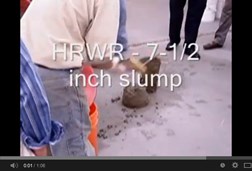
VIDEO: SCC - NO VIBRATON
Time: 01:06
Self-Consolidating Concrete flows easily between obstructions to fill a form without vibration. Thanks to Euclid Chemical for this video segment.
The currently accepted definition of what makes good SCC has three parts:
- High flowability — It flows easily into the finest details of formwork or molds and around reinforcing under its own weight. This is also called workability or filling ability (meaning it fills a form easily).
- Passing ability — The ability to flow through tight spaces, like congested steel reinforcing bars or narrow spots in the formwork.
- Stability — This is the big difference between SCC and simply wet, sloppy concrete. Stability implies that even at very high slumps (or slump flows), the concrete doesn't segregate; it remains homogenous and there is no separation of the aggregate from the cement paste. There are actually two kinds of stability: Dynamic stability (meaning it stays stable while being transported and placed) and static stability (meaning it stays stable — the aggregate doesn't settle and it doesn't bleed excessively while it is in the forms but not yet hardened).
Once hardened, SCC is not much different than conventional concrete. In fact, since we use superplasticizers (high-range water reducers) to achieve the flowability and lots of fines, we can often proportion the concrete for very low water-cement ratios and get very high strengths and low permeability.
MATERIALS FOR SELF-CONSOLIDATING CONCRETE
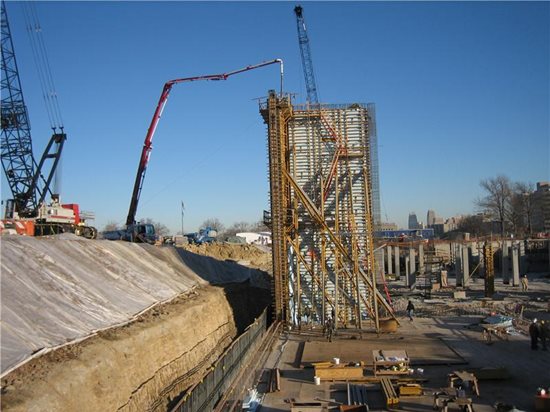
This huge wall with heavily congested reinforcing was poured in a single lift with SCC. Lafarge North America
SCC and conventional concrete differ only in some minor proportioning modifications and a couple of admixtures. But in many cases, the contractor won't even know what's in the mix, but rather will specify the performance required in terms of workability (slump flow), passing ability, stability, and strength. Lafarge even has a name, Agila, for its proprietary SCC mix.
There are three types of SCC mixes:
- high powder content and a high-range water reducing admixture (HRWRA)
- low powder content, HRWRA, and a viscosity-modifying admixture (VMA)
- moderate powder content, HRWRA, and a moderate dose of VMA
The powder referred to here is all the fine materials, including cement, fly ash, ground granulated blast furnace slag, silica fume, and ground limestone filler. This thickens the mix, keeping the coarse aggregate stable in the matrix and also contributes to slump flow. Here are some things to understand about the materials in an SCC mix:
- The fraction of coarse aggregate in the mix will be much lower (about 30%) and the size will be smaller (about ½ inch top size)
- The amount of portland cement will typically be low, less than 300 pounds/cubic yard or less than half of the total cementitious materials
- Other cementitious materials will be high fly ash in the range of 20 to 40% of total cementitious materials; slag in that range also, and often some silica fume
- The powder, which includes the cementitious materials, may be supplemented with ground limestone.
- The water-cementitious materials ratio is often quite low-as low as 0.27 in some mixes, although 0.4 is more typical.
- Viscosity-modifying admixture (VMA) increases the viscosity to keep the mix stable. Without a lot of powder in the mix, VMA is used to thicken the mix and prevent segregation. "Every SCC mix we do in New York we use a VMA because the producers don't have a lot of clout with the quarry," said Euclid Chemical's Bill Phelan. "The quarries ship what they want but the ready-mix producers need to have a mix that works every day and the VMA keeps it consistent." In other parts of the country, though, well-graded, high-powder mixes tend to be the norm.
- High-range water reducers for SCC mixes have recently been mostly those based on polycarboxylates, which have an incredible ability to increase slump at low dosages. Polycarboxylates, though, have created problems with foaming and adding unwanted air to the mix, so a de-foaming agent is added. There have also been some problems with sudden slump loss. It is recommended that for longer haul distances, the producer should consider using a naphthalene-based HRWRA instead of polycarboxylate.
Keep in mind that SCC mixtures are a little complicated, requiring just the right balance between all the materials, water, and admixtures. Find more information on concrete mix design. Always experiment with a mix like this first before you start a job. "On any important concrete project, you need to do a test placement," said Phelan. "Don't be practicing on someone else's job!"
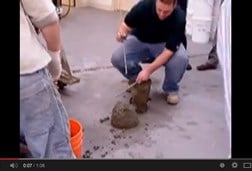
VIDEO: SCC - FLOWING
Time: 00:32
Self-consolidating concrete flows easily under its own weight. Note how there is no segregation, even on the leading edge of the concrete. The guy with the shovel was expecting to have to push the concrete into the footing but eventually he gave up. Thanks to Euclid Chemical for this video segment.
ADVANTAGES OF SELF-CONSOLIDATING CONCRETE
The advantages of using concrete that flows into place virtually effortlessly are obvious to anyone who works with concrete. We've been getting that kind of concrete for years by adding water. Unfortunately, as we know, adding water decreases the concrete's strength and leads to segregation.
The ultimate dream is being able to set up the forms then have the ready mix truck driver come and fill them up with no other workers on the job site. That may never happen, but SCC that has been properly proportioned and placed provides many advantages:
- Reduced labor since no vibration is needed for concrete in forms and little to no screeding is needed for flatwork.
- No need to worry about how good the vibration is-a contractor who used SCC once told me that the vibrator guys were always quitting on him; with SCC he didn't need to worry about the skills of the operator.
- Faster construction since the concrete places so quickly-a truckload can be discharged in as little as one minute!
- Extremely good finished surface quality — SCC can take on nearly a mirror-like surface and can produce concrete with very fine detail. This is really advantageous with sculptures and is why precasters love it so much. It can even flow into negative draft areas.
 Self-Consolidating Concrete flows easily and rapidly from a ready mix truck.PCA
 Self-Consolidating Concrete can provide extremely detailed castings. Lafarge Agilia
- Simpler to detail the reinforcing steel, since it can be fairly congested and still get completely filled with concrete.
- Quieter job sites or precasting shops since there is no vibrator noise. If you've ever been in a precasting plant when the vibrators are turned on you know what I mean.
- Increased safety since vibrator operators aren't up on the forms or dragging hoses and cords around the site, and there is less noise.
With these advantages, some would ask, "So why don't we use SCC everyplace?" The perception is that it's the cost that prevents wider use of SCC-these mixes use fines and admixtures that can increase the price of a yard of concrete by $10 to $15, although some producers may add a surcharge as high as $30. The best approach to controlling the cost is to work with your ready-mix producer to get the optimum mix for the intended use.
SELF-CONSOLIDATING CONCRETE CONSTRUCTION
Construction is where SCC really shines. What could be better than a mix that consolidates itself, eliminating all vibration, lift lines, and bugholes? For flatwork, SCC mixes can be described as self-leveling while formed concrete can be self-placing. Here are a few tips on construction with SCC:
- SCC can be delivered in ready-mix trucks although the trucks will often not be completely full, since the SCC can slosh around in the truck and even slosh out. Trucks carrying SCC have even overturned when the full load shifted during a turn.
- When placing SCC, it should be allowed to flow under its own weight from a single location if possible. SCC can flow horizontally as far as 33 feet or more. Walls and columns can even be pumped from the bottom up.
- SCC pumps very easily and with reduced pumping pressures. Air content tends to remain more stable in an SCC mix during pumping than for conventional concrete.
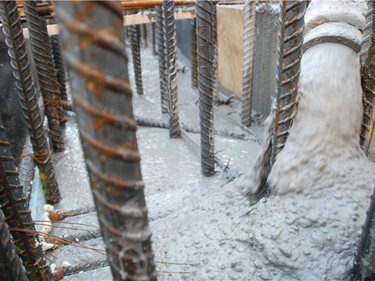
SCC easily flows around obstructions with no vibration needed. Joe Woolhead for iCrete
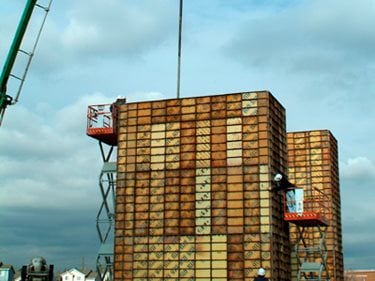
These elevator shafts were poured in a single lift using SCC, despite concern that the forms were not strong or tight enough to handle the pressure. Dot for Dot
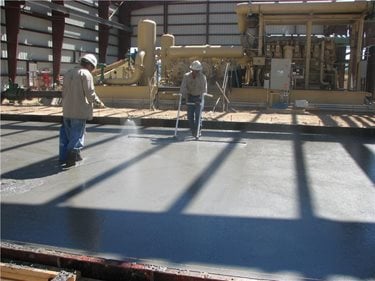
Self-leveling slabs require only minimal finishing to get a flat floor. Lafarge Agilia
Formwork should be designed for full liquid head. This means that there will be another 150 pounds of pressure for each foot of height of the forms. This is a danger for SCC since it places so rapidly and can develop pressures leading to blowouts. There have been serious blowouts with SCC and it has been known to find and leak through even very small gaps in their formwork.
- All SCC is not the same, so have the ready mix company provide a mix that is right for your application. Specific applications may require more or less filling ability, passing ability, or stability.
- Not only is vibration not necessary but can be damaging to SCC by causing segregation. To blend lifts, vibrators can be used but only for a few seconds.
- Slabs have not been a popular application of SCC-at least not prior to now. "We have helped develop self leveling mixes that are slightly less viscous but that need nearly no finishing," said Euclid's Caroline Talbot. "It's a niche market but growing. For small pours, driveways and such, the extra QC and cost may not be worth it, but for commercial slabs or floors for buildings, the self leveling concrete would be a big advantage." On floors that don't have high flatness tolerances, SCC can be placed with only minimal bullfloating. If applying a texture, even a broomed finish, don't start too soon or the concrete will slump back to a smooth surface.
- Curing is important for SCC since it is so often a low water-cement ratio mix. Low water mixes can develop autogenous shrinkage, where the unhydrated cement consumes all of the water in the concrete matrix. Wet curing is best, but at least apply a curing compound to protect the surface from drying out.
SELF-CONSOLIDATING CONCRETE FOR DECORATIVE WORK
SCC can be used for decorative work of any kind. It accepts color, either integral or dry shake, as easily as any concrete. Stamping SCC flatwork might be an interesting experience-don't start too soon or the lines will just disappear back into the concrete.
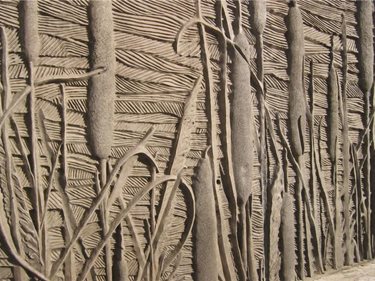
SCC allows castings with this kind of detail. Lafarge Agilia
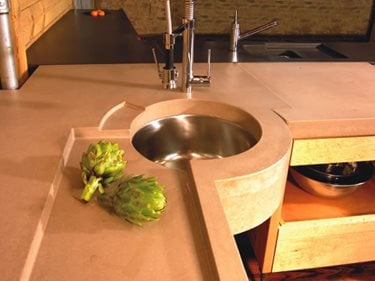
Pourfolio Custom Concrete in San Diego, CA
The most common use of SCC for decorative work, though, is for detailed molded (precast) concrete or intricate formliners. The high fluidity of SCC forces all of the air out the mold and results in perfect glassy surfaces. Remember, though, that with SCC any defect however slight in the forms will be directly reflected in the finished concrete. Also carefully select your form release agents to prevent bugholes (tiny entrapped air bubbles that cling to the form surfaces). In an article in Concrete Construction a study that concluded that the best form release was a reactive vegetable-based agent on a well-seasoned form.
Find more info on using SCC for precasting concrete and on setting up a precasting operation.
SCC has also been used for concrete countertops-mostly successfully. When cast face down, the SCC can produce a glassy surface that may not need any polishing. As with any concrete, experiment first to find the best mixes and techniques for your application. Experts advise that enough concrete for the entire countertop should be mixed in a single batch and placed in a single pour. As with all SCC, it is best to pour from a single location and let the weight of the concrete push itself into the forms or molds.
TESTING SELF-CONSOLIDATING CONCRETE
VIDEO: SCC - SPREADING
Time: 00:39
Self-Consolidating Concrete flows easily when the slump cone is removed. Thanks to Euclid Chemical for this video segment.
The primary test used in the field for SCC is slump flow, although there are other field tests currently in use. Here is a brief description of each-more information can be found in the appropriate ASTM test method.
- Slump flow-Flowability is measured with the slump flow test, which has been standardized as ASTM C 1611, "Slump Flow of Self-Consolidating Concrete." This test starts like a standard slump test, although many testing technicians will turn the cone upside down to make it easier to fill. When the cone is lifted, the SCC spreads out like pancake batter. The slump flow is measured as the diameter of the pancake. Typical SCC mixes have slump flows ranging from 18 to 30 inches.
- J-ring-The J-Ring is a measure of the concrete's passing ability-how easily it flows through obstructions and reinforcing. The J-Ring test is standardized as ASTM C 1621, "Passing Ability of Self-Consolidating Concrete by J-Ring." The J-Ring is a cage of rebar that is set up around the slump cone. The slump flow test is run both with and without the J-Ring in place and the passing ability is the difference in slump flow. A difference greater than 2 inches indicates poor passing ability.
- T20 (or T50) test-This is a measure of the concrete's viscosity and is measured as the amount of time it takes for concrete in the slump flow test to reach a diameter of 20 inches (or 50 centimeters). A T20 between 2 and 5 seconds is taken as a low viscosity concrete. Recently, pads with a printed 20-inch circle have been developed to make this test easier. The T20 is specified in ASTM C 1611.
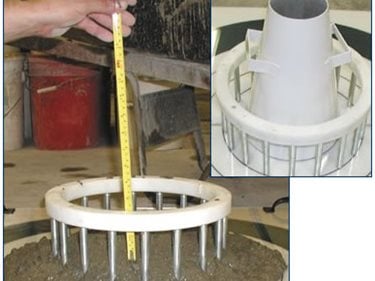
The J-Ring test measures the passing ability of the SCC through a rebar cage. ASTM
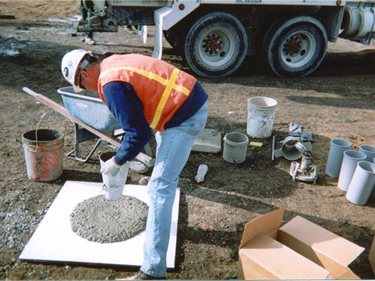
A slump flow test is often performed with the slum cone upside down. Bill Palmer
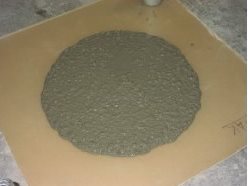
The T20 test measures viscosity by timing how many seconds it takes for the concrete to spread to 20 inches in diameter. Transportation Research Board
- Visual Stability Index (VSI)-This is a purely subjective test that is also described in ASTM C 1611. The technician observes the concrete as it spreads out in the slump flow test. A number from 0 to 3 is assigned-0 for no segregation to 3 for obvious segregation and paste separation (cement, water, and fines) from the concrete matrix. A VSI of 0 or 1 indicates a stable mix, while a 2 or 3 is unstable.
- Segregation probe-Not yet standardized, this test measures segregation by placing a thin wire ring atop the SCC and measuring how far it sinks into the concrete in two minutes. This test promises to provide a quantitative value for segregation potential.
ADDITIONAL SELF-CONSOLIDATING CONCRETE RESOURCES
A couple of places to visit for more information:
-
www.selfconsolidatingconcrete.org - this web site was established by the National Ready Mixed Concrete Association and has extensive information on SCC.
-
American Concrete Institute ( www.concrete.org)- ACI recently released ACI 237R-07 which combines the concrete industry's current knowledge on SCC.
RELATED:
Concrete Slump


