
- Staining Concrete
- Stamped Concrete
- Concrete Overlays
- Concrete Resurfacing
- Concrete Polishing
- Concrete Dyes
- Colored Concrete
- Indoor Concrete
- Concrete Floors
- Concrete Countertops
- Garage Floor Coatings
- Furniture, Sinks, Fire Bowls
- Basement Floors
- Outdoor Concrete
- Concrete Patios
- Concrete Driveways
- Concrete Pool Decks
- Outdoor Kitchens & Counters
- Outdoor Fireplace
- Concrete Walkways
- Concrete Pavers
- Concrete Walls
- Repair & Maintenance
- Foundation Repair
- Concrete Crack Repair
- Concrete Sealers
- Building with Concrete
- Concrete Homes
- Concrete Basements
- Decorative Concrete
FloorPix™- Changing the Flooring Picture
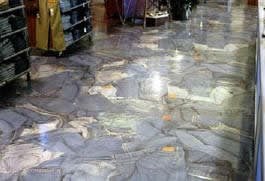
In very early times, people placed art on floors. Greco-Roman mosaics and frescoes on floors are classic examples. Now, in the 21st century, there is something entirely new—a patent-pending digital imagery revolution—FloorPix.
The initial project was creatively photographed images of blue jeans strewn randomly on the floor of Mr. B's Jean Store in Kalamazoo. Owner-Architect Gordon Julius brought the idea to Bill Rousos, an owner of Agio Imaging. Immediate experimentation began on small panels, trying different inks, fabrics and epoxies. "We had no idea of the chemical reactions. The component parts needed compatible chemistry. A process evolved —the idea worked!" said Rousos. They printed 8' by 10' blue jean images, which werelapped together and epoxied to the 3,000 sq. ft. floor. A major accomplishment according to Julius was marrying the large patterns so they did not appear tiled together.
About The Process
-
The Image: Agio Imaging can print as wide as 16 feet. Using solvent based inks that are permanent, a digital electronic file such as an e-mailed logo is enlarged and printed on perforated vinyl fabric to the design-spec size. Images submitted must have digital quality that allows enlargement. If you need an image supplied, Agio Imaging carries many from which to choose.
-
Floor Prep: Begin by preparing the concrete base. When applying toppings, a stable sub-strate is necessary. Concrete needs to be clean and open to create a good bond.
-
Primer: When the slab is clean, free of mastics or coatings of any kind, apply the first coat - a clear epoxy primer.
Epoxy: The primer coat must cure before applying the next coat, a troweled clear epoxy. -
Artwork: Into that second coat, place the artwork. The perforated vinyl allows the coatings to bond between layers - through the picture. Thus, a good bond forms between the layers of epoxy through mesh to concrete, which also allows gases to escape.
-
Completion: After the first two coats with the embedded image have cured, two to three additional coats of epoxy complete the process. There are approximately six to seven applications over the concrete slab.
FloorPix makes no recommendations for epoxies. However, Paul Sonderman, an epoxy manufacturer says, "The most durable and abrasion resistant epoxies are those that have 100 percent solids." The President of Polymerica in Carrolton, GA emphasizes his point: "You buy what you put down and end up with what you buy. If you want durable flooring for a warehouse or even autos, use good epoxy." Contractors should begin as Agio Imaging began: develop small samples in your warehouse. Try different conditions. Learn the timing needed between layers. Learn to place the fabric smoothly.
Endless PossibilitiesFloorPix offers a new decorative form to architects, interior designers and homeowners. Julius states that with the photography base, any kind of imagery is possible from realism to abstraction. He mentions "meadows, baseball diamonds and graphics." The limitation for the size of projects is yet unknown. Witha special vertical formula that prevents images from "crawling," they can be placed on walls. Use logos, graphics and photos on lobby entrances, showrooms, office buildings, and your own home...the list is endless."

Variations might include tinted primer, or tinting the clear topcoat. Finishes are available in gloss, matte or "orange-peel" to prevent slipping.
While the recommended application is over concrete, with micro-toppings and proper preparation and resin, the process could also work on a wood floor.
LimitationsThe recommended applications are indoors. UV rays outdoors are problematic. Inks have a limited life when exposed to sunlight and epoxies tend to yellow. There is UV block, but no guarantees as to its long-term effectiveness. A word of advice from Sonderman, "In areas of direct sunlight near windows or doors a light stable epoxy should be used for final coats." If there is a major problem along the way, a blast-track machine will handle the removal process.
Finding More InformationWith decorative flooring ever increasing, this new market gives contractors a cutting-edge addition to their repertoire. To learn more:
-
Call Gordon Julius of Julius Grill Architecture Site Design, Grand Rapids
at 616-742-2802. -
Call Bill Rousos of Agio Imaging in Kalamazoo at 800-982-4533.
-
Go to www.agioimaging.com.
The Agio Imaging website has many examples of installations as well as a crosscut of the layering needed from concrete floor, through imagery, and final epoxy clear-coats. -
Request a free kit on the website. It includes technical information for contractors, a sample of the proprietary FloorPix material - a printed image on vinyl mesh mat, price information, an electronic file guide and a marketing brochure.
-
Find information on epoxies at www.polymerica.com,
or call 800-762-1678.
Jeanne Fields is the owner of Fields Marketing, which provides marketing services for contractors and manufacturers in the decorative concrete industry.
Submit Your Own Project Photos
Learn more about logos and graphics in concrete


