
- Concrete Floor Information
- Concrete Floor Pictures
- Common Questions about Concrete Floors: Are they cold? Are they loud? Are they expensive?
- Popular Flooring Types: Kitchen floors, garage floors, basement floors and more
- Interior Floor Finishes: A comparison of finishing options available
- Concrete Floor Cost
- Concrete Floor Installation
- How to Clean Concrete Floors
- Concrete Floor Design Ideas: Get inspiration from floor installations across the country
- Concrete Floor Applications
- Staining Concrete Floors
- Painted Concrete Floors
- Stenciling Concrete Floors
- Polishing Concrete Floors
- Self-Leveling Concrete Overlays
- Related Information
- Concrete Products:
Concrete Stains | Concrete Overlays - Design Ideas: Concrete Floor Info
How to Fix Concrete Floors
Expert Tips on Concrete Floor IssuesPITTING ON POLISHED CONCRETE
Question:
My company was the contractor on a retail remodeling project that had an existing concrete floor requiring a grind and polish finish. We had to sawcut and remove portions of the floor for new underground mechanicals and then pour these sections back. Our job was to then grind and polish the entire floor to the level of gloss required. On the existing concrete areas, we had no problems. However we experienced problems from the start with the new concrete areas. The engineer involved with the project gave us a method of grinding that allowed us to achieve the correct sheen on gloss tests. Now less than six months later, these areas have failed miserably and the surface is visibly porous and is trapping dirt to the point where floor looks black in areas. The polishing contractor is claiming that this is a concrete finishing issue and the only way to take out the highs and lows of the concrete surface is to grind deep and expose the aggregate, but this would not be acceptable to the owner.
Part of me agrees with the polishing contractor, but during a preconstruction meeting with the polishing company and project engineer, concrete finishing was a non-issue, and the finish did pass initial gloss testing. There have also been some comments about how the store has maintained the floor and their use of chemicals to clean it, which may have caused the concrete finish to fail. Any input you could give us would be great. We are a large general contractor in the Midwest, but our experience in grinding and polishing concrete is limited and we are hoping that this is not going to turn into an expensive lesson.
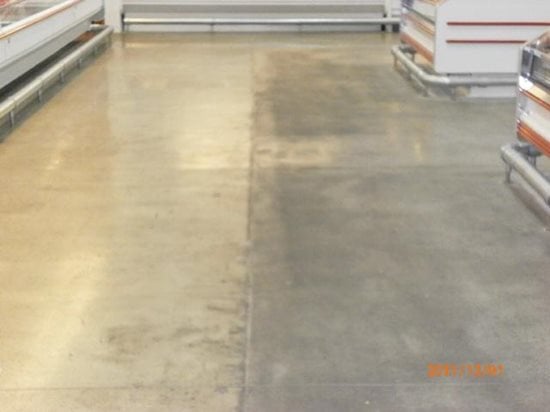
Polished concrete with a poor mix design or inadequate curing will suffer from premature pitting.
Answer:
Concrete, polished or not, should not pit and be weak on the surface. This usually indicates a mix design or curing issue. With situations like this involving many players, I like to go back to the start and focus on the key issue. In this case, the main issue seems to be that the replaced concrete sections are not holding gloss and polish because of surface deterioration that occurred soon after the floor was put into service - within the first six months.
From the details you have provided, it appears that the replacement sections of concrete are failing and soft, either due to substandard mix design and concrete placement or post-applied chemicals. Polished concrete needs to be properly chemically hardened during the polishing process. This increases the surface hardness and provides better gloss. Lithium or sodium silicate hardeners are most commonly used. If applied properly, these should harden the concrete to a point where soft pitting does not occur, unless the concrete was so substandard that it was really soft and weak to start with.
Related: Concrete Pitting
To zero in on what's causing the floor deterioration, the following questions need to be addressed:
- Is there anything different about the replacement areas in regard to mix design and how the concrete was placed and finished? Did the concrete freeze after placement? What you need to look for is anything that might have created a weak surface.
- What is the store using to clean the concrete? If a harsh cleaner is pitting the concrete, it would do it to some extent on all the concrete, not just the replacement sections.
In regard to the finish, it is probably one of the most critical parts of preparing the concrete when polishing. The concrete mix design, placement, finish, flatness, and curing are all critical. If you get a soft slab, you end up with what you are experiencing. As for the repair, you can regrind to go deeper and get rid of the pitting, but this ignores the real problem in hopes of a quick fix. If the concrete is weak, the new grind will last another six months and then you're right back to where you started. I suggest taking a core sample or performing a surface hardness test. Also, do some research on the hardener that was used and make sure it was applied correctly and at the right coverage rate.
EFFLORESCENCE ON A STAINED FLOOR SLAB
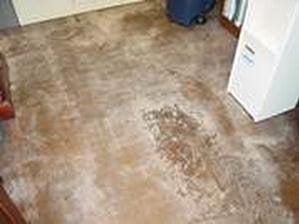
White efflorescence caused by high water movement pushing salts out of a concrete floor slab.
Question:
We have a stained concrete floor slab on grade in our Houston home. We have salts that our escaping and clouding the floor. During the three years we have lived in the house, our builder has tried various things to fix the floor. First, he tried redoing the stain and sealer, but the same discoloration happened. About six months ago, the builder removed the sealer and waxed the floor to allow it to breathe and the salts to rise through the floor. The salts are now easily wiped away, but the wax is wearing off, onto our socks, shoes, the dog's paws, etc. Can anything be done to salvage the floor? We have thought about tiling over it, but are any special preparations necessary, such as applying a thin-set mortar or a moisture barrier?
Answer:
It sounds like you have a chronic efflorescence problem. Efflorescence is a process where salts leach out of the concrete, carried by water, and end up on the surface as a white dusty residue. Since you have had this issue since you've lived in the home, it seems to be chronic and ongoing. Since water is the trigger, do you have a high water table, flood plain, or other situation that's causing water to get under your concrete foundation? Anything you can do to minimize water migration under your concrete will help. This would include installing French drains or possibly regrading the slope of your property.
No matter what you do, the efflorescence problem will need to be mitigated. Efflorescence will not only cause problems with a stained concrete floor, it can also delaminate tile and warp wood floors. The best approach would be to strip all the sealer and wax off the concrete. Once the sealer and wax are removed, a moisture test should be conducted so you can get an idea of how much water is moving through the slab. The test results will dictate your next step. If the water movement is low, a penetrating sealer designed to stop or slow efflorescence can be used. After the sealer is applied, you can reapply a stain or dye to the floor. If the water movement is high, a more drastic and aggressive topical waterproof coating may have to be used. If you then want to restain the floor, a cement and polymer topping would need to applied to create a new canvas on which to apply the stain. If you want to tile over the floor, the same water mitigation procedures would have to be completed.
ACCEPTABLE NUMBER OF CRACKS IN CONCRETE FLOOR
Question:
I am involved with the property committee of Saint Matthew Lutheran Church in Bel Air, Md. Since 2005, shortly after the stamped concrete floors of our new 750-seat sanctuary and 500-square-foot narthex were poured, there has been an ever increasing quantity of deep floor cracks. All of the floors are slab pours without expansion joints, but have saw cuts for alleged crack control. The cracks run both perpendicular and parallel to the saw cuts. There are also cracks running up to the audio and electrical boxes in the floor. No expansion joint material was wrapped around these metal boxes before the concrete was poured. In many areas, the cream is popping off of underlying large aggregate, and in other areas, pieces of the floor are starting to come out, which is causing a hazard for women wearing high heals. Unfortunately, the contractor went out of business shortly after project completion, and the general contractor has been less than sympathetic about the problem. Our committee has the following questions:
- What is an acceptable quantity of cracks, and should pieces of the floor come out?
- Is there any way to halt the seemingly never-ending growth of the cracks?
- What can we use to fill the cracks to minimize the dark moisture staining that is taking place along the surfaces adjacent to the cracks?
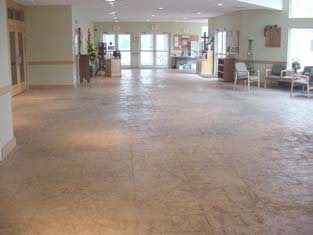

This concrete floor in Saint Matthew Lutheran Church is riddled with an unholy number of cracks,running both parallel and perpendicular to the joints. The likely causes are poor subbase preparation and joint location.
Answer:
All concrete cracks to some extent. While cracking is unavoidable, you can control where and how those cracks develop. This is where joints come into play. Both expansion joints and control joints are critical to concrete flatwork, but each type serves a different purpose. Expansion joints are designed to allow an entire slab to expand and contract without coming into contact with an adjacent slab, wall or structure. As you noted, a good place for an expansion joint or expansion material would have been around the electrical boxes and between slabs. Control joints are used to relieve the stress within a concrete slab. These joints, which may be formed with a jointer before the concrete sets or cut with a saw after the concrete hardens, are designed to "control" where the crack will occur by inducing the concrete to crack in the location of the joint. The placement and number of these joints are critical. (See Be Active in Deciding Where Control Joints Will Be Placed). It appears from your photos that the floors are saw cut in a square or tile grid pattern. If so, there seem to be plenty of control joints present, meaning the issue is not a lack of control joints, but rather their location in the slab.
Regarding your question of what number of cracks is considered acceptable, there are no hard-and-fast standards that I'm aware of. In all the cases I've been involved with, it comes down to floor size, perception and safety. On a floor comprised of thousands or tens of thousands of square feet of concrete flatwork, a few cracks are to be expected and are generally deemed acceptable. When the number becomes unacceptable is the gray area. Non-structural surface cracks are not as critical and pose only an aesthetic issue, so they are usually tolerated in larger numbers than structural cracks. The cracks in your floor appear to be structural, running through the depth of the slab and starting to come apart in certain areas. Aside from the number of cracks, their severity leads me to believe they are beyond what I would consider acceptable for a floor of this type.
Methods for stopping the formation of additional cracks are limited. If the subbase is jeopardized or was not prepared properly, no number of control joints will limit the cracking. It will continue to occur until the slab has come into equilibrium with the base on which it rests and the stress causing the cracks has been alleviated. Sawing additional control joints in places where there may not be enough of them is about the only solution. Consider having a concrete engineer inspect the floor and determine if additional joints are warranted and where they should be placed.
There are a number of remedies for repairing cracks in concrete floors. The technology has come a long way in terms of crack repair polymers and injection systems. Today, you can inject cracks with a resin (epoxy, polyurethane or polyurea) that will actually attain a strength greater than most typical concrete slabs (see Epoxies vs. Polyurethanes for Crack Repair). This means that the repaired crack will actually be stronger than the surrounding area. These repair systems are usually injected into the crack after cleaning and crack chasing (routing out the crack with a saw or angle grinder), and they cure in 12 to 24 hours. Some color choices are available, but aesthetics are usually not the most important factor. Another option is to fill the cracks with a concrete caulk, which is usually made of a softer resin material. These products are applied to the crack or joint with a caulk gun and are available in a wide range of colors. Because this type of repair is more visible than crack injection, aesthetics are very important. (For sources, visit Concrete Repair Products.)
I suggest that you start monitoring some of the cracks in the floors to see if they continue to move or remain static. If they are still moving or growing in length or width, crack injection may be the best solution. If they are static, a crack filler is best. The crumbling pieces of concrete may need to be removed, or they can be glued back into place with either system, depending on the size and depth of the pieces.
In the areas of the floor where you say "the cream is popping off," this is likely to be spalling or scaling. On interior concrete slabs, this is usually caused by overfinishing or excess water in the concrete, resulting in a weak surface. The cracking is probably causing an already weak surface to come off.
I believe that the cracks in your floor are caused by poor subbase preparation or some major movement or deficiency under the slab. If the proper amount of reinforcement was used, the concrete should hold together, despite the cracks, and not separate or heave. Ask your builder to provide documents showing how the subbase was prepared, the type of concrete poured, slab thickness, and the amount and type of metal reinforcement. I think you have a pretty strong case that installation deficiencies caused the problems with your floors. The fact that the contractor who installed the concrete is out of business also does not give me a lot of confidence in the quality of the work.
TERRAZZO CONCRETE FLOOR CONTROL JOINTS
Question:
Does the concrete slab for a terrazzo floor require control joints? Typically we pour a monolithic concrete floor, but then we get minor alligator cracking. We usually cover this with a bridging membrane and finish material.
Answer:
Control joints (also called contraction joints) are always recommended in concrete slabs to reduce random cracking. (See Joints in Concrete Slabs.)The bridging membrane is good, but if the slab develops major cracks down the road, they might telegraph through to the surface. I always look at control joints as cheap insurance.
TAPE MARKS ON CONCRETE FLOORS
Question:
I have a question about an integrally colored concrete floor that a subcontractor poured for me. The pigment was added to the concrete at the ready-mix plant, and the contractor added no additional water to the concrete at the jobsite or while finishing the slab. About two months after the floor was installed, we had the interior of the house painted, and the painting contractor covered the concrete floor with sheets of paper, using painter's tape to hold them in place. When he pulled up the tape a week later, after he finished his painting, it took off the top surface of the concrete down to sand and stone. What caused the surface to come off with the tape, and can anything be done to fix the floor? The tape marks are about an inch wide.
Answer:
The reason the tape pulled the surface up is because of plasticizer migration. Plasticizers are polymers that make glue, plastic and rubber flexible. In the case of tape, plasticizers are used to allow the glue to migrate into anything porous, like concrete. Most often I see situations where the tape pulls up the concrete sealer and stain, but every so often it can pull up the concrete surface as well. When painter's tape pulls off concrete, it's typically because the concrete mix contained too much water or the concrete was overfinished. Concrete strength is directly related to the water content when placed and finished. The more water you have, the weaker the concrete surface. Since the water was added at the ready-mix plant under controlled conditions, it's more likely that your concrete was overfinished. If concrete is worked too much with a trowel, too much water and cement paste are brought to the surface, producing a weak top layer that is often soft and dusty. Try performing a cross-hatch test to see how the surface holds. This test is often used to test sealers for adhesion to concrete, but it will also work on the concrete surface itself. (See How to Test Sealers for Adhesion.)
To treat concrete with a weak or soft surface, apply a concrete densifier or hardener. These types of sealers contain sodium or lithium salts that chemically reinforce the concrete surface and further solidify the crystalline network that makes up the "glue" in concrete. In the areas where the tape removed the surface paste, you can apply a microtopping (see Concrete Overlays) or a patch material colored to match the existing finish.
WAX FINISH SCRATCHES EASILY
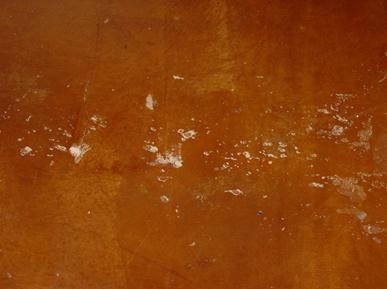
Scratches on a soft wax coating
Question:
Our contractor and decorative concrete subcontractor have installed a beautiful concrete floor colored with a brown stain and protected by a water-based epoxy sealer and a wax finish. We are having issues with the wax scratching and need to know how to maintain the look. From the first day we were able to walk on the floor, we've been getting marks and scratches from shoes (heel marks, not scuffs), foot and dog prints (from bare feet and dog paws -- not nail scratches), empty boxes that were set on the floor and scooted a few feet, and a soft push broom. We have tried several floor cleaners (most recommended by the installer) and soap and water. The dirt comes right up, but the tracks and scratches from any object that comes in contact with the floor remain.
I know the wax is a Johnson product, and the floors were not buffed. Our contractors have tried both a matte and high-gloss finish. The high-gloss wax makes the scratches more apparent. We were told we should rewax yearly, but have not been able to remove the scratches or prints since the floor was waxed the first time a month or so ago and then again a few weeks later. Recently, one area was covered with a high-gloss wax. We waited two days to walk on it, and within minutes scratches and prints that will not come up were present. I've been told that it is too late to have the concrete polished because of the color application. I also understand that the finish is a sacrificial coating to avoid scratching the sealer. However, the wax scratches so easily on the dark color that the floor always looks like it needs to be cleaned, even after it is freshly mopped.
The floor is gorgeous, except for the scratches and prints. Can we apply a durable urethane that will not scratch or show prints so easily? We are so frustrated that we are considering a different floor material altogether.
Answer:
Floor wax is actually a generic term for a special type of finish coating that is a blend of acrylic and wax. As a general rule, these finishes should not scratch under normal daily use, but they are not immune to wear over time. The questions then become:
- What type of daily wear are the floors seeing?
- How long before the scratches appear?
- What type of wax product are you using?
- How are you maintaining the wax?
You mention getting both scratches and scuffs. These are two very different issues. A scratch is a physical indentation in the coating surface, and a scuff is where another material is left behind on the coating surface (such as a black mark from a shoe). From your description, it sounds like you have a wax hardness issue. Waxes are softer than coatings, but they are designed to handle the traffic you describe.
Is the Johnson product specifically designed to go over a coating on a concrete floor? Does it state that it needs to be burnished? The heat generated by high-speed burnishing is sometimes needed to harden the wax. Check the instructions on the product to see if they mention the need to burnish or buff the wax to finish it off. Also, try buffing a small area of the floor with an angle grinder and a buffing pad, like you would use to wax a car. If this solves the issue, you know you need to have the floor burnished.
Not all waxes are alike. You may want to try a higher-grade finish, such as a commercial grade of wax designed to go over concrete coatings. You can purchase this at a janitorial supply store, and you want something that would be used over a polyurethane coating in a school or hospital. You should be able to apply the wax right over the existing wax. It may take three to five coats, but in the end you should get a nice smooth, hard finish. Test in a small area first.
Lastly, you can strip off the wax and just live with the epoxy sealer as your walking surface. Not a great approach, but better then what you have now. I feel confident you can solve this by using the right wax. Commercial-grade products designed for concrete floors are pretty fool-proof.
REPAIR TIPS FOR PEELING CONCRETE PAINT
Question:
I painted the concrete floors in my kitchen with a concrete paint purchased from a local hardware store. I primed the concrete before painting. The problem is the paint won't stay and it chips very easily. Would applying a topcoat to seal the paint help? Also, I'd like to paint some designs on the concrete floor because it seems a little plain.
Answer:
Your problem indicates that the concrete was not porous enough to accept the primer or paint - a very common issue when painting concrete. Sealing the painted surface may help, but it does nothing to fix the real problem, which is poor adhesion between the paint and the concrete. Because a kitchen is a high-traffic area, the paint will continue to fail in short order, even with a sealer.
I recommend stripping off all the paint, and preparing the concrete properly. (See Concrete Surface Preparation.) Then you can apply a stain, tint or dye that penetrates into the concrete. You can use stencils or faux finish techniques to create designs. Finally, seal your work with a good sealer, followed by a finish wax designed for stained concrete floors.
RELATED:
Concrete Stain Peeling Off


