
- Concrete Homes Home
- Concrete Homes Pictures
- Do Concrete Homes Cost More?
- Optimizing the Energy Efficiency of an ICF Home
- Design Ideas for Concrete Homes
- Related Information
- Hurricane-Proof Homes
- Building Concrete Safe Rooms
- Going Green with Concrete: An Overview of Concrete's Eco-Friendly Benefits
- Tilt-Up Concrete Construction
- Building a Concrete Basement
- Other Resources
- Concrete Home Infographic
- Free Brochures
- Concrete Contractors: Find Concrete Form Products and Suppliers
Section Sponsor

Concrete Homes
Concrete Safe Rooms & Storm Shelters
How to design and build a concrete safe room that protects you and your family during severe tornadoes and hurricanes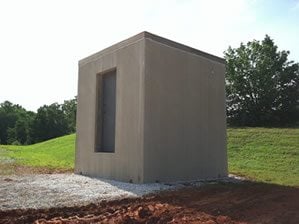
A concrete safe room stands ready for a home to be built around it.
Superior Walls of East Tennessee in Rock Island, TN.
Thirteen minutes. That’s all the time you have on average to seek shelter after a tornado warning is issued. If you’re at home when the warning comes, staying put will give you the best odds of survival. And those odds will increase substantially if you a have safe place in your home to ride out the storm.
For people living in wood-frame homes without basements, that “safe” place often ends up being an interior room, such as a closet or bathroom, with no windows. But in a powerful tornado or hurricane packing winds of more than 250 miles per hour, even well-constructed frame houses can be lifted right off their foundations, and large debris can turn into airborne missiles. During such extreme conditions, one of the safest places you can be is in a storm shelter, or safe room, constructed of reinforced concrete or concrete block with no windows and a concrete floor or roof system overhead.
That’s why more and more people, especially homeowners living in tornado-prone areas, are building concrete safe rooms in new and existing homes. When constructed according to approved plans, these windowless, heavily reinforced structures can withstand winds exceeding 250 mph and projectiles traveling at 100 mph or greater, protecting occupants from Mother Nature’s worst wrath.
Building a concrete safe room is not an inexpensive proposition, especially if you are adding one to an existing home. But it’s impossible to put a value on a structure that will give you peace of mind and could save your life. Here are a few factors to consider before building a concrete safe room as well as guidelines and resources for safe room construction.
WHAT IS A SAFE ROOM?
A safe room is a small, windowless chamber specifically designed and constructed to meet Federal Emergency Management Association guidelines, which are outlined in the publication Taking Shelter from the Storm: Building a Safe Room for Your Home or Small Business (FEMA P-320).
These structures are built to provide “near-absolute protection” for the occupants during extreme windstorms by meeting the following criteria:
- They are adequately anchored to the home’s foundation to resist overturning and uplift.
- The connections between all parts of the safe room are strong enough to resist failure during high winds.
- The walls, roof, and door are designed to resist perforation by windborne missiles.
- The walls of the safe room are completely separate from the structure of the home, so they will remain standing even if portions of the home around it are destroyed.
Safe room walls and roofs can be built using a variety of materials including reinforced concrete, reinforced concrete masonry or combinations of wood frame and steel sheathing or concrete masonry infill. The doors are typically made of high-gauge steel tested to resist high wind forces and perforation by windborne debris.
WHAT IS THE COST OF INSTALLING A SAFE ROOM?
Costs for safe room construction vary across the United States. The cost for constructing an 8- by 8-foot safe room that can double as a closet, bathroom, or utility room inside a new home ranges from approximately $6,600 to $8,700 (in 2011 dollars), according to FEMA. A larger 14- by 14-foot safe room runs from about $12,000 to $14,300.
The main factors that influence the cost of a concrete safe room include:
- The size
- The location of the safe room within the home
- The number of exterior home walls used in the construction of the safe room
- The type of door used
- The type of foundation on which the safe room is constructed
The cost of retrofitting an existing home to add a safe room will vary with the size of the home and its construction type. In general, safe room costs for existing homes will be approximately 20% higher than those in new homes. See this safe room cost calculator from HighWindSafeRooms.org for average remodeling costs for 8- by 8-foot and 14- by 14-foot units made of concrete, concrete block and ICFs.
Some communities offer incentives for owners who wish to build a safe room or shelter, including reduced property taxes. You may also be able to obtain FEMA funding to construct a safe room. For project eligibility, contact your State Hazard Mitigation Officer, who can advise you on what information to provide to be considered for funding. Some state and local governments have engaged in grant programs with the federal government to partially subsidize the construction of safe rooms.
Taking Shelter From the Storm: Building a Safe Room Inside Your House, from FEMA
WHY BUILD A SAFE ROOM USING CONCRETE?
By far, the biggest danger to people and property during tornadoes and hurricanes is the flying debris carried by the high winds. Any heavy windborne object can become a missile that can easily penetrate building walls.
To duplicate the effects of windborne debris, researchers at Texas Tech University’s Wind Engineering Research Center shot wall sections with 15-pound 2x4 lumber to simulate debris carried in a 250 mph wind. These conditions cover all but the most severe tornadoes. They tested 4x4-foot sections of concrete block, several types of insulating concrete forms, steel studs, and wood studs to rate their performance. The wall sections were finished as they would be in a completed home, with drywall, fiberglass batt insulation, plywood sheathing, and exterior finishes of vinyl siding, clay brick, or stucco. All the concrete wall systems survived the tests with no structural damage. Lightweight steel and wood-stud walls, however, offered little or no resistance to the test missiles. (You can download the complete Texas Tech report in PDF format.)
You can build concrete safe rooms that withstand such impacts using a variety of methods: cast-in-place concrete, concrete blocks, 4- and 6-inch flat ICF walls, and 6-inch waffle grid ICF walls. Basic safe room designs for all these building types can be found in the FEMA publication Taking Shelter From the Storm, which is available for download on the FEMA website.
In addition to extreme wind events, concrete safe rooms can provide protection from other disasters, including earthquakes, fires, and blast forces. See Disaster Resistance Benefits of Concrete, from the Portland Cement Association.
CONCRETE STORM SHELTER CONSTRUCTION TYPES
There are a number of ways to construct concrete saferooms. The three most common methods are with ICFs, concrete masonry and conventionally cast concrete.
Basic saferoom design with concrete blocks, traditionally cast concrete, and for 4- and 6-inch flat ICF walls and 6-inch waffle grid ICF walls may be found in the FEMA publication Taking Shelter From the Storm: Building A Safe Room Inside Your House, which includes construction plans, materials, and construction cost estimates. It's available from FEMA at no charge by calling toll free (800) 480-2520.
For additional information on ICF safe rooms contact Polysteel at (800) 977-3676 or Lite-Form International at (800) 551-3313.
Insulated concrete forms (ICFs)
ICFs are basically forms for poured concrete walls that stay in place as a permanent part of the wall assembly. Made of foam insulation or other insulating material, they come in two basic configurations: pre-formed interlocking blocks into which the concrete is poured, and as individual panels with plastic connectors that form cavities into which the concrete is poured. All major ICF systems are engineer-designed, code-accepted, and field-proven.
To further help homebuilders and homeowners build economical safe rooms for new and existing homes, the Portland Cement Association, American Polysteel, and Lite-Form International worked together to develop safe room plans specifically for insulating concrete forms (ICFs).
Up until now, the Federal Emergency Management Agency's (FEMA) guide for safe room construction included plans for conventionally cast concrete safe rooms and reinforced concrete masonry safe rooms. The new plans include details for 4- and 6-inch flat ICF walls and 6-inch waffle grid ICF walls.
Read more about this project here and view project photos.
For more information about ICFs, click here
Concrete masonry
Concrete blocks are another quick, relatively simple method for building a saferoom. Water repellant can now be mixed into the block at the plant, and additional sealer and flashing applied on-site. Foam insulation is used as a moisture repellant, while lightweight metal brackets allow space for wiring and plumbing.
Concrete masonry can be used in new construction, on existing homes, and in stand-alone saferooms.
The Federal Emergency Management Agency's (FEMA) guide for safe room construction included plans for conventionally cast concrete safe rooms and reinforced concrete masonry safe rooms. The new plans include details for 4- and 6-inch flat ICF walls and 6-inch waffle grid ICF walls.
The FEMA publication Taking Shelter From the Storm: Building A Safe Room Inside Your House, includes construction plans, materials, and construction cost estimates. It's available from FEMA at no charge by calling toll free (800) 480-2520.
Conventionally cast concrete
Conventionally cast concrete structures are built with re-usable aluminum or plywood forms to form walls and foundations.
The process is very quick, as all walls can be poured at the same time, with door and window openings cast at the time the walls are poured. Steel reinforcing bar is typically used to strengthen the wall. Some systems even use cast-in-place floors and ceilings. These saferooms may be built in existing homes, new homes or as stand-alone rooms.
Basic saferoom design with concrete blocks, traditionally cast concrete, and for 4- and 6-inch flat ICF walls and 6-inch waffle grid ICF walls may be found in the FEMA publication Taking Shelter From the Storm: Building A Safe Room Inside Your House, which includes construction plans, materials, and construction cost estimates.
It's available from FEMA at no charge by calling toll free (800) 480-2520.
ASSESSING YOUR RISK: DO YOU NEED A SAFE ROOM?
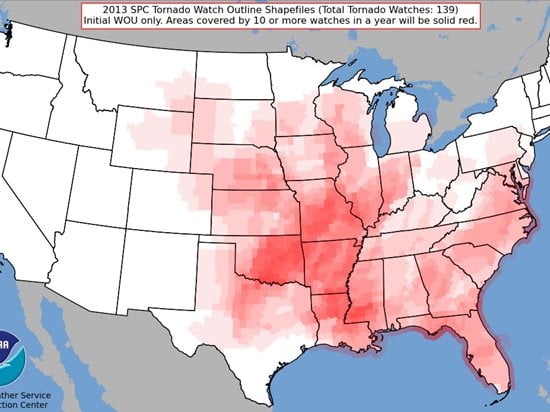
This map from NOAA / National Weather Service shows 2013 tornado watches across the country.
Do you live in a high-risk area? According to the National Oceanic and Atmospheric Administration, tornadoes have been documented in every U.S. state and on nearly every continent. However, some parts of the country, such as the zones in “tornado alley,” are much more prone to tornadoes than others. If you live in the hurricane-susceptible Gulf and Atlantic states, you are exposed to a potential double-whammy, since the severe weather from hurricane conditions often spawns tornadoes.
See NOAA's national map of average tornado activity to see the average number of tornado occurrences in your state. Also visit the National Storm Damage Center’s severe weather risks page.
What code design winds is your home built to withstand? Most homes are built in accordance with local building codes that consider the effects of minimum, code-approved wind impacts in your area. In most tornado-prone regions, the building code design wind event is 90 mph. So simply living in a home built to code doesn’t mean you are protected from the winds and windborne debris generated by an extreme tornado or hurricane. Even a Category 1 hurricane (at the lowest end of the Saffir-Simpson Hurricane Wind Scale) can have winds as high as 95 mph, and a relatively minor EF 1 tornado can unleash winds exceeding 100 mph.
Saffir-Simpson Hurricane Wind Scale
| Category | Wind Speed | Possible Damage |
|---|---|---|
| 1 | 74-95 mph | Some damage |
| 2 | 96-110 mph | Extensive damage |
| 3 | 111-129 mph | Devastating damage |
| 4 | 130-156 mph | Catastrophic damage |
| 5 | 157+ mph | Catastrophic damage |
Related: Basic Overview of Tornados & Hurricanes
WHERE TO LOCATE A CONCRETE SAFE ROOM
A safe room can be incorporated into the construction of a new home, or it can be retrofitted into an existing one. In-ground and basement safe rooms provide the highest level of protection. If there is no basement, an in-ground safe room can be installed beneath a concrete slab-on-grade foundation or concrete garage floor. A safe room can also be located in a central, interior, ground-floor area of the home if built according to FEMA guidelines. For tornado-prone areas, you should locate your safe room so that you can reach it as quickly as possible from all parts of your home.
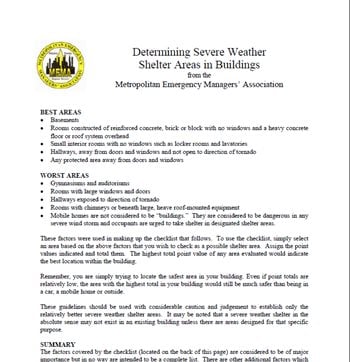
Download a checklist for determining severe weather shelter areas in buildings from the Metropolitan Emergency Managers’ Association (PDF format).
Possible safe room locations in a home on a slab-on-grade or crawlspace foundation include the following spaces on the first floor:
- Bathroom
- Closet
- Storage room
- Laundry room
- Corner of the garage
Possible safe room locations in a basement include:
- A corner of the basement, preferably where the basement walls are below ground level
- A bathroom, closet, or other interior room in the basement
- As a freestanding addition to the basement
Note that if your house is located in an area prone to flooding or storm surges, or if someone living in your home is handicapped or physically challenged, the basement may not be a suitable location for a safe room.
SAFE ROOMS VS. CONCRETE HOMES
Instead of building a safe room, it is possible to build a tornado-resistant concrete home, but it is unlikely to provide the same level of protection as a concrete safe room unless the connections of the structural elements are capable of withstanding 250-mph wind pressures and the windows, entry doors, and garage doors can resist the impact of debris propelled by high winds.
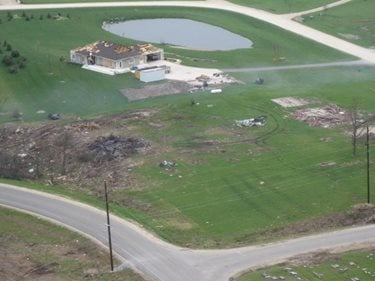 A home built using insulated concrete forms stood strong through a tornado in Parkersburg, IA, while nearby structures were leveled.
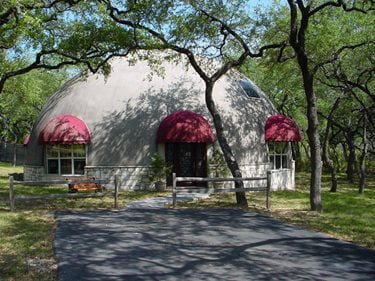 A monolithic home, such as this one near San Antonio, TX, is nearly disaster-resistant.
Debris impact resistance of walls and even roofs can be achieved using ICF construction, however the connections for long-span roofs and tall walls to transfer the loads induced by a 250-mph wind must be 7½ times stronger than those routinely required by today’s codes. Then there is the issue of how to protect the door and window openings. Realistically, it is more practical to build your home with strong wind-resistant connections (wind clips, anchor bolts and proper nailing of wall and roof diaphragms) and include a safe room shelter within the home.
Having a well-constructed concrete house with wind-resistant features will certainly minimize the damage in strong winds. Many of these features are easier and less expensive to implement at the time of construction. For more information about storm shelter construction, see Texas Tech University's Storm Shelter FAQs.
Monolithic dome homes, which are made of steel-reinforced concrete and foam insulation, have proven especially strong in tornadoes and hurricanes. Because of their sturdy concrete construction and dome shape, some of these structures have been built to meet FEMA standards for near-absolute protection from tornadoes and hurricanes. For more information, visit the Monolthic Dome Institute.
Where to find design criteria and building plans for safe rooms and concrete homes
Safe room construction plans and specifications (FEMA)
Stronger than the Storm (PCA)
Plans and designs for monolithic dome homes (Monolithic Dome Institute)
Safe room and concrete home testimonials
Family Rides Out Sandy in ICF Home
Safe Room Case Studies (FEMA)
Monolithic Dome Home Testimonials (Monolithic Dome Institute)
SAFEROOM FINANCING
There has long been an emphasis on reducing loss of life and injury during major storm events in the United States. Today, many governmental and non-governmental bodies are realizing that saferooms provide a means of doing this in a logical and economical fashion. This has been shown by the availability of financing programs designed to reduce the financial burden on property owners wishing to have saferooms installed.
FHA Financing
The U.S. Department of Housing and Urban Development (HUD) now provides mortgage insurance that enables homebuyers to borrow up to $5,000 to create saferooms in their homes. Recognizing that storm shelters will save lives and prevent injuries when tornadoes and hurricanes strike, HUD is making it possible for more families to place these shelters in their homes.
The mortgage insurance will be provided by the Federal Housing Administration (FHA), which is part of HUD. Rather than making mortgage loans directly, FHA insures loans made by private lenders to homebuyers.
FHA insurance guarantees a lender timely payment of principal and interest, in the event a homebuyer defaults on a loan. As a result, HUD's new initiative will enable a lender to loan a homebuyer up to $5,000 more than the amount needed to buy a home, with the extra money used to pay for the cost of installing a windstorm shelter.
Designs for the saferooms financed with FHA-insured first mortgages must follow guidelines developed by the FEMA, with the cooperation of the Wind Research Center of Texas Tech University.
SBA Disaster Loans
Homeowners who receive a disaster assistance loan from the U.S. Small Business Administration (SBA) to repair or rebuild a damaged or destroyed home may use some of the loan proceeds to construct a safe room. The SBA can also increase the approved disaster loan by up to 20 percent to cover the cost of adding a safe room.
Here is a link to SBA information
PERFORMANCE CRITERIA FOR SAFEROOMS
The following link is the "National Performance Criteria for Tornado Shelters", by the Federal Emergency Management Agency (FEMA).
Shelters constructed to these performance criteria are expected to withstand the effects of the high winds and debris generated by tornadoes such that all occupants of the shelter during a tornado will be protected without injury. These performance criteria are to be used by design professionals, shelter manufacturers, building officials, and emergency management officials to ensure that shelters constructed in accordance with these criteria provide a consistently high level of protection.
Some of the items covered:
- Resistance to Loads from Wind Pressure for Shelters
- Windborne Missile Impact Resistance On Shelter Walls and Ceiling
- Shelter Access Doors and Door Frames
- Shelter Ventilation
- Emergency Lighting
- Shelter Sizing
- Shelter Accessibility
- Emergency Management Considerations for Shelters
- Additional Requirements for Below Grade Shelters
- Multi-hazard Mitigation Issues
- Construction Plans and Specifications
- Quality Control
- Obtaining Necessary Permits
Get the "National Performance Criteria for Tornado Shelters" here
HOMES WITH BASEMENTS
Shelters should be built in the basement of a new home that is going to have a basement.
In new construction
The most economical basement saferoom is a lean-to built in the corner of the basement utilizing two existing basement walls because it requires fewer materials and the least amount of labor than other types of basement saferoom construction.
However, if you do use existing basement walls, they will have to be specially reinforced, since typical reinforcement in basement walls will not provide sufficient protection. During new home construction, the builder can reinforce the walls near the shelter.
Separate reinforced ceilings on the basement saferoom are a necessity to prevent falling debris from penetrating the rooms envelope. First floors of the typical home are not strong enough to serve as the ceiling of a basement saferoom.
Basic saferoom design with concrete blocks, traditionally cast concrete, and for 4- and 6-inch flat ICF walls and 6-inch waffle grid ICF walls may be found in the FEMA publication Taking Shelter From the Storm: Building A Safe Room Inside Your House, which includes construction plans, materials, and construction cost estimates. It's available from FEMA at no charge by calling toll free (800) 480-2520.
Existing homes with basements
In most cases, it will be more practical to purchase an in ground shelter or a shelter that attaches to the house.
HOMES BUILT SLAB-ON-GRADE
Homes built on a concrete slab that is installed on compacted or natural soil are said to be built "slab-on-grade." Most such concrete slabs are reinforced with steel that helps prevent cracking and bending.
In new home construction:
When building a new slab-on-grade house that will contain a concrete or masonry saferoom, the slab must be made thicker where the shelter will be built in order to serve as a footing for the shelter walls, and to provide structural support.
Basic saferoom design with concrete blocks, traditionally cast concrete, and for 4- and 6-inch flat ICF walls and 6-inch waffle grid ICF walls may be found in the FEMA publication Taking Shelter From the Storm: Building A Safe Room Inside Your House, which includes construction plans, materials, and construction cost estimates. It's available from FEMA at no charge by calling toll free (800) 480-2520.
In existing home construction:
Building a saferoom in an existing slab-on-grade house requires the removal of a part of the slab and replacing it with a thickened slab if a concrete or masonry block shelter is built. Since this is usually impractical, an alternative would be a properly designed and constructed wood-frame saferoom built with plywood and steel on wood studs.
In this type of construction, the shelter walls and ceiling structure must be isolated from the surrounding house structure. Layers of plywood and heavy gauge sheet metal are installed on the wall side selected for retrofit. This method requires anchorage of wall sill plates to the slab and the walls to the new ceiling joists installed below the existing ceiling.
In most cases, it will be more practical to purchase an in ground shelter or a shelter that attaches to the house.
HOMES WITH CRAWLSPACES
A house built on a crawlspace usually has a floor constructed of wood framing supported by the exterior foundation walls. Crawlspace foundation walls may be concrete, but are usually constructed of concrete masonry.
With these types of home, serious consideration should be given to building the saferoom as a separate, exterior slab-on-grade structure adjacent to the homes exterior, with access provided through a door installed in the wall. This is because in a home with a crawlspace, the saferoom must not only have its own floor, but its walls and ceiling must also be separate from the framing of the house. In other words, it must be a completely self-contained structure. This makes it more difficult to build inside the home than either the home with a basement, or a slab-on-grade home.
Basic saferoom design with concrete blocks, traditionally cast concrete, and for 4- and 6-inch flat ICF walls and 6-inch waffle grid ICF walls may be found in the FEMA publication Taking Shelter From the Storm: Building A Safe Room Inside Your House, which includes construction plans, materials, and construction cost estimates. It's available from FEMA at no charge by calling toll free (800) 480-2520.
In existing homes with crawl spaces:
In many cases, it will be more practical to purchase an in ground shelter or a shelter that attaches to the house.
MISSILE-RESISTANT DOORS
With an envelope of reinforced concrete, it becomes obvious the one weak link in an otherwise almost impermeable saferoom would be the entranceway, or door.
A number of doors have been developed to withstand tornado or hurricane-force winds as well as the wind-driven missiles found during such events. These doors can be either built on-site or bought through a supplier.
The site-built door is comprised of two thicknesses of 3/4-inch plywood glued together and covered on the outside with 11-gauge sheet steel. The door must be supported on both sides and is best mounted in a pocket inside the shelter and used only when the room is occupied as a shelter.
The manufactured door consists of a hollow door with 14- to 20-gauge metal skins. Metal doors can be purchased from most home improvement centers. The 16- and 20-gauge doors must be strengthened with a single layer of 14-gauge steel on one side of the door. Solid core wood doors in a hollow metal frame will also work if an 11-gauge steel sheet is attached to the door.
Precast shelters that are installed underground or attach to a home come with their own doors as part of the system.


