

Types of Concrete Admixtures
What is air-entrained concrete and why is it important in decorative work? Here’s all you need to know.Concrete admixtures are used to improve the behavior of concrete under a variety of conditions and are of two main types: Chemical and Mineral.
CHEMICAL ADMIXTURES
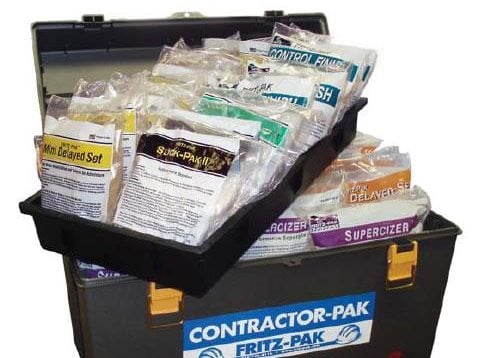
Fritz-Pak Corporation in Dallas, TX
Chemical admixtures reduce the cost of construction, modify properties of hardened concrete, ensure quality of concrete during mixing/transporting/placing/curing, and overcome certain emergencies during concrete operations.
Chemical admixtures are used to improve the quality of concrete during mixing, transporting, placement and curing. They fall into the following categories:
- air entrainers
- water reducers
- set retarders
- set accelerators
- superplasticizers
- specialty admixtures: which include corrosion inhibitors, shrinkage control, alkali-silica reactivity inhibitors, and coloring.
Find Manufacturers: Shop Admixtures
MINERAL ADMIXTURES
Mineral admixtures make mixtures more economical, reduce permeability, increase strength, and influence other concrete properties.
Mineral admixtures affect the nature of the hardened concrete through hydraulic or pozzolanic activity. Pozzolans are cementitious materials and include natural pozzolans (such as the volcanic ash used in Roman concrete), fly ash and silica fume.
They can be used with Portland cement, or blended cement either individually or in combinations.
ASTM Categories - Concrete Admixtures
ASTM C494 specifies the requirements for seven chemical admixture types. They are:
- Type A: Water-reducing admixtures
- Type B: Retarding admixtures
- Type C: Accelerating admixtures
- Type D: Water-reducing and retarding admixtures
- Type E: Water-reducing and accelerating admixtures
- Type F: Water-reducing, high range admixtures
- Type G: Water-reducing, high range, and retarding admixtures
Note: Changes occur in the admixture industry faster than the ASTM consensus process. Shrinkage Reducing Admixtures (SRA) and Mid-Range Water Reducers (MRWD) are two areas for which no ASTM C494-98 specifications currently exist.
 NCA (Non-Chloride Accelerator)
All weather admixture
NCA (Non-Chloride Accelerator)
All weather admixture
 Rescue-Pak
Contains six of our most effective admixtures
Rescue-Pak
Contains six of our most effective admixtures
 Standard Delayed Set
Dry Powdered Admixture
Standard Delayed Set
Dry Powdered Admixture
WHAT SPECIAL PERFORMANCE DO YOU NEED?

Understanding Spalled Concrete
Time: 06:08
Watch this easy-to-understand explanation of what causes concrete spalling, from concrete expert Chris Sullivan.
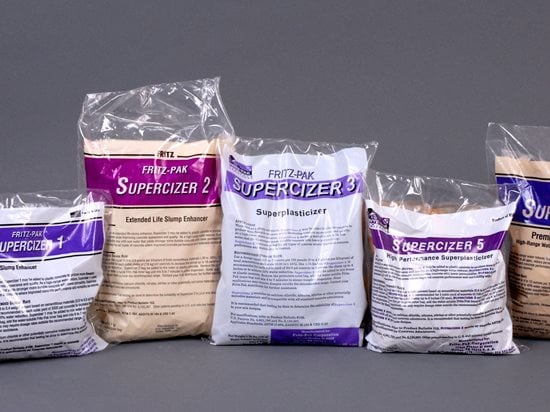
Fritz-Pak Corporation in Dallas, TX
Protect Against Freeze Thaw Cycles Improve Durability
Air entrainment is particularly effective in providing resistance to freeze-thaw cycles. When the moisture in concrete freezes, these air cells relieve internal pressure by providing microscopic chambers for the expansion of water as it freezes.
Some air entraining mixtures contain a catalyst for more rapid and complete hydration of portland cement.
To protect concrete from damage during freezing, bubbles must have the proper size, distribution and volume. ASTM C 260 specifies requirements for air entraining admixtures.
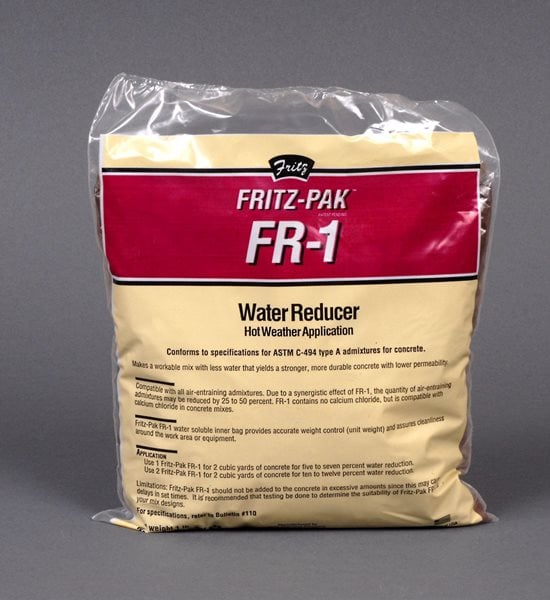
Fritz-Pak Corporation in Dallas, TX
Benefits of air-entrainment include:
- Improved resistance of concrete to severe frost action or freeze/thaw cycles
- High resistance to cycles of wetting and drying
- High degree of workability
- High degree of durability
Dosage: Typical air entrainment ranges from 5% to 8% of the volume of concrete.
Water Reduction in the Mix
Water reducers have become so important in concrete, that they could be considered the "fifth" ingredient.
They can be used to: (1) increase slump, (2) lower the water-cement ratio, or (3) reduce cement content.
Water reducers come as Low Range, Mid Range, and High Range Superplasticizers. There are enough different admixtures available that it is possible to select one that meets the need of a particular project whether it is tall columns that need a mix that pumps easily, or an easy-to-finish durable floor slab.
In general, they provide the required slump with less water in the mix, and may provide higher strength concrete without increasing the amount of cement.
Conventional water reducers
Are required to achieve a minimum 5% water reduction. A conventional water reducer can reduce slump by about 1 to 2 inches without the addition of water.
Mid-Range water reducers
Can reduce water content by at least 8% and as much as 15%. They tend to be stable over a wider range of temperatures and tend to give more consistent setting times. These reducers work most effectively in mixes designed to have a slump in the range of 4 to 5 inches.
-
Particularly useful in hot weather concreting by counteracting the accelerating effect of high ambient and concrete temperatures
-
Slow the setting rate of concrete
-
Delay initial set of concrete
-
Keep concrete workable during placement
High-Range water reducers (superplasticizers)
Can reduce water content from 12% to as much as 40% and are typically used in concretes designed to have slumps of 8 to 11 inches. They can be used to either increase slump (by 4 to 8 inches) or lower the water content of hot weather concrete mixes. Used to increase flowability. You can also read frequently asked questions about superplastisizers on the Fritz-Pak website.
Related: Concrete Slump
High Strength Concrete
Admixtures containing microsilica (condensed silica fume) are used to meet high strength and low permeability requirements.
Benefits include reduced permeability, increased compressive and flexural strengths, and increased durability.
Applications include high-strength structural columns, less permeable parking garage decks, and abrasion resistant hydraulic structures.
Silica fume can be used in concrete to produce compressive strengths approaching 20,000 psi under jobsite conditions. This admixture can be added in a slurry or in a dry form, whichever meets the batching equipment needs. In either case, performance is the same.
Strength Enhancement
Concrete strength enhancement can be achieved through use of superplasticizer admixtures to produce a low water/cement ratio giving high performance concrete.
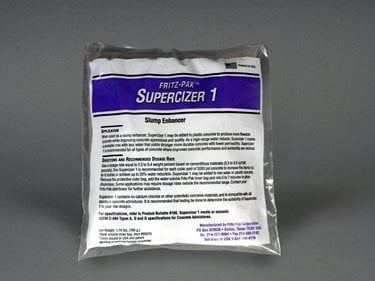 Fritz-Pak Corporation in Dallas, TX
 Fritz-Pak Corporation in Dallas, TX
These admixtures promote a high slump, extremely flowable concrete that achieves high strengths while providing superior workability and pumpability.
High range water-reducing admixtures can also be used for precast/prestressed structures where it is desirable to keep the water/cement ratio to a minimum for low permeability and high early strengths without set retardation.They are also used for concrete requiring high-early stripping strengths.
Fly Ash - Making Concrete Stronger, More Durable, and Easier to Work With
Derived from burning coal, fly ash is a valuable additive that makes concrete stronger, more durable and easier to work with.
Fly ash aids the formation of cementitious compounds to enhance the strength, impermeability and durability of concrete.
Two main classes of fly ash are used in concrete, Class F, and Class C.
Class F
Reduces bleeding and segregation in plastic concrete. In hardened concrete, increases ultimate strength, reduces drying shrinkage and permeability, lowers heat of hydration and reduces creep.
Class C
Provides unique self-hardening characteristics and improves permeability. Especially useful in pre-stressed concrete and other applications where high early strengths are required. Also useful in soil stabilization.
Silica Fume: Early Strength and Reduced Permeability
Silica fume can make a significant contribution to early-age strength of concrete. One pound of silica fume produces about the same amount of heat as a pound of portland cement, and yields about three to five times as much compressive strength.
Silica fume improves concrete in two ways the basic pozzolanic reaction, and a microfiller effect. Addition of silica fume improves bonding within the concrete and helps reduce permeability, it also combines with the calcium hydroxide produced in the hydration of portland cement to improve concrete durability.
As a microfiller, the extreme fineness of the silica fume allows it to fill the microscopic voids between cement particles.This greatly reduces permeability and improves the paste-to-aggregate bond of the resulting concrete compared to conventional concrete.
For further information on microsilica and its benefits visit:
Dosage:
| 8% to 15% | by weight of cement but as an addition not replacement |
| 8% to 10% | High durability / Low permeability such as bridge decks or parking structures |
| 10% to 15% | High strength structural columns |
| 10% max | Flatwork |
The amount required is related to silica fume dosage and the water-cementitious materials ratio. Silica fume is cementitious, but typically is added to and not replacing the existing portland cement.
Tip: The higher percentage of silica fume used, the higher the amount of super plasticizer needed - but mix can become "sticky". Consider replacing about 1/3 of the super plasticizer with a mid-range water reducer to improve workability
Uses:
- Reduces concrete permeability
- Increases concrete strength
- Improves resistance to corrosion
Concrete Admixtures that Control CrackingReducing Drying or Shrinkage Cracking
Hydrated cement paste shrinks as it loses moisture from its extremely small pores. As the moisture is lost in these small pores, the surface tension of the remaining water tends to pull the pores together which results in a loss of volume over time.
Shrinkage reducing admixtures (SRAs) are designed to decrease the effects of drying shrinkage by reducing the surface tension in these pores.
It should be noted that the type of aggregate and the cement properties themselves can influence the amount of cracking that can occur. Thus, it is important to test local project-specific materials if doing shrinkage testing.
Curing also affects cracking. In slabs, the top tends to dry out first and shrinks while the lower sections still have a higher moisture content. This difference in moisture can be altered by use of Shrinkage Reducing Admixtures, which alter the way water migrates through the concrete and results in a more uniform moisture profile.
Corrosion Protection
Reinforced concrete that is exposed to deicing salts and marine environments is particularly susceptible to chloride-induced corrosion.
A well-designed, durable, low permeability concrete mix will provide some protection against chloride-induced corrosion of reinforcement.
Corrosion inhibitors can be effective in parking structures, bridges and marine environments. Other ways of reducing corrosion are to use penetrating surface sealers to help prevent chloride penetration, epoxy-coated rebar, or silica fume in the mix. Silica fume can increase durability and reduce permeability.
Non-chloride containing set accelerator admixtures are available which conform to ASTM C 494 Type C.
Calcium chloride has been used in the past because it is relatively inexpensive and provides set acceleration and early strength development. However, the corrosive effects of the chloride have been observed as much as 20 years after the concrete was poured. Thus, non-chloride containing admixtures have been developed for use where potential corrosion of embedded or stressed steel must be avoided.
As with all other admixtures, manufacturers instructions for its use in conjunction with other admixtures and dosage must be followed to be effective.
Set Acceleration
Fritz-Pak Corporation in Dallas, TX
Set accelerators work by accelerating cement hydration, which results in shortened setting times and increased early age strengths, particularly in cooler temperatures.
They increase the rate of early strength development and reduce time required for curing and protection
At one time, calcium chloride was the predominant accelerating admixture. However, it is now considered by many to be a main contributor to long-term concrete problems. In Europe, use of calcium chloride is banned for some applications. Chloride is considered to contribute to corrosion of reinforcement or embedded metal in concrete. In turn this corrosion has been associated with spalling, cracking, loss of bond and if left uncorrected can cause eventual failure of the element involved.
Now, chloride-free set accelerators are available based upon other chemicals. Some of these newer admixtures also can act as ASTM C494 Type E water-reducers.
Set Retardation
Fritz-Pak Corporation in Dallas, TX
Set retarders are used where delay in setting time is required to ensure sufficient placement, vibration or compaction time.
Set retarders permit application of higher temperature curing of precast/prestressed concrete without negatively affecting the ultimate strength.
Applications:
- Long hauls
- Trucks waiting a long time - even for a small pour
- Undermanned placement crew
- Slow pour rate
- Stamping concrete in warm weather
Things to consider:
Project location - long or short haul
- Size of pour
- Rate of pour
- Placement method
Environment exterior, interior
Thick sections - (if dry windy conditions, early surface drying while the underlying concrete is still soft can make finishing difficult and result in a wavy or cracked surface
When a set retarder may not be required
- Short hauls with quick placement
- Cool moist interior location
- Residential or commercial basement
- Fast pour rate
Flowability
Superplasticizers (High-Range Water Reducers) can make a low-to-normal slump concrete into a high-slump flowing concrete which can be placed with little or no vibration. However, the change in slump usually lasts only about 30 to 60 minutes depending upon the brand and dosage rate.
High-range water reducers fall into either ASTM C494 Type F or Type G classification. In either case, they can be used to produce very high slumps without segregation, an ideal situation where increased flowability is necessary due to congested reinforcement.
Other applications and benefits of high-range water reducers include:
- difficult wall placements
- narrow forms
- sections with blockouts, penetrations, or embedded items
- pumping high vertical distances
- fast placement of concrete
- increased lift heights and free fall distances
Note: The increased thinness of the concrete mix means that forms should be tight to prevent leakage even through small joints which can result in fins and discoloration.
Type F superplasticizers
Added at the job site and keep concrete flowable for a short period of time. At some point, the concrete will lose slump quickly.
Type G superplasticizers
Can be added either during batching or at the job site. This admixture will delay setting, but cause the concrete to be flowable for a longer period of time which could delay finishing. If haul times are particularly long, Type G can be added at the plant. However, if delivery is delayed too long, the effects can be diminished. Redosing is possible to regain the plasticity of the mix and manufacturers recommendations should be followed closely.
Fritz-Pak Corporation in Dallas, TX
Finishing Enhancers
Mid-range water-reducing admixtures can be used as finishing enhancers for concrete -particularly in commercial and residential flatwork and formed concrete applications.
MRWRs produce less permeable, more durable concrete and concrete with significantly early and ultimate compressive strengths.
Cold Weather Concreting Note
A drop of 20o F can double the time it takes concrete to set. ASTM C494 Type C accelerators or a Type F combination of accelerators and water reducers may be the solution.
Hot Weather Concreting Note
As a general rule, each 10o F increase in ambient temperature reduces slump about 1". A 30o F increase in mix temperature can cut setting time in half, increase water requirements, and reduce the 28-day compressive strength as much as 25%.
A switch from ASTM C494 Type A to Type D water reducing and set retarding mix may be part of an effective plan for hot-weather concreting.
Produce a Fluid Backfill Which Flows Easily and is Self Leveling
Controlled low strength material (CLSM)
This material provides a fluid backfill which flows easily and is self-leveling.
While it costs more than a dry granular material, it does not need to be placed in lifts, spread, and compacted after each lift.
It is a fluid mixture made of portland cement, water, fine aggregate and/or fly ash and can include an admixture to improve flowability, lower densities, eliminate segregation and settlement, and control strength development in applications where future excavation is required.
Typical 28-day compressive strengths are 50 to 200 psi and densities range from 115 to 145 pcf.


