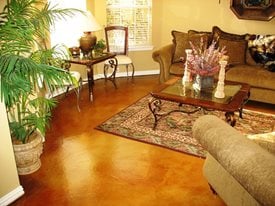
Residential Concrete Floors - Questions About Concrete Floors in Homes
Is a decorative concrete floor right for you? Here, we answer your questions to help you make an informed decision. By Anne Balogh, The Concrete Network Updated April 6, 2020
When people are first introduced to the beauty of decorative concrete flooring, they are initially "floored" by its good looks (sorry, the pun was too tempting to pass up). However, once that love-at-first-sight reaction fades, it's often followed by skepticism about the practicality of concrete flooring, especially in a home environment. Many homeowners will ask: Beyond its aesthetic attributes, is concrete really a flooring material I can live with for the long term?
To help you decide, here are answers to common questions about concrete floor benefits, appearance, performance, and maintenance.
In its plainest form, it’s simply the concrete slab underneath your carpet, tile, wood, or other flooring. Uncovering and finishing that surface with stains, polishing, epoxy, or other decorative finish is what makes it a flooring choice suitable for showing off.
Are concrete floors cold and damp?
Concrete can be cold, but no more so than ceramic tile or natural stone flooring. Plus, it’s possible to warm up concrete floors by embedding radiant heating elements in them or by designing your home to maximize the amount of sunlight coming through windows in winter, allowing concrete floors to absorb and radiate the heat.
Concrete floors won’t become damp unless they aren't insulated properly or the slab is built on a poorly drained subgrade. Today's building codes typically require installation of a vapor barrier under concrete slabs to block moisture migration. (see Choosing a Vapor Barrier).
Are concrete floors hard on the feet?
Concrete is hard and won't cushion or "give" under bare feet. But concrete's hardness is also what contributes to its durability and abrasion resistance. You can help cushion it with area rugs, which are easier to clean than wall-to-wall carpet. While concrete may be hard, it's not abrasive to the feet, especially if it's polished or has a smooth finish.
Watch These How-To Videos
Are Concrete Floors Cold?
Time: 01:25 View all concrete floor videos
Are Concrete Floors Hard?
Time: 01:26 Get ideas on where to install concrete flooring.
How Long Does Concrete Flooring Last? Time: 01:28 Find out how long concrete floors last.
Are concrete floors slippery?
As with other hard flooring surfaces such as laminate, marble or ceramic tile floors, concrete floors can become slippery when wet. Applying a high-gloss sealer may also reduce traction somewhat, but that's easily remedied by mixing a non-slip additive into the stain or sealer before application (see Making Concrete Slip Resistant). When kept clean and dry, polished concrete floors are generally no slicker than plain concrete surfaces, and tend to be less slippery than waxed linoleum or polished marble (see Can Polished Concrete Be Slippery?).
Do concrete floors look too industrial?
Certainly plain, unadulterated gray concrete can be perceived as sterile and "industrial." However, anyone who has seen a concrete floor enriched by a brown or earth-toned stain knows that concrete can be made to look warm and inviting. In fact, brown is the most popular color choice for concrete floors. See for yourself: Brown Concrete Floors - A Look at Why This Concrete Floor Color Is So Popular.
Are concrete floors loud?
Concrete floors can be loud and produce an echo effect, but no more so than ceramic tile, natural stone flooring, and some hardwood or bamboo floors. You can muffle the echo effect by using sound-absorptive materials in the room, such as area rugs, curtains, pillows and wall fabrics.
Look to Your Surroundings Time: 01:01 Find beautiful design inspiration for concrete flooring.
ARE CONCRETE FLOORS DURABLE?
Concrete floors are extremely durable, simply due to concrete’s inherent strength and hardness. A properly installed and sealed decorative floor is also scratch and stain resistant and will last for decades.
Are concrete floors prone to cracking?
The most common objection to concrete floors is the potential for cracking. However, some people actually love the rustic, organic look achieved by staining and leaving minor random cracks exposed (see Polishing and Dye Enhance Cracks in Existing Floor). If cracks are perceived as an eyesore, microtoppings can hide them under a smooth, new surface that can accept a wide array of decorative treatments, including staining, stamping, and stenciling. Learn more about what you can do with decorative concrete overlays.
A properly applied sealer will not only prolong the life of your floor, but also enhance its appearance. Sealers also protect the decorative treatments from abrasions and stains. Learn more: Concrete Floor Sealer Information.
Is decorative concrete flooring maintenance free?
While concrete floors are relatively easy to maintain, compared with other types of floor surfaces, they aren't completely maintenance free. How much maintenance your floor will need largely depends on the amount of traffic it receives. The maintenance needs of a residential floor will be much different than those for a floor in a high-traffic commercial or retail environment.
In most cases, residential floors experience light foot traffic, and a simple cleaning regimen of occasional sweeping and damp mopping will keep concrete floors looking like new for many years. Protecting concrete floors with a good sealer and a coat of floor finish or wax will make them even more resistant to stains, chemicals and abrasion. In areas of heavy traffic, such as entrances and foyers, you can reduce maintenance and wear and tear by using floor mats, both inside and outside of the entryways.
Few flooring materials are friendlier to pets and their owners than concrete. From being scratch-resistant to easy to clean, concrete is one of the most pet-friendly flooring materials. Find out more about pets and concrete floors in Six Reasons Why Concrete Floors are Pet Friendly.
ARE DECORATIVE CONCRETE FLOORS EXPENSIVE?
When compared with high-end floor coverings, such as slate and marble, decorative concrete is often an economical alternative. Plus, skilled concrete artisans can duplicate the look of these pricier materials. The life expectancy of a concrete floor will also far surpass that of low- to mid-priced floor coverings, such as carpeting, vinyl tile, and wood laminates. That means that you’ll save money in the long run because you won’t need to rip out and replace worn or damaged flooring. See this overview of the average costs for installing basic to high-end decorative concrete floors.
Will they increase the value of my home?
The durability, lower maintenance requirements, and longer lifespan of concrete versus other flooring materials also adds to its ultimate value. If you’re planning on selling your home, there is no way to predict what future buyers will want for flooring. Concrete floors can be left as is or easily covered with carpet, tile, hardwood or laminate flooring-with no added expense of removing the existing flooring.
WHAT CAN I DO WITH CONCRETE FLOORS?
There are many options for decorative concrete flooring, including stains, dyes, polishing, stencils, saw cuts, and epoxy or metallic coatings. There really aren’t any limits to the design possibilities.
Standard paints aren’t designed for long-term use on concrete surfaces and may chip, peel, or bubble. Concrete stains and dyes are absorbed into the surface or react chemically with the concrete to provide long-lasting color.
Yes, concrete floors can be installed upstairs if your support beams and bearing walls will support the weightmdash;a professional engineer can determine this for you. If the area is large, you may need some reinforcement.
DIY: Can I transform my floors myself?
Although there may be tutorials available on many decorative concrete flooring applications, such as how to stain or polish floors, most of these projects are best left to the pros. For instance, stains are permanent so mistakes are permanent as well, surface prep and finishing of overlays must be done meticulously for good results, and if polishing equipment isn't used properly it can leave permanent marks in your flooring. For more, see Applying Concrete Stain: Is it a DIY Project?. Get more information on your flooring project from a local contractor near you.
Can I pour concrete over a wood floor?
There are overlays or microtoppings that can be applied over wood, tile, or even vinyl flooring with proper surface preparation.