
- Staining Concrete
- Stamped Concrete
- Concrete Overlays
- Concrete Resurfacing
- Concrete Polishing
- Concrete Dyes
- Colored Concrete
- Indoor Concrete
- Concrete Floors
- Concrete Countertops
- Garage Floor Coatings
- Furniture, Sinks, Fire Bowls
- Basement Floors
- Outdoor Concrete
- Concrete Patios
- Concrete Driveways
- Concrete Pool Decks
- Outdoor Kitchens & Counters
- Outdoor Fireplace
- Concrete Walkways
- Concrete Pavers
- Concrete Walls
- Repair & Maintenance
- Foundation Repair
- Concrete Crack Repair
- Concrete Sealers
- Building with Concrete
- Concrete Homes
- Concrete Basements
- Decorative Concrete
- Fire Resistant
Concrete History Timeline - Full Linear Version

3000 BC-Egyptian Pyramids
The Egyptians were using early forms of concrete over 5000 years ago to build pyramids. They mixed mud and straw to form bricks and used gypsum and lime to make mortars.
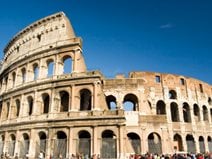
300 BC - 476 AD-Roman Architecture
The ancient Romans used a material that is remarkably close to modern cement to build many of their architectural marvels, such as the Colosseum, and the Pantheon. The Romans also used animal products in their cement as an early form of admixtures.

1824-Portland Cement Invented
Joseph Aspdin of England is credited with the invention of modern portland cement. He named his cement portland, after a rock quary that produced very strong stone. Photo courtesy of Concrete Thinking.

1836-Cement Testing
The first test of tensile and compressive strength took place in Germany. Photo courtesy of Portland Cement Association.
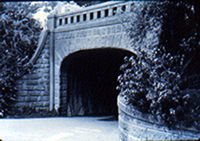
1889- Alvord Lake Bridge
The first concrete reinforced bridge was built in San Francisco. Alvord Lake Bridge still exists today, over two hundred years after it was built! Photo coutesy of Portland Cement Association.
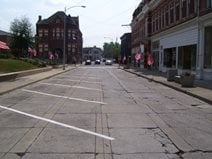
1891- Concrete Street
The first American concrete street was built in Bellefontaine, Ohio. This is a modern photo of the historic street. Photo courtesy of www.waymarking.com.
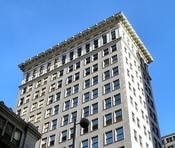
1903-The Ingalls Building
The first concrete high rise was built in Cincinnati, Ohio. The Ingalls Building has sixteen stories and was a great engineering feat of its time. Photo courtesy of Emporis Buildings.
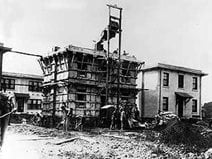
1908-Concrete Homes
Thomas Edison designed and built the first concrete homes in Union, New Jersey. These homes still exist today. Photo courtesy of flyingmoose.org.
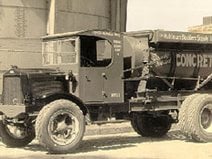
1913-Ready Mix
The first load of ready mix was delivered in Baltimore, Maryland. Photo courtesy of Kuhlman Corp.
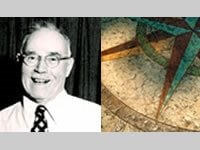
1915-Colored Concrete
Lynn Mason Scofield founded L.M. Scofield, the first company to produce color for concrete. Their products included color hardeners, colorwax integral color, sealers, and chemical stains. Photo courtesy of www.concreteconstruction.net.

1930-Air Entraining Agents
Air entraining agents were used for the first time in cement to resist against damage from freezing and thawing.
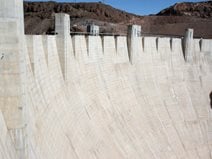
1936-Hoover Dam
The Hoover Dam was built along the Colorado River, bordering Arizona and Nevada. It was the largest scale concrete project ever completed.

1938-Concrete Overlay
John Crossfield was the first to receive a patent for a concrete overlay. He add latex to portland cement, aggregate, and other materials to make a covering for ship decks. Photo on right of modern concrete overlay, courtesy of Milagro Custom Flooring Solutions, LLC.
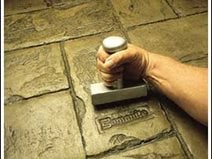
1950's-Decorative Concrete
Brad Bowman developed the Bomanite process, the original cast-in-place, colored, textured and imprinted architectural concrete paving, in the middle 1950's in Monterey, California. (Courtesy of bomanite.com).
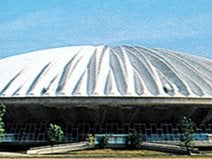
1967-Concrete Sports Dome
The first concrete domed sports arena, known as the Assembly Hall, was built at the University of Illinois.

1970's-Fiber Reinforcement
Fiber reinforcement was introduced as a way to strengthen concrete.

1980's-Concrete Countertops
Buddy Rhodes, the father of the concrete countertop, cast his first countertop in the mid '80s. Around the same time, Fu-Tung Cheng also cast his first concrete countertop. (Photo courtesy of Cheng Design.)
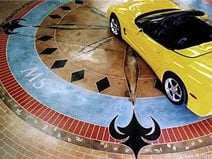
1990-Concrete Engraving
Darrel Adamson desined the Engrave-A-Crete ® System.

1992-Tallest Concrete Building
The tallest reinforced concrete building was built in Chicago, Illinois. The 65-story building is known only by its street address, 311 South Wacker Drive.
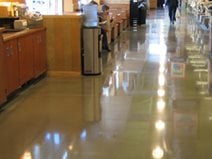
1999-Polished Concrete
The first installation of a polished concrete floor in the US was a 40,000-square-foot warehouse floor for the Bellagio in Las Vegas. (Photo courtesy of HTC-America.)


