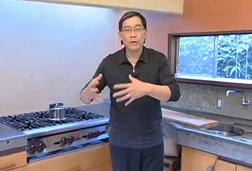
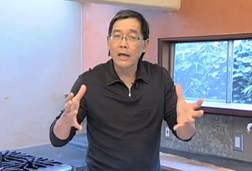
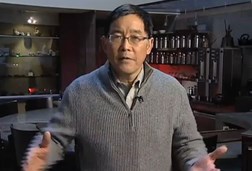
Watch 16 how-to concrete videos about designing with concrete. Award-winning designer and renowned trainer, Fu-Tung Cheng explains how to incorporate lighting, texture, shape and more into creating functional and appealing concrete applications. Fu-Tung Cheng is the founder of CHENG Concrete, a concrete countertop contracting company, and CHENG Design, a residential and commercial design firm. He is also author of the books Concrete Countertops and Concrete at Home.
Designing Functional Concrete Countertops
Time: 03:10
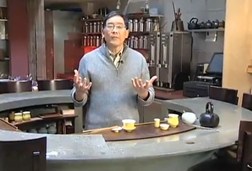
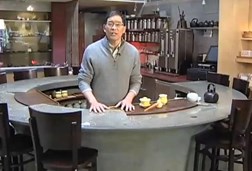
Designer Fu-Tung Cheng's Teance Tea Shop in Berkeley, Calif. is a unique example of how decorative concrete can be incorporated into a commercial setting that calls for great aesthetics and functionality. One of the biggest aspects of good design is form and function and how the two are linked together.
Cheng's design is not just to be unique or different, though it often is. Each element or material he uses serves a functional purpose. At the Teance Tea Shop, the bar is shaped to match a tea cup. This curved shape is not only aesthetically pleasing, but also provides space for patron's knees when they are sitting at the tea bar.
When clients are sampling tea at the bar, hot water is poured over all the tea vessels to keep them warm, a classic Chinese tradition. This produces a lot of water runoff. Cheng devised a copper plate under which a drain captures all the runoff water. The copper drain board serves two practical purposes: One, it hides the drain from visual sight. Two, the copper plate protects the concrete surface from damaging blows from tea pots.
Understanding the Durability of Concrete Counters
Time: 03:58
Award-winning designer, Fu-Tung Cheng, shows us one of his projects, the Teance Tea Shop in Berkeley, Calif. This shop incorporated a great deal of decorative concrete and design. Durability is a key component of good design.
Concrete has its strengths and its weaknesses. Understanding this during the initial design phase of a project is important. At the tea bar, there is an area that gets heavy use and wear from water, cup, and tea pots. This is not an optimal place to have exposed concrete. Cheng chose to cover the concrete with a copper plate that protects the concrete and takes the initial punishment from the hot water.
It is also important to consider the finish of your concrete countertop surfaces. A polished concrete countertop surface with lots of aggregate exposed will show less wearing. Whereas, a smooth finished countertop will show scratching and wear much sooner.
One question that is often asked is whether or not concrete countertops are durable enough for a commercial environment. Fu Tung's response is, "Yes, they most certainly are." One of the concrete countertops in the tea shop that is used for cleanup and hot water making was used at trade shows by a large kitchen appliance manufacturer for over 10 years. This countertop traveled the country on display, in trucks, getting beat up. It has held up very well.
Be aware of the certain characteristics of concrete that fit with a particular situation. For example, using concrete in an area that has heavy use, constant water flowing over it, harsh soaps, in kitchen sinks would not be optimal. To get around some of the weaknesses in concrete consider lining it with stone, stainless steel, copper or granite. Take a look at the what the space, sink, etc. will be used for before you decide on installing concrete countertops in that particular space.
Using Concrete to Design for an Experience
Time: 02:57
Decorative concrete and good design go hand in hand. Design is one of the most valuable tools from the beginning to end of a project. In the Teance Tea Shop in Berkeley, Calif., award winning kitchen and home designer, Fu-Tung Cheng shows the tea bar he designed and built.
Concrete is used here to bring out the ideas of texture and touch because in designing Cheng is looking to enhance the emotional response that people feel then they experience concrete. Here Cheng uses several design features to create a tactile experience when people sit at the tea bar.
The tea bar has electric heating elements embedded in the concrete countertop. In the winter, people approach the tea bar and feel its warmth. Cheng uses the warmth to communicate with customers. The heat is welcoming and soothing. The concrete countertops radiate warmth and good will.
In the summertime the countertops are cool to the touch. They are refreshing. Customers react to the cool countertops with a relaxing, "Ahh." Iced tea that is served reinforces the coolness of the concrete.
Inlays of stone and fossils are also used to create texture. Customers are able to feel the rough edges of stone or a smooth fossil while they are drinking their tea and conversing at the tea bar. In the shelving, the bug holes in the concrete countertop surface are still present to create a more natural looking finish. All of these design features complement each other to create a dynamic user experience.
Kitchen Countertop Design Ideas Using Concrete
Time: 04:18
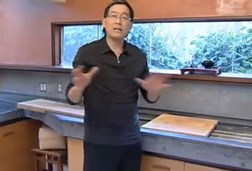
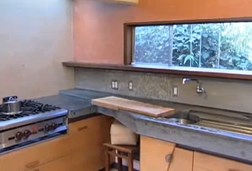
Fu-Tung Cheng, award-winning designer and author of Concrete Countertops, shows the first concrete countertops he designed and built in his own home 25 years ago. Cheng began the design of these concrete countertops by first thinking about how they are used.
Cheng was cooking at children's camps, on ships, and at a few restaurants which led him to thinking about making a very practical countertop. At the time, he could not afford even formica countertops so he found a material that was durable, inexpensive, and could be molded into a very unique surface. Concrete was the material of choice.
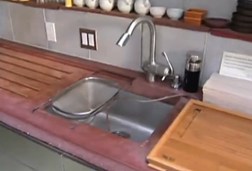
From the germination of this idea, he then thought about creating a laboratory sink where cooking ingredients or spilled soup, for example, could simply be brushed into the sink. The food preparation sink is separated from the clean-up sink by a sloping drain board and cutting board area. A second sloping drain board is incorporated into the concrete surface next to the main sink. Reliefs in the concrete countertop surface serve practical uses. Chopping boards can be placed into these reliefs, slide from one end of the sink to another, and allow the chef to sweep chopped food into a bowl over the sink as opposed to over the floor.
Two sinks and chopping boards are incorporated into the design so two chefs can use the space at the same time without rubbing elbows. Another design idea Cheng uses is metal trivet strips to protect the concrete counters from pots and pans. The countertop has aged and still has a timeless quality. People want to touch it and feel the character that has developed over the concrete countertop's 25-year life.
Personalizing Concrete Countertops
Time: 03:16
Fu-Tung Cheng, award-winning designer and author of Concrete Countertops, shows why concrete countertops are so appealing. He shows us his home in Berkeley, Calif. where he designed and built his first concrete countertop over 25 years ago.
One of the key reasons why people choose concrete for their home, kitchen or bathroom is the idea of customization and personalization. Not only can you personalize the countertop surface for function, like adding a unique cutting board, but you can embed personal items in the counter.
You are able to embed items that delight you and make you smile or bring back great memories. Fu-Tung embedded Chinese divinity coins in the countertop as well as Brazilian blue slate. He also integrated family items that people interact with and which gives the countertop a personality.
Integrating Concrete Counters with Other Materials
Time: 03:47
Award-winning kitchen designer, Fu-Tung Cheng, takes us into the home he designed, built and still lives in to show us how good design and concrete countertops merge when you use many types of materials.
Cheng likens concrete to a timeless material especially when it is used to sculpt practical landscapes in the concrete countertop. These designs are referred to a landscape because there are elevation changes and subtle changes to the surface in depth and length and thickness.
Using concrete in this sculptural way for concrete countertops allows you to selectively place the concrete where it works best. Concrete shouldn't be used everywhere in a kitchen. It's essential that the practicalities of concrete (i.e. being able to form it to any shape and personalize it) and the vulnerabilities of concrete (i.e. wear in sinks or around a stove or range) are understood during the design process.
Where concrete countertops fall short or may be weaker consider using a more durable material like granite. Using both concrete and granite sparingly highlights the best features of each material. This also helps create interest in the kitchen design by avoiding too much granite or too much concrete.
Each material that is used adds a practical as well as an aesthetic element to the overall kitchen design. For example, the rough slate backsplash contrasts well with the smoothness of the concrete countertop. The black granite tiles are shiny and have distinct grout lines. There is a wood shelf below the window. These materials are all blended with the concrete, which acts as the anchor for these parts.
Consider also using stainless steel around a stove. Butting the steel up to the stove and the concrete countertop serves two purposes. One, it protects the concrete from cooking oils. And two, it makes the concrete look warm because steel is a colder material.
Think about the practical aspects of concrete as well as aesthetics when selecting materials for a kitchen.
Why Choose Concrete Countertops
Time: 03:25
One of the most frequent and important questions asked about concrete countertops is why use concrete in a kitchen or in a home. Concrete is often thought of as a material used strictly for building retaining walls, subfloors and the like. This is not the case.
Award-winning home and kitchen designer, Fu-Tung Cheng shows why concrete is a perfect material for use in any kitchen. As an example, at Cheng's home, which he designed and built 25 years ago, you can see the original concrete countertop that was installed. The form and function of the countertop blend together seamlessly. The main reason for this was that using concrete as the finished material allowed for complete freedom in the design and construction process.
Depth and thickness can be created in the front apron of the countertops. This stands in contrast to the typical one inch thick slab nature of granite. With concrete you are able to show off the mass of the material.
Practically speaking, adding depth and thickness to the countertop surface allows for the creation of landscapes in the surface area. This includes the addition of drain board reliefs, cutting board reliefs, or areas for potted plants.
Concrete is an ideal material for countertops, benches, vanities, bathroom countertops, or fireplaces. This material allows for customization and creation of unique surfaces.
Vulnerabilities & Durability of Concrete Countertops
Time: 04:36
Award-winning designer, Fu-Tung Cheng, invites us into his home to learn more about the vulnerabilities and durability of concrete countertops. He explains how to design around the inherent weaknesses of concrete and design to its strengths.
Concrete is a strong material yet over time it will erode with water constantly flowing over it. For this reason, using integral concrete sinks are not recommended. In the kitchen, Cheng uses stainless steel under-mount sinks. The countertop in Cheng's home was designed and built over 25 years ago, and still looks beautiful. But if you focus in around the drain board, you will notice the aggregates are exposed as the concrete paste wears down.
One main reason for using undermount stainless steel or porcelain sinks is that they can take the harsh wear of pots and pans, soaps, and detergents. In addition, integral sinks are very hard to restore should the concrete begin to erode.
When you consider where in the kitchen to put concrete, either as a homeowner, designer, or contractor think about how the space will be used. High use zones with a lot of oils, such as around stoves, is probably not the best place for concrete. However, in Fu-Tung's home these unsealed concrete countertops have aged with the home. The oils that have leeched into the concrete around the stove give the countertops life. They keep changing and maturing as the family does and the house does.
Using a variety of building materials in your kitchen can create a dynamic and extremely functional environment for a family to live, cook and enjoy.
Sustainable Kitchen Countertops
Time: 04:33
Award-winning home and kitchen designer, Fu-Tung Cheng discusses the sustainability of concrete countertops and shows us the first countertop he built over 25 years ago that is in the house he still lives in today.
When Cheng first conceived of the idea of this house he had much more time than money and he was looking for materials that were used. So he gathered glass from the Berkeley, Calif. dump, wood from a navy shipyard, and wood floors from a junior high gymnasium that was being torn down. With all these used materials he didn't want a countertop that was harmful to the environment.
So how does sustainability and green building materials relate to concrete countertops? Cheng believes good design, timeless design, is green. Good design means the piece is appreciated over a long period of time. The reason is that the projects are not constantly torn down and replaced. This wastes tons of materials.
The material itself is also green because local materials are being harvested like aggregates, and sands, and fines. Then regionally made cement is also being used. The carbon footprint of all the materials is local. This can be compared to the local food movement where food is bought from local farmers.
The carbon footprint of concrete can be compared to that of granite which is quarried in Italy, hauled to China to be polished, then shipped to the United states, and finally trucked to a person's residence. The materials in concrete are all harvested within a 100 mile radius of a person's home. Making concrete countertops locally is a sustainable and green enterprise.
Dramatic Coloring Ideas Using Concrete
Time: 03:46
The Teance Tea Shop in Berkeley, Calif. is an interesting example of how decorative concrete and good design can be used to create a colorful space. Designer Fu-Tung Cheng designed this tea shop and shares his thoughts on good design and coloring techniques.
In the tea shop, you see many different colors, but it is important that these colors don't clash with each other. One of the key ways Cheng avoids clashing colors is by using integrally colored concrete. It's his philosophy not to select really bright colors or using too much white cement (which makes colored concrete brighter). What he tries to do is to stay in line with the basic color scheme of concrete, which is earthy. Using earthtones allows colors and the concrete to blend with everything else in the space.
In the shelving system, there is a blue gray concrete shelf that extends out over bamboo cabinets. The variation in color between the cabinets and the shelf is subtle. Behind the shelf is a wall covered in a red wine colored Japanese plaster with wood chips in it. All of the colors used here are very earthy.
The tea shop floors also provide some great coloring ideas for concrete. These concrete floors combine three materials: earthy green integrally colored concrete, Brazilian black slate tile, and a brass strip. As you approach the tea bar from the entryway, you switch zones from walking on the black slate to the central area where the green concrete has been installed. This helps signify that the central tea bar area is special.
The central tea bar is also an earthy green color with was selected to match a green tea leaf. Little bits of aggregate, stone and fossils are embedded in the countertop. These flecks of color add interest to the countertop that customers can look at and enjoy.
With color, one of the aspects of good design that is most important is light and proper lighting. Here in the tea shop Fu-Tung uses diffused natural light that is centered directly over the main tea bar. Again this is significant because it makes this area bright and more important. The light draws customers into the central area.
Creating Visual Drama Using Concrete
Time: 01:59
Award-winning designer, Fu-Tung Cheng, takes a look at the Teance Tea Shop in Berkeley, Calif. He designed this commercial space with decorative concrete as the centerpiece. Cheng explains the design elements he used in designing and building a display wall.
In the background, there is integrally colored Japanese plaster with little flecks of wood chips in it that is troweled on smooth over drywall. Next to the plaster there are curved cold roll steel shelves that cantilever out from the wall. Cheng incorporated concrete here by curving the concrete countertop around the wall following the same arc. The countertop cantilevers out from the wall giving it a very sculptural quality. Underneath the concrete, bamboo cabinets float above the concrete floor helping to give the concrete countertop a weightless look.
Creating Structure when Designing with Concrete
Time: 01:41
Award-winning designer and author, Fu-Tung Cheng discusses decorative concrete and good design at the Teance Tea Shop in Berkeley, Calif. Cheng designed this tea shop and shares his insights on designing with concrete.
One of the aspects of concrete that make it great to design with is its mass and its sense of structure. This is displayed in the tea shop on a curved shelf that cantilevers out into the shop as though it is weightless. By playing up its structure using rebar inside, the concrete looks as though it is not being held up by anything.
By contrast, cold rolled steel, which is also considered a heavy material, is used directly above the concrete. Here the heavy steel also cantilevers into the room and looks as though it is floating. When tea pots and cups are placed on the shelving, they are enhanced because they are framed with the idea of good design.
Creating Unique Designs With Concrete
Time: 02:50
Award-winning kitchen and home designer, Fu-Tung Cheng shares how he created some uniquely shaped concrete countertops on one of his projects. He designed and fabricated the interior of the Teance Tea Shop in Berkeley, Calif. Fu-Tung feels that design in really the most important tool from the beginning of a project to the end of a project.
The tea shop's original structure (the shell) is a linear, boxcar shape. In order to make the space more interesting he incorporated the idea of the circle. This was done to make the central and most important space in the shop, the tea bar, very communal. This area has a feeling of community and intimacy.
Concrete is the key to this project's success as it is one of the few building materials that can be formed into any shape. The tea bar's shape is modeled after a traditional tea pot. Surrounding the central concrete tea bar is concentric circles in the floors and other concrete countertops. This reinforces the idea of the circle. It also effectively draws the customer in from the entryway to the center of the space.
On the floor the self-leveling concrete is frame with a circular brass ring. On the walls there is a grey concrete countertop that is curved in the same arc as the floor and central tea bar. Fu Tung uses the circle and shape to nestle customers into important space, the tea bar tasting area.
Integrating Concrete into a Functional Space
Time: 01:32
Fu-Tung Cheng designed and built the interior of the Teance Tea Shop in Berkeley, Calif. where he is still part-owner. This is a great example of where concrete has been used in a commercial environment and integrated with other materials.
Texture was created with fossils and stones inlayed in the concrete countertops. Smooth on some surfaces, the concrete is incorporated with natural stone right beside it creating a dynamic contrast between the rough stone and smooth concrete.
Shapes have also been incorporated into the space by using concentric circles around a central tea bar where patrons gather to drink tea. The circular shape is reinforced by curved concrete countertops.
Concrete also serves a practical use throughout other areas of the tea shop, including the bathroom. The use of concrete and other materials combine to bring out a commercial environment where the public is welcomed by the refreshing design, they experience the space, they are impressed, and it holds us to a lot of hard use.
Designing an Entryway - Using Mosaics in Concrete
Time: 01:21
Award-winning designer Fu-Tung Cheng shows the interior of the tea shop he designed in Berkeley, Calif. He explains how he used decorative concrete and design to make an impression to the clients as soon as they approach the shop. To do this, he created a mosaic and integral colored concrete entryway with the tea shop's name, Teance, inlayed in the concrete surface.
The logo was created using stone tile. The tile was broken and cut into little mosaic pieces and then arranged to form the Teance logo. The arrangement was glued to cement board and then inlayed in the entry. Integral colored concrete was poured over the entire piece and the surface was polished to expose the mosaic logo.
Designing Concrete Floors
Time: 01:49
Fu-Tung Cheng, award-winning home and kitchen designer, shows us one of his projects and how he designed the concrete floors. Cheng designed the Teance Tea Shop in Berkeley, Calif., and decorative concrete plays an important role in the tea shop's appearance and function.
The concrete floor in the tea shop is a perfect example of how decorative concrete is used as a design element. There is a contrast between natural stone and the concrete. As you approach the central tea bar, there is an indicator-the floor changes from a Brazilian black slate to an area of poured concrete. This is done to signify the central tea bar as the important space.
The concrete used on the floor is an integrally colored self-leveling overlay with a few fossils inlayed in the surface. This floor was not polished. The contrast between the slate and concrete floor is achieved in two ways. One, the texture provides contrast as the slate has grout lines and the concrete is smooth with no grout lines. Second, the contrast is also created in color with one area in black and the central area in an earthy green that matches the actual tea bar.