
How to Make Concrete Non Slip
An overview of your options for making decorative concrete surfaces slip resistant without detracting from their appearance
Slip Resistant Concrete
Time: 01:11
Watch an overview of techniques used to make concrete slip resistant.
Any concrete surface can be slippery when it is wet or icy, especially color hardened or sealed concrete. You want your clients to be pleased with the appearance of your work, but you don't want them to slip on it and get hurt (or even to sue you), so it makes sense to understand how to make concrete slip resistant when the situation demands.
Find concrete contractors near me.
Increasing the Coefficient of Friction: Two Options
Slipperiness is not a well-defined technical term. The quantifiable term is coefficient of friction, which we could go into, but those numbers don't mean much more to most of us than the more subjective terms. The objective, however, is to increase the slip resistance by increasing the coefficient of friction of the surface.
There are two ways to create slip-resistant surfaces: texture the concrete itself (typically with a broom) or apply some sort of gritty material to the surface. There are several ways to accomplish the latter: mix a gritty material into the sealer before it's applied, put down a textured overlay, or apply a gritty faced tape to the surface. You can also, of course, put down rubber mats, but who wants ugly mats on top of our beautiful concrete surfaces?

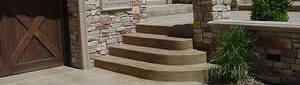

Does Sealing Concrete Make it Slippery?
Sealers for decorative concrete provide protection and enhance color. But the same thin, layer that provides this protection and enhancement can become slippery when wet.
Is Stamped Concrete Slippery?
A stamped concrete job where the imprint has a full texture and a nonskid additive is used in the sealer should not be slippery. If the concrete starts getting hard during the stamping process, this greatly reduces the amount of texture that can be achieved, which in certain scenarios can contribute to a slippery surface, especially in the presence of moisture. Read more: Is Stamped Concrete Slippery?
Is Polished Concrete Slippery?
Polished concrete floors may look as smooth as glass, but they are completely safe to walk on when kept clean and dry. However, in high traffic locations the use of an anti-slip conditioner or sealer with frit additive can improve slip-resistance. Learn more about polished concrete floors.


