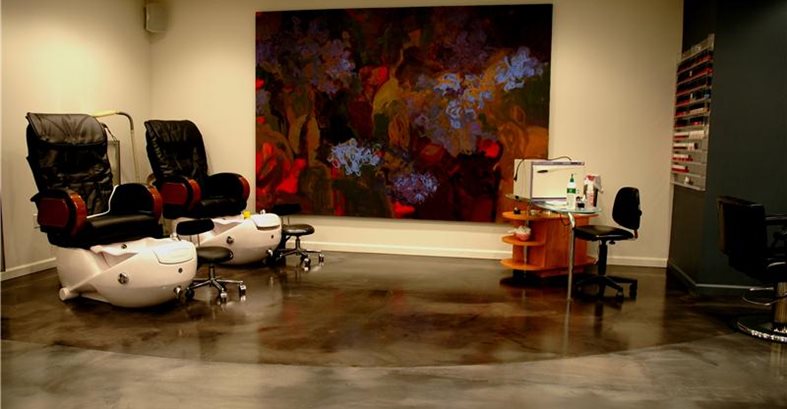
Colored and polished concrete floors in a salon are attractive and easy to clean. Custom Concrete Solutions, West Hartford, Conn.
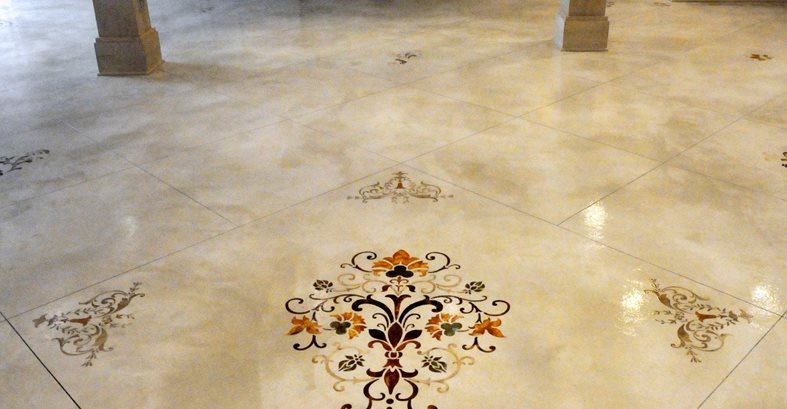
A stenciled concrete overlay in an upscale consignment shop provides sophistication. Custom Concrete Solutions, West Hartford, Conn.
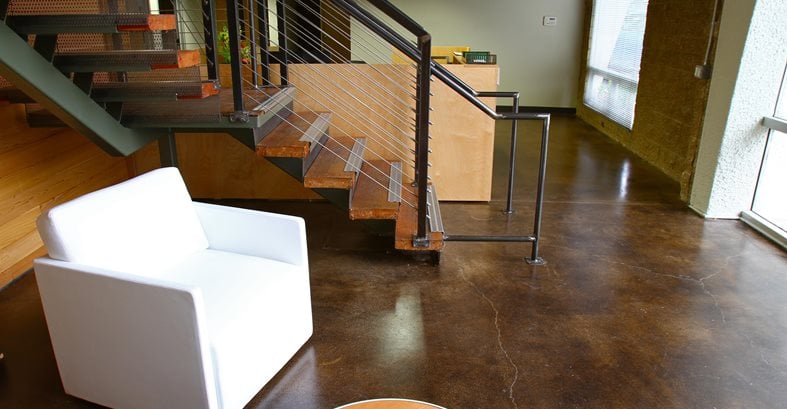
Concrete floors are an elegant option for a business lobby. Life Deck Coating Installations, San Diego, Calif.
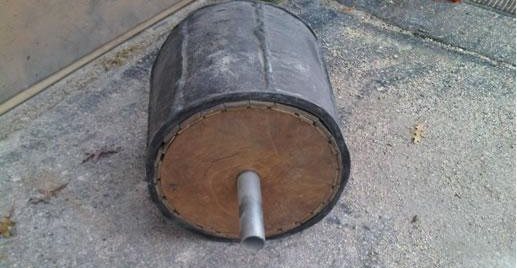
Carpet glue, tire marks and unsightly stains must be ground off the existing concrete before staining. Life Deck Coating Installations, San Diego, Calif.
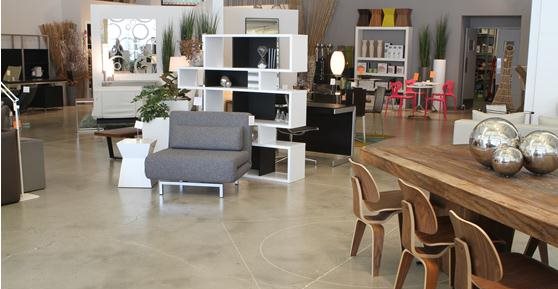
Left its natural color, and coated with a neutral epoxy, this concrete floor is the perfect backdrop for the store's modern furnishings. Life Deck Coating Installations, San Diego, Calif.
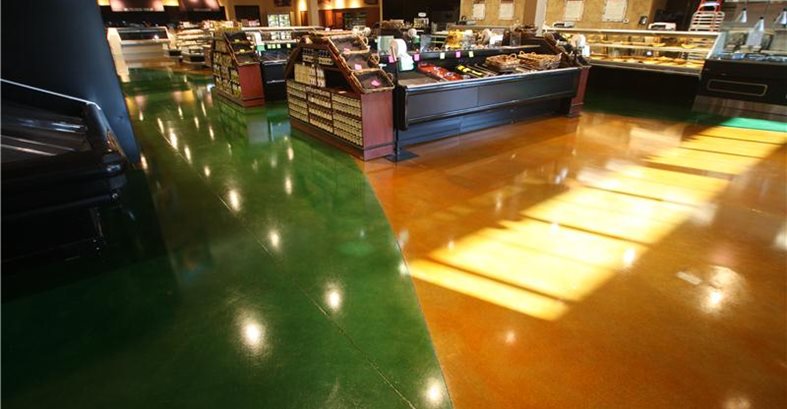
This multi-colored floor adds to the unique atmosphere of a specialty grocery store. Becker Architectural Concrete, St. Paul, Minn.
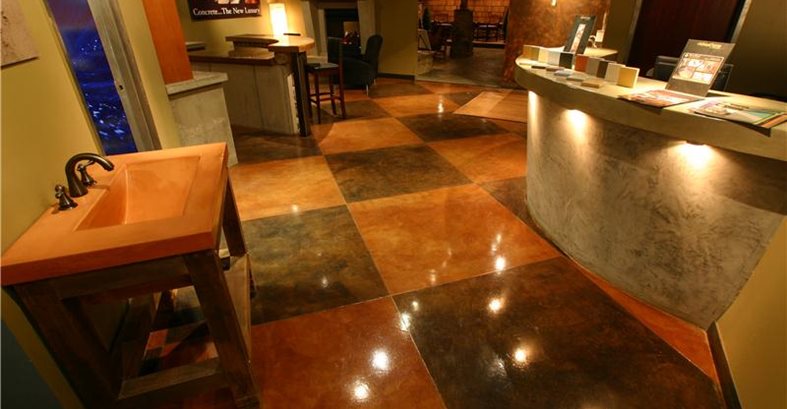
An impressive showroom can help land retail flooring jobs. Becker Architectural Concrete, St. Paul, Minn.
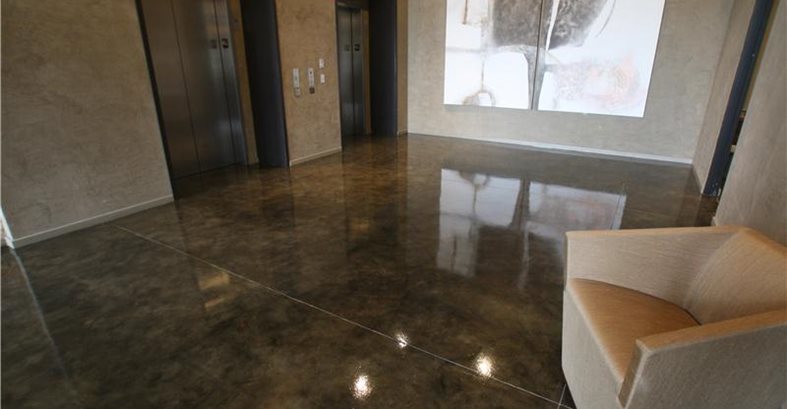
Concrete can be used to create nearly any look a company desires. Here the floors luxuriously mimic marble. Becker Architectural Concrete, St. Paul, Minn.
If you want to install decorative concrete floors that attract a lot of attention and serve as calling cards for your business, there's no better market to go after than the upscale floors in high-profile reception areas, offices, salons and retail buildings. These highly visible floors can be especially lucrative for decorative concrete contractors since the buzz they generate often leads to new work. However, these projects also come with a slew of challenges, from overcoming client concerns about the viability of concrete floors in high-traffic environments to meeting stringent expectations for floor color, composition and performance.
Looking for a pro? Find concrete floor contractors near me.
So what does it take to achieve success in this demanding field of decorative concrete work? The Concrete Network asked three concrete contractors about their firsthand experiences installing high-profile floors: Don Pinger of Custom Concrete Solutions, West Hartford, Conn.; Gil Koury of Life Deck Coating Installations, San Diego, Calif.; and Chris Becker of Becker Architectural Concrete, St. Paul, Minn. Here's a summary of what they've learned along the way and their advice to other contractors considering this line of work.
Landing the project
While decorative concrete floors are becoming more and more commonplace in commercial and retail facilities, they can still be a hard sell to clients who haven't seen how beautiful these floors can be or have doubts about their long-term durability. So how do you convince the skeptics about the attributes of concrete flooring? Displaying your work in a showroom, marketing on the web and customer referrals are several strategies our experts recommend for landing high-profile jobs.
"I get many of my jobs from people seeing my website. I have a very aggressive ad campaign that includes a few different concrete-related sites, like The Concrete Network. I also have a newly expanded showroom that displays the many different decorative concrete applications we offer. My biggest selling point is now my showroom. Ever since I opened the expanded showroom, I close probably 75% of the jobs that come in," says Pinger, whose company specializes in decorative concrete polishing and resurfacing.
Becker has also been successful using his showroom to land jobs. "The vast majority of these kinds of projects come through interior designers that have an initial concept for their client's project. We have the best success when we have the opportunity to meet with the client at our showroom, and wow them with our sensibility with the materials and show them our digital portfolio. This usually gets them excited about the possibilities," he says.
Koury takes a different approach and attracts customers by maintaining a large presence in the commercial and retail market and building confidence among his clients by being knowledgeable and flexible. "Most of our jobs come from referrals. We are celebrating 30 years in business, so customers know we are a reputable, stable company that will follow through and do great work," he says. Convincing people about the attributes of decorative concrete isn't much of a problem for him since most of his clients are already familiar with this type of flooring. "The popularity of decorative concrete floors continues to grow. Many people have experienced the look and feel of concrete floors in commercial applications, such as restaurants, but now more exposure in magazines, retail spaces and residences have made this option more common and desirable," Koury says.
Ideas for Concrete Flooring in Retail Shops
Time: 01:46
Watch an overview about RockMolds Lava Rock concrete stamp products.
Coming up with a design scheme
In most cases, the design of the floor is a collaborative effort involving the building owner, architect and concrete contractor. But on some projects, the client needs more guidance and will rely on the concrete contractor's experience and creative ability to come up with the best design scheme. In either case, the concrete contractor is expected to play a role in the design and color selection, rather than just being the decorative flooring installer.
"It starts with our creative process, asking questions about the client's business, the designer's goal for the space and, most importantly, the budget, and then creating a concept and samples that exceed their expectations without destroying the budget," says Becker, who does everything from interior flooring to architectural paving, bars and countertops, sinks, and even concrete furniture. "We have a solid reputation as a design/build firm, more so than a company that strictly provides installations, so for both owners and designers, they have an expectation that they are talking to us for our input on not only products and installation systems, but also layout, color and composition."
In Pinger's case, the final design is usually a collaborative effort, even if the customer doesn't think so. "What I mean by that is I use what the overall design of the room or rooms will be to fine-tune the colors and dyes we use. Rarely does a customer give me complete freedom to do whatever I want," he says.
Koury, whose specialty is concrete coating design and installation, also takes the collaborative approach much of the time. "I take the client's wants and needs and balance them with my suggestions and experience to come up with a great flooring system for them," he says.
Retail Floor Projects
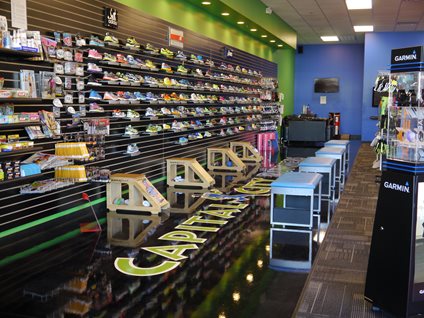
An Acetone Dye & Urethane Sealer Combine to Produce a Dark, Glossy Floor
Pro Floors Plus, Lynn Haven, Fla.
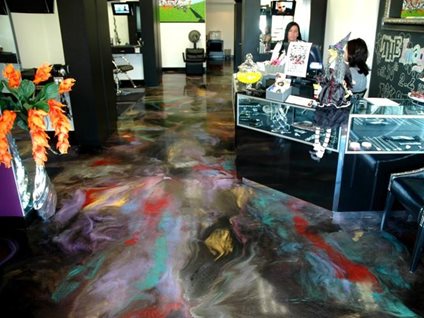
Concrete Overlay is a Kaleidoscope of Color
from Custom Concrete Solutions in West Hartford, Conn.
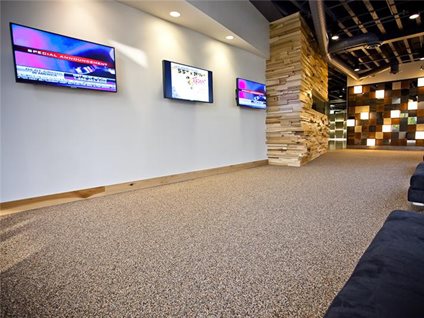
Concrete Overlay Imparts Look of Pebble Floor
from Surfacing Solutions Inc. in Temecula, CA
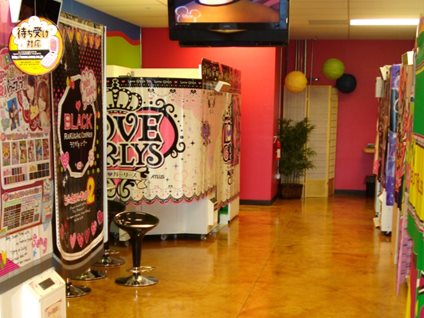
Carpet Removed and Concrete Floor Enhanced in Chino Hills, Calif.
Staintec, Rancho Cucamonga, CA
Concrete Polishing
Cuviello Concrete and Terrazzo Polishing, Stevensville, MD
Dealing with existing concrete surfaces
As you might expect, many of the projects our decorative flooring contractors get involved with deal with existing surfaces rather than newly placed floors. This often entails the removal of existing floor coverings and careful assessment of the condition of the underlying concrete. Becker is especially cautious before taking on these projects, and insists on creating mockups onsite before signing any contracts.
"I try to avoid what may be the biggest challenge, which is the uncertainty of what the actual concrete we will be working on is all about," says Becker. "Creating mockups gives me the chance to see what is really under that carpet, mastic, tile, etc. and eliminate any big surprises that I may not have accounted for in my bid. In one instance, I was bidding on a retail space conversion that was slab-on-grade concrete that had carpet as an existing floor covering. The client wanted stained concrete, so I knew that it would most likely be a grind, microtop and stain process. After a bit of research onsite, I found that a third of the floor had been leveled with a cheap underlayment that would have to be removed and releveled with an overlay. This would have been a real bummer if it was not accounted for in the proposal."
For Pinger, the biggest challenge is getting carpet glue or tile mastic off of existing concrete floors. "Even shotblasting it doesn't get all the nooks and crannies and a lot has to be done by hand," he says.
In established businesses with existing concrete floors, the owners often can't afford to shut their doors while the work is being done, creating a whole new set of challenges. "This is definitely a challenge but inevitable," says Koury. "We understand that businesses need to stay open during construction and do our best to work around their hours and schedules. It is important to be flexible, efficient, swift and tidy." Becker agrees with the need to adapt to the situation. "In projects that have to remain open for business, I have to be creative with the clock, working nights and weekends as needed."
Sealing and protecting high-traffic floors
With all the foot traffic and attention high-profile floors receive, using a tough, stain-resistant sealer to protect them is a must. High-solids epoxies and urethanes are the top choices of our contractors, who also favor water-based products because they emit no fumes.
"I use two-component water-based epoxies as primers, with two-part urethanes as top coats, but I'm looking into switching more to polyaspartic and polyurea systems once I am comfortable with installing them," says Becker.
Pinger also uses a 100%-solids epoxy as a primer, topped by two-part high-solids urethanes on overlays or regular concrete. With polished concrete, he uses a burnished sealer.
For Koury, the type of coating system he installs and the wear and tear the floor is exposed to determine the type of sealer to use. "Our Westcoat EC-31 100%-solids clear epoxy is very tough and reliable. When a tougher, mar-resistant sealer is needed, Westcoat's EC-95 polyurethane is an excellent choice. Westcoat's new EC-65 water-based urethane is a good choice when fumes are a problem," he says.
Maintenance requirements
Sometimes, clients have a perception that little effort is needed to maintain their floors because they're concrete. While concrete floors are certainly easier to maintain than many other floor surfaces, neglecting them will lead to unnecessary wear and tear that could damage the decorative finish, even if the floor is sealed.
"We traditionally have had to bring up what we feel are the realities of what these kinds of surfaces require for maintenance, to make sure owners understand what they are purchasing and make sure they will take care of the surfaces as we suggest," Becker explains. His biggest challenge is getting the client on a regular maintenance schedule, which includes cleaning, buffing, periodic applications of topcoats, and using floor mats in the winter. "It's a big education process that I have to take the lead on. My name is on that project, so it will become my problem if something goes wrong down the road. Generally it's the smaller retail spaces that do not have an outside cleaning service that have a bigger problem taking care of their floors," he says.
Koury agrees that keeping clients on a maintenance schedule is very important. He also says that regular site visits to check on floors for maintenance needs is key, since the degree of wear varies depending on traffic and use. "We would recommend site visits every two to three years for a typical commercial concrete floor, with regular cleaning and upkeep by clients during that time. Polishing can be done more frequently if needed," he says.
Pinger also stresses the importance of regular maintenance and instructs his clients how to keep their floors clean. "Concrete floors are easy to clean, but it's not as noticeable when they're dirty like carpet is, so they often get neglected. With any decorative concrete floor we do, we try to impress upon the customer the need to keep the floors relatively clean. First, they should be just swept. If that's not enough, we recommend light mopping with warm water and just a couple of drops of non-abrasive soap," he explains.
Addressing customer concerns about decorative concrete floors
Maintenance is certainly a big concern clients have about their floors, but often other considerations weigh even more heavily on their decision of a flooring material. "The single biggest concern is how slippery the floors will be," says Pinger. "With overlays, I try to talk them into an application that has texture. With polished concrete, I show them SCOF info (a measure of slip resistance), and with epoxy floors I talk them into using a topcoat of urethane, which tends to be less slippery. For entryways, I often add some type of additive, like Shark Grip, to the final coat of sealer."
Koury notes that cost is a chief concern among his clients, especially in this economy. He explains to building owners that a concrete floor coating or stain is often a more economical choice than hardwood or carpet. "We can be pretty competitively priced, depending on the condition of the existing concrete," he says.
The smartest thing a contractor can do is acknowledge the concerns of their clients and find ways to alleviate them. "It is important to help customers pick a flooring system that will address their specific needs. We accomplish this by consulting with the customer, asking key questions and offering a coating system that addresses their requirements, whether it's a coating that stands up to heavy foot traffic, is heat resistant, easy to clean or highly decorative," says Koury.
Custom Concrete Solutions
West Hartford, CT
Life Deck Coating Installations, San Diego
Becker Architectural Concrete
Woodbury, MN
Related Information: