
- Concrete Coatings Home
- Garage floor coatings
- Epoxy terrazzo toppings
- Polyaspartic coatings: A new polymer for one-day floor toppings
- Metallic Coatings
- Choosing the Best Coating for the Job
- Selecting the proper coating for concrete floors
- Coating product reviews
- How-To Tips for Installing Coatings
- How to install epoxy terrazzo
- Reducing bond failures caused by moisture-vapor transmission
- Related Information:
- Concrete floor videos, with Bob Harris
Polyaspartic Coatings
A polymer for one-day floor toppings
Video: Polyaspartic Coatings
Time: 01:29
Watch an overview of what polyaspartics are and how they can be used.
Every so often you hear about some new wonder material that sounds too good to be true-and that's usually because it isn't true. Recently there has been a lot of talk about a miraculous new concrete floor coating and sealer called polyaspartic polyurea. This material, according to its proponents, can be applied at nearly any temperature, bonds easily to nearly any concrete surface, cures to full strength within half an hour, is flexible enough to bridge small cracks, can withstand high temperatures when cured, and has superior stain and UV resistance.
So, you're asking, is all that really true? After talking to lots of people, both believers and skeptics, I believe that the simple answer is, yes, it is true-BUT. The big "but" is that you must properly prepare the floor and the moisture vapor emission rate can't be too high and you need to have the proper solids content in the polyaspartic coating to allow it to wet out the concrete surface in order to develop proper bond. When those conditions are met, polyaspartic floors are extremely successful and an experienced contractor can indeed complete a floor in a single day. But-another but-when moisture-vapor emission rates are too high and when using 100% polyaspartic coatings, some floors have failed. Here, we'll give you both sides of the story and discuss the applications for polyaspartics, ranging from a new way to topcoat decorative concrete floors to sealing concrete countertops.
Not sure which coating to use? Compare polyaspartics vs. epoxy.
Need help with your project? Find a concrete floor contractor near me.
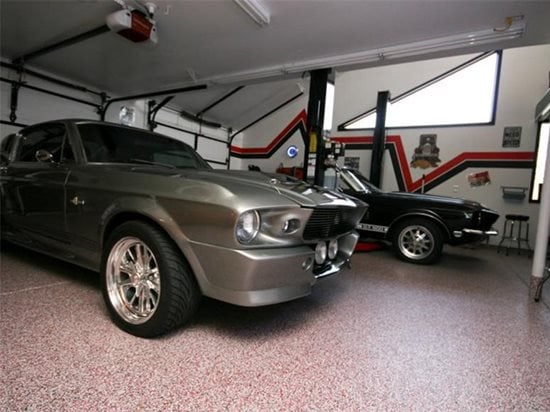
Polyaspartic Garage Floor Coating, HP Spartacote
WHAT ARE POLYASPARTIC COATINGS?
To begin with, a polyaspartic is a type of polyurea (actually a polyaspartic aliphatic polyurea). Polyurea as a commercially viable material was developed in the 1980s by Texaco Chemical Company (now Huntsman Chemical). All polyureas are two-part systems, meaning that a resin has to be mixed with a catalyst to create the curing reaction that hardens the material. Polyurea has been used very successfully for corrosion-resistant coatings and repair materials, although application is awkward since it has an extremely short pot life-about 3 seconds, so the two parts must be mixed at the spray tip, requiring lots of maintenance on expensive high-pressure equipment.
Polyaspartic polyurea (or simply polyaspartics) overcomes many of those difficulties, while retaining the advantages. According to Bayer Material Science, polyaspartics are "based on the reaction of an aliphatic polyisocyanate and a polyaspartic ester, which is an aliphatic diamine." I bet you're glad we got that cleared up!
For most of us, the important thing to understand is that polyaspartics are a polymer coating material that has the following characteristics:
- Rapid curing (from 5 to 120 minutes, depending on the formulation)
- Can be successfully applied at surface temperatures from -30°F to 140°F
- Very low viscosity-equivalent to water-which gives it outstanding wetting ability on a properly prepared concrete floor
- High film build (up to 18 mils in a single coat)
- Bubble-free surfaces even at high humidity (although high humidity can speed up the cure time considerably)
- Potlife of 5 to 120 minutes
- UV stable so it will never turn yellow-and can provide UV protection to underlying coatings
- Made with a high solids content (as high as 100%), which means low or no volatile organics (VOCs) during application
- The cured coating can handle temperatures up to 350°F
- Crystal clear and does not blush white from moisture in the concrete
- Able to resist most stains, especially from oils and fats and even from red wine
- High abrasion resistance-higher than epoxy or urethane
- May be able to resist higher internal moisture vapor emission rates than some other non-breathing coatings-although this is an issue that is currently being investigated
WHAT ARE POLYASPARTICS USED FOR?
In exterior structures, especially bridges, corrosion of the embedded reinforcing steel is the number one enemy. If these structures can be sealed so that water can't penetrate, there can be no corrosion. Polyaspartics can play a role in this protection.
On the San Mateo-Hayward Bridge, a 7-mile crossing of San Francisco Bay, all concrete beams and piles received a thee-part coating developed by Hehr International Polymers. The coatings were an epoxy sealant, a polyurea primer, and a polyaspartic top coat that provided additional protection and prevented UV-degradation of the polyurea coating. Not only has this coating system prevented any chlorides from migrating into the concrete, it has remained crystal clear and has even prevented barnacle growth.
Some less dramatic applications of polyaspartics include:
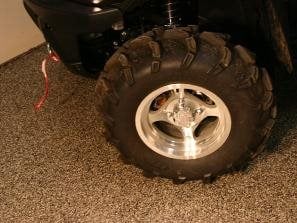
Citadel Floor Finishing Systems
Garage floors
This has been the first major decorative use of polyaspartics. Several companies have emerged that are selling and installing pigmented polyaspartic garage floors with embedded vinyl flecks or quartz sand beads, similar to epoxy floors. The big selling point for the polyaspartics is the speed of the application. A polyaspartic garage floor can be completed start to finish in about 5 hours (an epoxy floor typically takes 5 days). While the materials may cost more, since the contractor can theoretically do the job in a single trip to the site, profits can increase. Rob Hanson, president of GarageFloorCoatings.com, however, cautions that polyaspartics may not be the best material for all situations, depending on the condition of the concrete-especially if the floor has high moisture vapor emission rates (see Is It Better than Epoxy/Polyurethane?). Find a Garage Floor Coating Contractor
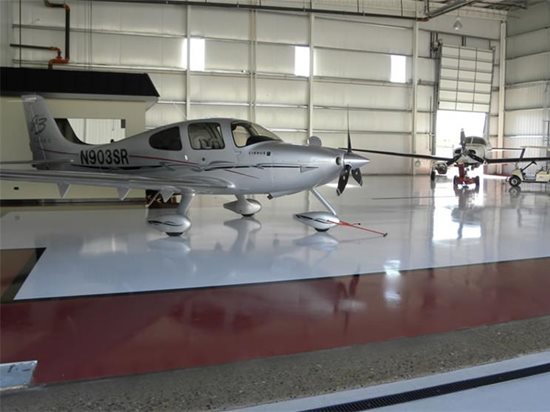
Polyaspartic Hangar Floor, HP Spartacote
Commercial floors
Kitchens, restrooms, and other commercial applications are great applications for this surface, since it resists stains and withstands heavy abrasion-as much as 3 times the abrasion resistance of epoxy. "We are finding that contractors start with garage floors," says Doug Bannister of The Stamp Store, "but I think polyaspartics have great applications for high-wear commercial use. You've got superior abrasion resistance, optical clarity, and quick turnaround, so you can return to service in hours."Find an Interior Concrete Floor Contractor
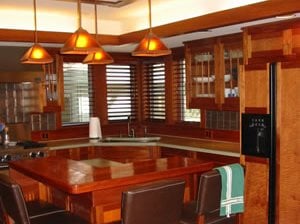
Concrete Countertop Institute in Raleigh, NC
Countertops sealers
The search has been on for many years for the perfect countertop sealer. Polyaspartics are not damaged by temperatures up to about 350°F and are very stain resistant, even to acidic materials like lemon juice and red wine. Jeff Girard at the Concrete Countertop Institute, however, has tested several polyaspartic sealers and when asked directly if this material is a better sealer than other materials, said, "No. Polyaspartic sealers have a lot of potential but they are fairly new and there aren't a lot of user-friendly versions yet." Click on "Polyasprtics for countertop sealers" to learn more about this application. Find Concrete Countertop Products
Additional Decorative Applications for Polyaspartics
Interior Stained or Dyed Floors
The ability of polyaspartics to wet out and penetrate hard concrete surfaces makes them a good choice over traditional polyurethane and acrylic sealers. Most polyaspartics allow for dilution of the first coat with common solvents to create a self-priming system. This is especially beneficial when they are applied over a stain or dye system, as a deeper wetting out of the surface will produce better long-term sealer adhesion. Also, the ability of polyaspartics to go down from as thin as 3 mils to as thick as 120 mils gives an applicator a lot of flexibility in gloss development and abrasion performance.
Exterior Stamped or Stained Concrete
In most cases, high-performance, high-build coatings are not recommended for use in exterior applications due to their impermeability and potential to trap moisture. Polyaspartics can be diluted or applied to thicknesses of less than 6 mils, which make most of them permeable and breathable. With the breathability issue resolved, you now have the option of using this extremely durable coating for exterior stamped and stained work.
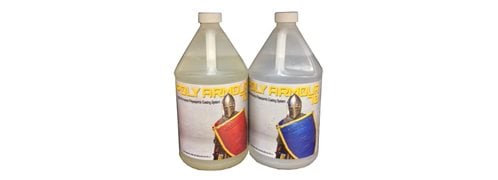 POLY ARMOUR 70
70% solids two component polyaspartic
POLY ARMOUR 70
70% solids two component polyaspartic
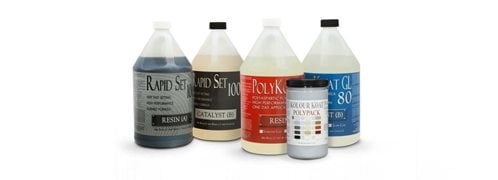 Rapid Cast
Polyaspartic chip system
Rapid Cast
Polyaspartic chip system
 Polyaspartic 90 Standard Set
High Solids, High Performance, UV Stable and Clear Gloss
Polyaspartic 90 Standard Set
High Solids, High Performance, UV Stable and Clear Gloss
HOW TO INSTALL A POLYASPARTIC FLOOR COATING
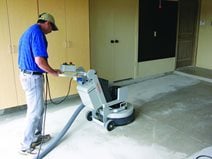
The Stamp Store in Oklahoma City, OK
Step 1
Installation of a polyaspartic floor starts with floor preparation to rid the surface of laitance and contaminants. This is critical to success. The low-viscosity material must be able to penetrate the surface. Acid etching is not recommended, since it adds moisture to the concrete and the lower pH can lead to delamination problems. Most providers recommend a diamond grind at a 60 to 80 grit-just enough to get through the paste surface layer and open the pores of the concrete.
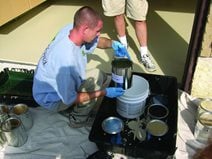
The Stamp Store in Oklahoma City, OK
Step 2
Cracks and joints can then be repaired. Bracco recommends filling the cracks with sand then wetting the sand with polyurea. Polyureas cure so rapidly that these repairs can be ground flush with the concrete surface in about 20 minutes. "The polyaspartic has such great elongation properties that you simply install the coating right over the top of these repaired cracks without getting any reflection" said Bannister. Advantage's Harms notes that this does not include contraction joints. "We don't fill the joint, we coat down into it and back out, because if you tie the joint, it can crack the slab at mid-panel." Polyaspartic is usually mixed with equal amounts of Part A and Part B.
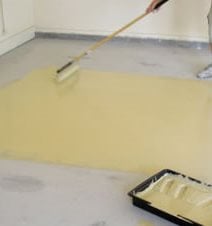
Flexmar Coatings
Step 3
At this point, the floor can be acid stained or colored with acrylic water-based stains. It should be noted that prior to sealing, a test area should be stained and sealed to assure proper adhesion and chemical interaction between the top coating and the stain. The installer should be looking for any areas where the stain may be interfering with the coating, or once cured, where the coating may be delaminating due to the stain. The installer then rolls on the recommended number of coats of polyaspartic. This is when you can see whether the coating is wetting--absorbing into the concrete. Different providers recommend different thicknesses for this primer coat and the one or two subsequent coats of polyaspartic. Bracco and Bannister recommend a 2 to 3 mil thick primer coat, while Harms goes with a 10-mil coat. "Bonding comes from two things," said Bracco, the surface profile and the ability to flow into the substrate. With polyaspartics we have a little extra time before it cross links, so it has time to absorb into the concrete." The primer coat and bed coat typically contain pigmet.
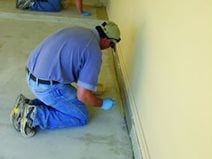
Flexmar Coatings
Step 4
Within an hour (or less) the primer has cured enough to walk on. For applications that incorporate vinyl chips or quartz sand, the second coat is then put down. For applications with color, both of these first two coats incorporate pigment. For acid stained floors, Bannister recommends stopping at two coats of clear polyaspartic. For floors with vinyl chips or quartz, that material is immediately broadcast into this "bed" layer. This layer varies from 2 mils to 18 mils thick, with the vinyl chips adding as much as 8 mils. "The chips wet out to form a laminar layer parallel to floor," said Bracco. "The ability to wet those chips is very important. Epoxy has a much higher viscosity, so the chips tend to lay on edge. Polyaspartics wet out the chips and they lay down to give you the laminar effect that helps in the overall protection of the concrete."
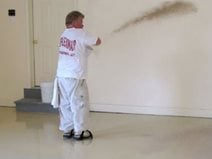
Flexmar Coatings
Step 5
Once the bed coat has cured, Harms recommends scraping the surface. "We scrape it hard with a floor scraper to clean up the vinyl chips. That makes it smoother and also reduces the amount of product needed in the top coat to cover the vinyl chips." Workers then vacuum up all loose materials before rolling on the top coat. The top coat is always clear and goes on in a range of 6 to 18 mils. Thinner coats are applied with 3/8-inch nap rollers and thicker coats with ¾-inch naps. Thinner coats leave a slight texture to the surface as some of the vinyl chips or quartz pokes through. Vinyl chips are broadcast until saturation.
This all results in final coating thicknesses from 11 to 40 mils. All of this can be accomplished in a single day. Typically, the new floor can be opened to foot traffic in 2 or 3 hours and can be driven on within 24 hours.
POLYASPARTIC CASE STUDY
The meat department in this grocery store had a two-year-old epoxy coating of which about 90% had peeled up, leaving the concrete unprotected and able to support bacterial growth. The floor needed to be fixed immediately, but the store owners didn't want to close their meat department for several days to install a new epoxy system. This would have been an extreme inconvenience for employees and customers and a significant loss of profits. There also was concern over the loss of business due to the odors emitted during installation of an epoxy system. A final condition was the need to keep the freezers on, meaning the new coating would have to be installed at temperatures as low as 15°F, much too cold for epoxy.
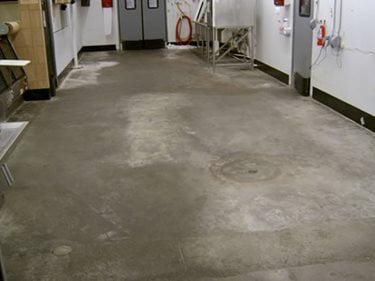
This failed epoxy coating allowed bacterial growth in the concrete. Advantage Chemical Coatings
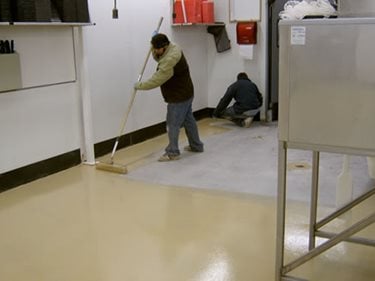
The pigmented polyaspartic coating was applied to the freezer floor at 15°F. Advantage Chemical Coatings
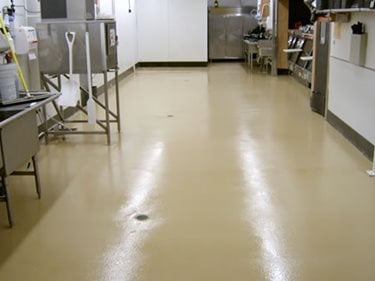
The newly coated floor was ready for use by the next morning. Advantage Chemical Coatings
One evening, the flooring contractor moved in immediately after closing time and began by diamond grinding the floor. Degraded areas were removed and patched with polyaspartic mixed with silica sand. All the patch work was cured and diamond ground 45 minutes later.
The first treatment applied was a penetrating silicate moisture barrier, supplied by Advantage Concrete Coatings, that was intended to eliminate moisture vapor emissions. Advantage recommends this material any time a floor has a moisture vapor emission rate greater than 7 pounds/1000 square feet/24 hours or if the floor will be washed down on a regular basis. When this coating was dry-in about 3 hours--workers applied a pigmented coat of 75% solids polyaspartic (AdvaCoat) and waited 45 minutes for it to cure. The top coat was again 75% solids pigmented polyaspartic polyurea into which a non-slip grit was broadcast and the entire floor was back-rolled.
Before opening time the next morning the store's workers had moved their tables back in to the meat department and business resumed as usual.


