
- Concrete slabs home
- Use a low water-cement ratio: How to calculate
- Subgrades and subbases for concrete slabs: Tips for ensuring good support
- Concrete Slab Finishing Tips
- DIY Slab Mistakes to Avoid
- How to Prevent Cracks
- Guidelines for preventing cracks in concrete slabs
- Be active in deciding where control joints will be placed
- Reinforcing Concrete Slabs
- Proper Curing of Concrete Slabs
- Properly curing concrete slabs: Why and how
- Related Information:
- Concrete fasteners
- Concrete forms
- The three types of concrete foundations
- Aggregates in ready-mix concrete
- Vapor barriers for concrete slabs
- Post-tensioned concrete slabs
- Concrete slabjacking
- Concrete testing
Concrete Fasteners
An overview of fastener types and how to choose the right size and capacity for the application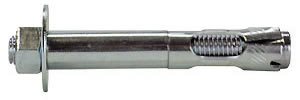
Whenever you affix a nonstructural item to concrete, such as a picture frame, window shutters, or shelving, you'll need the right fastener to ensure a secure attachment. You have several types of fasteners to choose from, depending on the application and the weight of the item you're hanging. Here's an overview of your options and advice on what to consider when selecting a fastener. We also offer tips for properly installing concrete fasteners, including the appropriate tools to use and the mistakes to avoid.
Is it a fastener or an anchor?
Many people use the two words interchangeably including manufacturers. However, attachment of non-structural items to concrete is generally considered to be "fastening", while attachment of structural elements to concrete is considered as "anchoring". Or another way of looking at it is that fasteners tend to be lighter and smaller than anchors although some can be used for both applications.
FASTENER TYPES
Chemical Fasteners
These fasteners can be either surface mounted or injection fasteners using a variety of adhesives or epoxies.
They are bonded in place with two-part chemical compounds epoxies, polyesters or vinylesters. As with the expansion fasteners, the injection fastener is inserted into predrilled holes and the adhesive is injected into the hole. (Remember to blow out the dust before injecting the adhesive, otherwise it will bond to the dust coating the interior of the hole and not the surface of the hole itself.)
Mechanical Fasteners
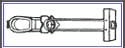
A toggler bolt is a mechanical fastener
Mechanical Fasteners work the best with hollow-core material such as drywall, hollow-core concrete block (which is often used in basements), and plaster.
These fasteners open up on the back side (inside the material being fastened to) and compress against the material being fastened to when the mechanical fastener is tightened.
Expansion Fasteners
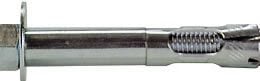
The base of the fastener is designed to expand against the sides of the hole in any number of ways dependent upon the type of fastener selected.
Expansion fasteners are for solid-core material like concrete (or brick, stone, and mortar). They work by transferring the tension or pulling force on the bolt into the concrete through friction or expansion pressures.
The base of the fastener is designed to expand against the sides of the hole in any number of ways dependent upon the type of fastener selected.
Here are some examples of expansion fasteners:
- Wedge fastener: This system uses a nut, washer and a steel stud bolt which has a tapered mandrel at the bottom. Surrounding this mandrel is either a steel clip or separate steel wedges. When the nut is tightened the mandrel is drawn up into the clip or wedges forcing them to become wedged between the mandrel and the sides of the hole.
- Sleeve fastener: The sleeve expansion fastener has a nut, washer, steel stud bolt and a sheet metal expansion sleeve. As in the wedge expansion fastener, the bottom of the bolt has a uniformly tapered mandrel of the same diameter as the expansion sleeve. The sleeve itself is slit lengthwise to aid in expansion. When the nut is tightened it draws the mandrel into the sleeve forcing it to expand and bear against the sides of the hole.
- Stud fastener: In contrast to the wedge and sleeve fasteners which use a tightened nut to cause expansion of the fastener against the sides of the hole, the stud fastener is expanded by hammering upon the top of the stud. The stud expansion fastener is threaded at the top end and has a drilled hole with vertical slits at the bottom end of the stud. This hole at the bottom of the stud sits over a tapered steel plug. When the top of the stud is hammered, the bottom of the steel stud is forced over tapered steel plug which results in an expansion of the steel stud against the sides of the hole.
- Self-drilling fastener: Rather than being set into a predrilled hole, the self-drilling fastener has teeth for cutting its own hole in the concrete. This fastener is comprised of a steel shell (with teeth) and a tapered steel plug. The top of the shell is internally threaded so a bolt can be screwed into it. By hammer drilling the shell over the tapered steel plug, the bottom the shell is forced to expand and bear against the sides of the hole.
- Drop-in fastener: This system uses a steel shell and an internal steel expander plug.
Adhesive Fasteners
Surface-mounted adhesive fasteners can be used to mount electrical fixtures, bathroom accessories, mirrors, brackets, smoke detectors, kitchen items, remote control boxes, picture frames, clocks, doorbells, chalk boards, etc.
HOW DO I DECIDE WHAT TYPE OF FASTENER TO USE?
The type of fastener used depends upon what you need to fasten and the material you are fastening it to. Something heavy, like shutters, requires a different type of fastener compared to something light, like a doorbell. Also, a hollow block wall requires a different type of fastener than a solid concrete wall.
There are a few basic things to consider:
- How heavy is the item to be mounted? Consider the size and weight. This information will help you determine the fastener size and quantity required.
- What is it going to be mounted to? Is it a hollow-core base such as drywall, concrete block, or plaster and lath? Or is it solid-core like stone, brick, or concrete.
- Is the installation to be exterior and subject to the elements? Or interior?
- How far from corners?
- Consider the thickness of the base material.
Earthquakes and Fasteners
A good thing to remember in earthquake country, is to select fasteners a bit stronger than required just to support the weight of the object.
Vibration or motion induced by the earthquake puts an additional load on the fasteners.
See the list of non-structural applications for examples of the wide range of items that can be affected and protected in an earthquake.
There are two other factors to consider, tension and shear, and the capacity of the anchor for each is often listed in the manufacturers specifications.
- Tension is related to the question, "Will the fastener pull out?"
- Shear is related to the question, "Will it break off?"
These are the answers to have for the fastener supplier so they can supply you with the proper fasteners for the job using their product information.
Manufacturers have developed guidelines for use of their products and have tables which list: the type of use as light, medium or heavy duty, types of fasteners, sizes available, and tensile and shear capacities.
NON-STRUCTURAL APPLICATIONS FOR FASTENERS
There are two categories of masonry fasteners commonly used:
The first is the self-drilled fastener which works by cutting threads into the concrete/brick or block. These can be used to mount electrical junction boxes, furring strips, HVAC strapping, exterior insulation systems, plywood backer boards, etc.
The second type is the mechanical fastener inserted into a predrilled hole. This type of anchor provides a larger bearing surface than just the threads in the self-drilling fastener and can be used to mount heavier items such as shutters, sheet metal flashings, railings, and screened porch or pool enclosures.
Utilities:
- Electrical fixtures, junction boxes, conduit clips
- HVAC
- Control systems
- Telecommunications equipment
- Remote control boxes
Household or Office Items:
- Shelving and supports
- Picture frames
- Mirrors
- Clocks
- Bulletin and chalk boards
- Thermostats and smoke detectors
Exterior Items:
- Shutters
- Porch and pool enclosures
- Sheet metal or flexible flashings
- Railings
- Metal or tile roofing
- Decorative wrought iron
- Furring strips to masonry
- Rigid insulation to masonry or concrete decking
INSTALLING FASTENERS
Cast-in-Place Fasteners
These are typically used to attach structural members to a concrete wall or slab or footing but can also be used for non-structural applications. The fastener or concrete is spotted prior to the concrete being poured. The concrete hardens and the bolt is in the proper place.
The advantage of the cast-in-place system is the enhanced anchorage properties available. Bolt(s) with the head embedded in fresh concrete can later be used as mounting points for non-structural items. However, as these are non-adjustable care should be taken in their location. Templates have proven useful in this regard.
Other types of cast-in-place fasteners include threaded rod, threaded inserts and bolted connections (either embedded or through).
Post-Installed Fasteners
Typically, these are installed in a hole drilled into the cured concrete and are either bonded (grouted or chemical) or expansion-type fasteners.
A third category of post-installed fasteners is the adhesive fastener, which is usually used to attach lightweight objects to a concrete/brick/or block surface.
In the first two cases, a hole is drilled into the concrete to the desired depth and sufficiently wide enough to accept the selected fastener. The fastener is set into the hole and the hole is filled with either a cementitious material (like a Portland cement and sand grout or premixed grout) or an epoxy. Care must be taken to ensure the fastener is in the correct position (depth and at the desired angle) or attaching the desired fixture may be difficult.
Hint: For bonded fasteners in particular, remember to blow out the dust before proceeding.
What type of equipment is needed to install a concrete fastener?
For bonded fasteners and most of the expansion fasteners, a power drill with a masonry bit will do for the predrilled hole.
Bonded fasteners use either a cement-based grout or two-part chemical adhesive which can be purchased with the fasteners. A bulb-type blower is useful to remove the dust from the hole.
Some expansion fasteners require a wrench to tighten the nut to make cause the base expand.
Other expansion fasteners are expanded by hammering the top of the fastener (or using a hammer drill). For these fasteners, pounding on the top forces the bottom to expand outward against the hole.
In either case, follow the manufacturers directions and use safety precautions.
Things to Watch For in an Installation (Problems to Avoid)
There are two main things to protect against: the fastener pulling out of the wall (relating to tension) or breaking off (relating to shear). Both of these problems can be avoided by knowing the weight of the item to be mounted and what it is going to be mounted upon. This information can help determine the size and number of fasteners to be used.
Refer to the manufacturer's ratings for light, medium, or heavy duty; and tables which list the type of fastener and how strong each diameter of that type of fastener is in tension and shear. There are trade-offs here. It may be that 2 larger fasteners make more sense than 4 smaller ones, but smaller fasteners mean smaller holes and faster drilling and perhaps a more even support of the object such as would be the case for shelving.
Here are things to guard against:
1. Pulling out of the wall — chemical or adhesive fasteners
- Dusty hole. Not removing the dust in a pre-drilled hole before injecting the adhesive can cause problems. The dust can be removed by either blowing it out or vacuuming it out. However, for small holes blowing it out is easier. There are "blowers" specifically designed to accomplish this. They typically have a rubber bulb at one end and a thin tube at the other. The tube is inserted into the hole and the rubber bulb squeezed vigorously. This will force air into the bottom of the hole, which will lift and carry out the dust. (A dust mask is a good idea here). An alternate method is to flush the hole clean with running water and then letting it dry out before injecting the epoxy.
- Improperly sized fastener, too small a diameter or not long enough. The result of either of these is too small a bearing surface to resist the loads the item puts on fastener. With bonded anchors, this can cause the adhesive to separate from the surface of the hole (more likely) or from the fastener itself.
2. Pulling out of the wall — expansion fasteners
- Improperly sized hole, too large for the anchor. This can happen if the wrong sized bit is used to drill the hole. The manufacturers instructions should be followed. If the hole is too large, then either not enough of the expansion portion will get to bear upon the sides of the hole, or it wont be wedged in firmly enough.
- Improperly sized fastener too small a diameter. If the hole size is correct and the anchor has been properly set, it could start to yield (stretch) if a heavier than designed for item is hung upon it. In this case, it actually becomes a bit narrower and can be pulled out. Many fasteners have been tested by the manufacturers and come with ratings for light, medium or heavy duty use.
3. Breaking off
- If too small a diameter fastener is selected for the weight of an object, the bolt used to attach the object to the wall can be broken or sheared off. This can happen even if the hole has been properly drilled and the anchor set correctly (whether bonded or an expansion type).
- It really is a matter of sizing the fastener to match the weight of the object being hung or attached. In earthquake country, its also a good idea to have the fastener a bit stronger than required to support the weight of the object. Vibration or motion induced by the earthquake puts an additional load on the fastener.
Related Reading:
Concrete Tools
Concrete Stencils
Concrete Repair
 Brickform Ultra-M1x
Add color and fiber with one product
Brickform Ultra-M1x
Add color and fiber with one product
 Rescue-Pak
Contains six of the most effective admixtures
Rescue-Pak
Contains six of the most effective admixtures
 UltraFiber 500®
Will not ball or fuzz, accepts color
UltraFiber 500®
Will not ball or fuzz, accepts color


