
- Colored Concrete Home
- Concrete Color Charts
- Ways to Color Concrete
- Concrete stains
- Integral Color
- Dry-Shake Color Hardener
- Concrete Dyes
- Concrete Paint
- Comparison Chart: Concrete Coloring Products
- Design Ideas for Colored Concrete
- Which Color Scheme is Right for Your Home?
- Creating color and texture with Stamped Concrete
- Adding Interest with Exposed Aggregate
- Creating Excitement with Color: Endless Possibilities with Polymer Stain
- Related Information:
- Problems with colored concrete: Common problems, why they occur, and how to avoid or fix them
- Guide to Buying Concrete Stains and Dyes
- Lea este artículo en español
Concrete Color Hardener vs. Integral Color
Learn the differences between color hardener and integral pigments, plus how to apply hardeners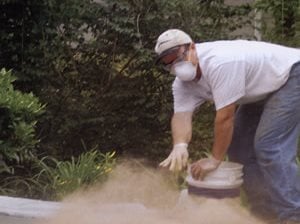
Although color hardener must be applied by hand, the results are worth the effort.
Dry-shake color hardeners come as a powder that is hand broadcast onto freshly placed concrete and then worked into the surface with a float or trowel. Unlike integral pigments, which color the entire concrete matrix, hardeners color only the top surface layer. Because the color is concentrated at the surface, it tends to be more intense than integral color.
Most shake-on color hardeners are a blend of pigments, finely graded silica sand, wetting agents, and portland cement. Coloring options come in a wider array of hues than integral colors, including various shades of blue and green (see this page for color hardener suppliers). As the name implies, they also densify the concrete surface because they contain hard mineral aggregates and portland cement. The result is a surface that's stronger, more wear resistant, and less permeable to moisture and deicing chemicals than standard concrete.
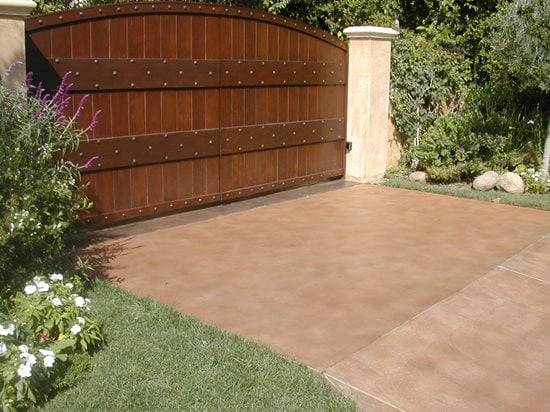
Concrete FX in Agoura Hills, CA
WHERE TO USE COLOR HARDENER
Decorative contractors often use dry shakes to color stamped concrete or concrete overlays because the rich surface paste helps to produce sharper imprints. Hardeners also produce more robust tones than possible with integral pigments and permit greater variability. For example, contractors can apply one or more accent colors of hardener to achieve subtle tonal variations, such as you would see in natural stone.
Because color hardeners improve the strength and density of the concrete surface, they are a great choice for exterior slabs exposed to freeze-thaw cycles and deicing salts and for interior floors exposed to heavy foot traffic and abrasion. However, on indoor projects, especially if the concrete will be polished, concrete densifiers are a better choice.
PROS & CONS OF COLOR HARDENER
Pros:
- Produces a stronger, more durable concrete surface
- Offers a greater selection of colors in more vibrant hues (see color charts)
- The cost is fairly affordable
"I am a big proponent of color hardener! Using color hardener produces a stronger, brighter, more durable concrete surface than using integral color alone," says Chris Sullivan, Vice President of Sales at Fenix Group. "Not only do they expand your color palette, but hardeners also reduce color-related callbacks and produce a better surface finish," he adds.
"Color-hardener is a layer that can be up to 1/8" thick and have a compression strength up to 8,000 psi which is twice the strength of the concrete base. The surface is now stronger and more wear resistant than regular concrete, the surface is also less permeable, preventing the intrusion of water, salts and other stains," says engineer and architectural concrete expert, Jeff Potvin.
 Hardener with Water-Reducer
View product
Hardener with Water-Reducer
View product
 Ready-to-use Color Hardener
Wear-resistant silica quartz aggregate
Ready-to-use Color Hardener
Wear-resistant silica quartz aggregate
 Concrete Densifier & Hardener
Hardens and dustproofs concrete at a molecular level
Concrete Densifier & Hardener
Hardens and dustproofs concrete at a molecular level
 UV Stable Color Hardener
Colors & Hardeners
UV Stable Color Hardener
Colors & Hardeners
 Brickform Color Hardener
Technical Information
Brickform Color Hardener
Technical Information
Cons:
- Best for use on horizontal surfaces
- They are messy to apply and labor-intensive
- Surface crusting can occur in dry, windy conditions
"Contractors tend to avoid color hardener for two reasons. First, integral color is easier to use. No application is required, and there's no mess. Just order it from your ready-mix supplier, and you're done. Second, many contractors don't understand how color hardener works, and thus are afraid to use it. That's too bad, because using integral pigments limits your color options and puts you at the mercy of the ready-mix company in regard to color consistency," says Sullivan.
Concrete Color Hardeners
Time: 04:28
HOW TO APPLY COLOR HARDENER TO CONCRETE
Color-hardener is tossed or broadcasted over a concrete surface that is in a plastic state. The hardener wets up and is then floated into the surface with a wood or magnesium float. Before stamping the surface it is closed up or sealed with a steel trowel or Fresno.
Because some of the material goes airborne during broadcasting, it's necessary to protect adjacent buildings, landscaping, and existing slabs with plastic sheeting. This airborne powder can also be harmful to breathe, so it's important to wear a respirator or dust mask when working with these products.
Although properly applying color harder is a bit of an art form, you can take a lot of the guesswork out of the process by following these basic guidelines:
- Use the coverage rate recommended by the manufacturer. Coverage rates generally vary by color. Lighter hardeners typically require a heavier application to achieve full color saturation (about 3/4 to 1 pound per square foot) while darker color hardeners hide better so you often need to use less (about 1/2 to 3/4 pound per square foot).
- Apply color hardener while the concrete is plastic (wet) but most of the bleed water has dissipated. It's better to apply the hardener a bit early than to wait until the concrete is too hard.
- Allow enough "wet out" time for the proper amount of moisture to wick up from the concrete and be absorbed by the color hardener properly. This step, though one of the most critical, is often overlooked by new color hardener applicators. Give the hardener at least 7 to 10 minutes to wet out before trying to float it into the surface. Running a float across the surface too early will cause tearing.
- Use a wood or resin float to incorporate the color hardener into the concrete rather than a magnesium or aluminum float.
Find a contractor in your area who specializes in colored concrete.
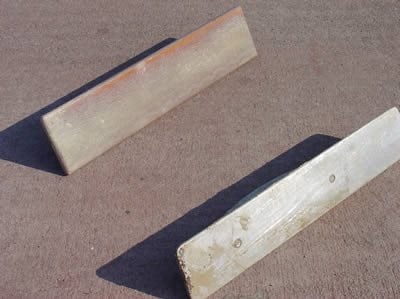
A resin hand float (top left) is often the tool of choice for working in color hardener, vs. a magnesium float(bottom right).
When applying dry-shake hardeners on extremely hot or windy days, you will also need to take measures to prevent moisture in the surface from evaporating too fast. Not only can this rapid moisture loss lead to surface crusting and cracking, it will make it impossible for you to properly wet out the color hardener. However, you can use an evaporation reducer, such as Mini Delayed Set from Fritz-Pak or Eucobar from Euclid Chemical, to help slow surface moisture loss on hot, windy days.
Potvin points out that most manufacturers of color hardener recommend applying color hardener in two separate applications, or "shakes," instead of applying the entire recommended dosage all at once. This gives the hardener a chance to "wet out," or absorb water. After each application, the hardener must be worked into the surface with a float.
With dry shakes, you can apply accent colors of hardener to achieve contrast, using one shade as a base topped with as many as four or five different accent colors. Bob Harris of the Decorative Concrete Institute recommends using this technique on stamped concrete projects to replicate the subtle color variations you would see in natural stone.
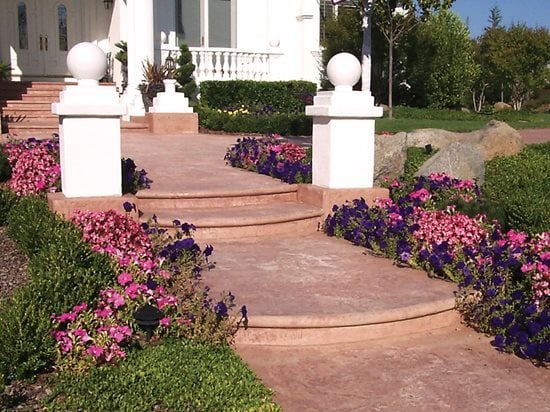
Using accent colors of hardeners can produce surfaces that replicate the subtle color variations in natural stone. Brickform in Rancho Cucamonga, CA.
Harris also says that you can apply them to step faces by combining the hardener with a bonding agent and water and then plastering this mixture onto the vertical faces with a trowel.
More expert application tips:
-
As with integral pigments, make sure the color hardener meets ASTM C 979 standards for color stability. If abrasion resistance is a priority, look for products that produce surfaces meeting the abrasion-resistance standards of ASTM C 944.
-
Always follow the manufacturer's recommendations for color hardener dosage rates. Most suppliers package hardener in 60-pound buckets or bags that will cover approximately 100 square feet of surface area (or about 2/3 pound of material per square foot). But lighter colors often require a heavier application, ranging from 90 to 120 pounds (or two containers) of hardener per 100 square feet.
-
Consult with your ready-mix producer and explain that you will need a mix design appropriate for use with a dry-shake hardener. Some admixtures, such as air-entraining agents and water reducers, can reduce or minimize the amount of bleed water available for absorption by the color hardener. Some manufacturers recommend limiting the air content of the concrete to 4%.
-
If you want to use a dry-shake hardener to color an overlay, ask the manufacturer of the overlay system if hardeners are a viable coloring method. A dry-shake hardener must absorb some moisture from the overlay so you can work it in properly. Some overlay systems, however, don't contain enough moisture to wet out the hardener.
Get tips for achieving consistent color.
Using hardeners and integral color together
Both color-hardener and integral color have their advantages and disadvantages. What a contractor may use could vary from job to job depending on the circumstances. The best is a combination of both, which adds to the cost, but achieves a better overall product. Create layers of color by using color hardeners and other surface-applied treatments—such as chemical stains—in conjunction with integral colors.
COLOR HARDENER PRICES
Generally, integral color will cost more than a dry-shake hardener because you are coloring the entire concrete slab rather than just the surface. But a dry shake may not always be the most economical choice if you factor in the additional labor involved to apply it and work it into the surface. Also remember that when using lighter shades of color hardener, you will need to use more product to get good results.
"The price of color hardener ranges anywhere from 15 to 40 cents a square foot depending on the color and its coverage rate. But we must also look at the labor cost of its application. It will usually take six man hours to spread color hardener on approximately 500 square foot of concrete. These man hours are usually wasted while workers wait for the concrete to set up. In most cases, however, the labor cost can be justified," says Potvin.
Clark Branum, director of technical services for Brickform Products advises that creating samples or mock-ups of the work to be done are critical to the success of any colored concrete application. "With color hardener, it is easy to create small panels and mock ups that can be reproduced on a larger scale, making it much more cost effective during the front end phase of a project. While, mock ups with integral color are typically expensive since a minimum of 3 cubic yards must be used to produce consistent color, partially due to the amount of cement paste it takes to coat the drum of a cement mixer," says Branum.
Find Local Suppliers: Decorative Concrete Stores
WEIGHING THE OPTIONS - INTEGRAL COLOR
When making side-by-side comparison of integral colors and dry shakes, here are some additional factors to evaluate before making a decision:
- The two biggest advantages of integral color are speed of placement and color mixed through the whole slab.
- Lighter and brighter colors are much harder to achieve with integral colors.
- With integral coloring, surface strength is not improved and may wear faster after stamping.
See a comparison chart of concrete coloring products.
The cost of integral color will vary from 10 cents a square foot to a $1.00. These costs are based on a 4" slab with 6 sack mix. So, the cost of integral color can be an advantage or disadvantage. Although it's possible to obtain more vibrant pastel shades with integral color, doing so could be cost prohibitive because you would need to use a white cement and a higher dosage of pigment.
If you can't find just the right color for your project, ask the manufacturer about the possibility of custom color matching. Suppliers of both integral color and color hardeners are often able to match existing color tones or formulate custom hues to suit your design scheme.
HOW TO FIX COLOR HARDENERS
Chris Sullivan answers color hardener questions:
Color hardener fails to adhere
Question: A colored and textured concrete pool deck I placed a year ago is showing signs of surface failure. I used color hardener in conjunction with powdered antiquing release and seamless slate-patterned texturing skins. The entire surface was sealed with a solvent-based acrylic sealer. Only one section of the project is showing signs of failure, while all other areas are wearing well and look good. What is causing this and how can it be repaired? Rip out and replacement of the deck is not an option because of the swimming pool.
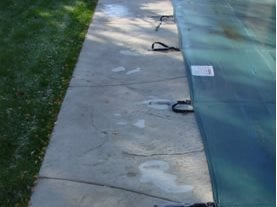
Answer: The problem you are seeing is lack of adhesion between the color hardener and concrete. Color hardener is a dry cement-based powder that is cast on the concrete surface when it is still wet. The water from the concrete "wets out" the color hardener from below as it sits on concrete surface. Timing is everything. Applying the hardener when there is too much bleed water on the surface will wash out the color. Waiting too long, after most of the water evaporates and the concrete becomes too dry, will create a weak, thin layer of color.
The other key factor in successful color hardener application is proper floating. Once the color hardener has completely wet out it needs to be worked in with a float (preferably wood or resin) to become one with the concrete. Certain sections of this slab are showing signs that insufficient floating took place, with the color hardener coming off quite easily, in pieces ranging from penny to quarter size. The final piece of the puzzle came when the homeowner explained that the section with failures was poured late in the day, under poor light conditions, and was rushed. I suspect that lack of floating really caused this problem. Rushing the job and skipping a crucial step (floating color hardener into the surface) ruined what otherwise would have been a very nice problem-free pool deck.
The fix, unfortunately, will never look as good as what the original work would have looked like if it had been done properly. You will need to explain to the homeowner that the look will differ slightly, and the colors and texture may not match exactly. Since the color hardener is flaking off quite easily, high-pressure water or sandblasting can be used to remove all the loose color in the areas that are failing. Once all the loose color is gone, apply a stampable overlay in a matching color. The good news is that the original gray concrete surface is rough enough from the original application so that no additional surface preparation will be needed.
Apply the colored, stampable overlay at a thickness of ¼ inch, and use the same color release and texture skin originally used on the project. If necessary, use water- or alcohol-based stains over the entire slab or select areas to blend the new with the old once the overlay has cured. Once the overlay and color work is complete, the entire project (new and old) should be sealed.


