
- Coloring Supplies
- Concrete Stains
- Concrete Dyes
- Color Hardener
- Integral Color
- Resurfacing & Overlays
- Concrete Coatings
- Concrete Overlay Supplies
- Concrete Resurfacer
- Vertical Concrete Overlays
- Terrazzo Flooring
- Concrete Countertops
- Countertop Mixes & Supplies
- Texturing & Patterns
- Concrete Stamps
- Concrete Stencils
- Concrete Engraving
- Forms & Molds
- Concrete Forms
- Concrete Molds
- Step Forms
- Concrete Polishing
- Polishing Equipment
- Concrete Densifiers
- Tools & Equipment
- Surface Preparation
- Concrete Tools
- Concrete Power Tools
- Concrete Pumps
- Protection & Repair
- Concrete Sealer
- Cleaning Concrete
- Concrete Repair
- Curing Concrete
- Vapor Barriers
- Foundation Waterproofing
- Concrete Mix
- Concrete Admixtures
- GFRC Mixes & Supplies
Form Liners for Cast-in-Place Concrete
Textured surfaces or stone walls right out of the box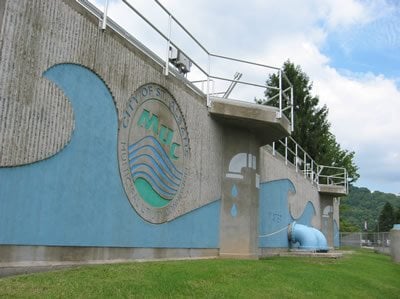
City of St. Albans, W.V. water treatment plant. Concrete Artforms
Find Manufacturers: Concrete Forms
Contrary to what a layman might think, placing a perfectly smooth plain gray concrete wall is very difficult. Thank God, then, that most people prefer concrete with texture and color, where minor imperfections either disappear or are perceived as bestowing character to the concrete.
For horizontal work, we typically bestow that character by imprinting the fresh concrete with stamps. But with formed vertical concrete surfaces, stamping the fresh concrete is impossible while it's in the forms. Rather than hoping we can miraculously strip the forms while the concrete is still soft enough to stamp, form liners attached to the inside face of the form can impart an incredible variety of patterned surfaces.
Form liners have been used for many years to create what ACI calls architectural concrete-defined as "concrete that will be permanently exposed to view and therefore requires special care in selection of the concrete materials, forming, placing, and finishing to obtain the desired architectural appearance." Sounds like a definition for decorative concrete, doesn't it? The standard architectural form liners for many years were textured plastic or fiberglass sheets fastened to the form facing to create ribbed patterns on the concrete. New materials and techniques, though, are allowing us to create form liners that impart more intricate patterns on the concrete surface-realistic rock patterns, detailed graphics, even photographs.
APPLICATIONS
Forms with form liners are really no different than the molds we use for concrete countertops, sinks, or furniture (see Concrete Molds). Urethane rubber form liners are frequently used to texture countertop edges and stair risers, whether cast-in-place or precast.
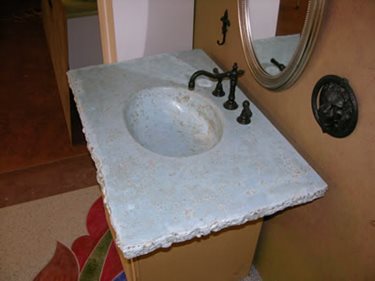
enCounter, Oklahoma City, OK
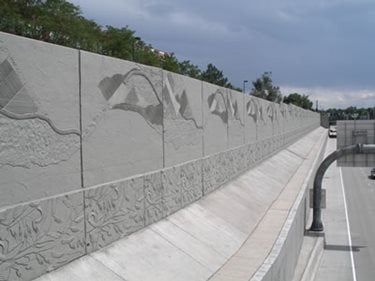
Decorative sound walls on I-25 in Denver
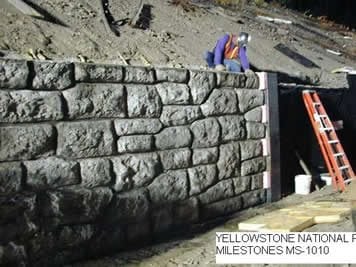
Stone patterned concrete walls in Yellowsotne National Park. Milestones, Hudon, WI
Liners are used in many precast applications. Architectural concrete cladding panels and spandrel beams for buildings often are cast using form liners to impart textures. Textures and custom decorative features on precast highway sound walls are becoming increasingly popular as money on public projects is set aside for art. Panels for mechanically stabilized earth (what used to be called Reinforced Earth) nearly always are cast with some decorative features. On the recent reconstruction of Interstate 25 in Denver, over 8 miles of sound walls were precast using a variety of form liners.
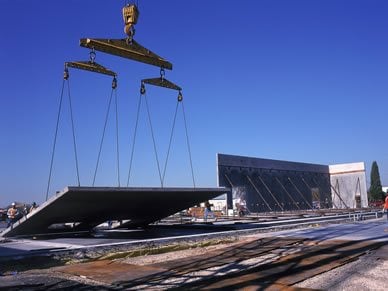
Tilt-up panels, which amount to on-site precast, are also often cast using form liners, especially ribbed patterns. "For tilt-up, you should always look for single-use plastic form liners," said Jill Richards, Fitzgerald Formliners, Santa Ana, Calif. Cast-in thin bricks are another common feature of tilt-up panels-installed using what amounts to plastic form liners to hold the thin bricks in position so they can bond with the concrete.
In this article, though, we are primarily reviewing form liners used inside the forms for cast-in-place concrete walls-although the liners and techniques are really no different for precast concrete. Liners are attached to the form panels in various ways and concrete is cast for vertical element: walls or columns. The most popular liners today, provide a stone masonry appearance that is then stained, resulting in a wall that looks like stone but that has more strength and durability. Paul Nasvik, Milestones, Hudson, Wis., has built concrete "guard rails" in several national parks, including Yellowstone and Sequoia. In these applications, the Federal Highway Administration specifications won't allow masonry, although the parks demand walls consistent with the traditional masonry walls. Concrete walls made with custom form liners and special stains easily meet these requirements.
TYPES OF FORM LINERS
The first thing to decide when considering form liners is how many times you hope to reuse it. Some materials will withstand up to 100 pours or more, while others are intended for a single use. The price varies accordingly. Most form liner manufacturers have a selection of standard liner textures and most will make custom liners.
There are basically four materials used to make form liners, each with its advantages and disadvantages:
- Elastomeric urethane rubber
- Plastic
- Polystyrene or polypropylene foam
- Fiberglass
Elastomeric Rubber (Urethane)
Buck Scott of Scott System, Denver, has been making elastomeric form liners longer than anyone--since about 1970. He notes that "Elastomeric means a material that is stretchable from a point within itself in all directions. Mostly for form liners, that means urethane rubber. Plastic is flexible but not stretchable." This stretchable quality allows elastomeric liners to create nearly any surface texture imaginable and even allows some undercut textures.
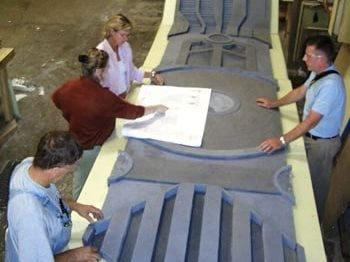

Custom elastomeric form liners can be made in very large sizes to create special effects, like this locomotive motif that now graces the Demonbreun Street Viaduct spanning Nashville's historic railroad yards. Scott System.
Form liners made with the casting face of urethane rubber are the longest lasting, with 100 or more uses possible and can be produced with patterns as deep as 5 inches. Within the category of urethane liners, there are some manufacturers who have different grades. Paul Nasvik of Milestones, Hudson, Wis., only makes urethane liners, but has three grades. "Even what we call our single-use liners have a urethane facing and are cast in the same mold as those that will withstand many uses. For some applications, the contractor intends to use the liner only once, so we cut down on the thickness of the urethane facing and use a lower grade of plywood backing. They still aren't as cheap as plastic liners but are about half the price of our high-reuse liners."
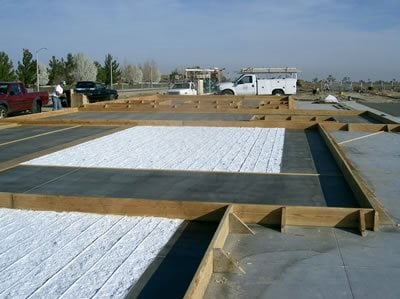
A concrete block pattern will be created on this tilt-up panel using an elastomeric rolled liner. Fitzgerald Formliners
Elastomeric liners can be supplied as rolled rubber sheets, as flat sheets, or cast onto a plywood backing. The contractor glues the rolled or flat liners to a plywood backing or directly to the form panel. Milestones places polystyrene foam between the rubber facing and the plywood backing to bond the two together. Scott System has what they call Hydro Edge liners, where the plywood, including the edges, is embedded into the urethane, protecting the edges from damage from wet concrete.
The cost of elastomeric form liners varies from about $14 per square foot to as much as $75 for custom patterns and patterns with deep relief. "The liner price is determined by the amount of relief in the surface," said Scott. "If you have deep detail, all that has to be solid rubber. It's sort of sold by the pound. If a liner weighs 10 pounds per square foot, it will cost $50 or more per square foot. If it's a light sand blast texture that's only 2 pounds per square foot it would be only $14 or so. The price is primarily based on the cost of the rubber."
Plastic
Plastic form liners are typically made using a vacuforming process. Plastic liners can be single-use or can go up to 15 uses, depending on how thick the plastic is and what type of plastic is used. Fitzgerald Formliners makes plastic form liners of styrene for single-use applications, like tilt-up panels, or from ABS for cast-in-place uses. Fitzgerald also makes an extruded plastic formliner for applications where the designer wants long sections without seams, but this only works with ribbed patterns.
Plastic form liners are easy to handle because they are very lightweight-as little as 0.4 pounds per square foot, compared to an average of about 6 pounds for elastomeric liners. A wide variety of plastic patterns are available, although the more typical plastic form liners are those used for ribbed patterns. Plastic patterns can't achieve the deep relief of rubber liners (maximum is about 1 inch) and can't get the sharp detail of elastomerics. Allowable form pressures (controlled by pour rate) are lower with plastic liners-600 to 750 psf. For deeper plastic patterns, wood strips are often added behind the liner to provide added support.
Plastic form liners cost from $1.50 to about $7.00 per square foot, depending on the type of plastic and the relief.
Polystyrene or Polypropylene Foam
Styrofoam can be used in formed concrete as a block out to create various patterns or even logos. To make that work, however, it must be waterproofed. One clever technique is to form patterns with Styrofoam then to actually melt the foam out with acetone when stripping. Styrofoam single-use form liners are also available in rock patterns.
One fairly recent addition to form liner technology is expanded polypropylene liners available from Karlson Forming Specialties, Amery, Wisconsin. Produced in roughly 3x3-foot panels, these liners are very lightweight and will last from 6 to 8 pours. They are easy to trim to size with a utility knife or a circular saw. To install, they are nailed to the forms with finish nails or attached with double-sided tape. Cost for these liners is $8.00 per square foot.
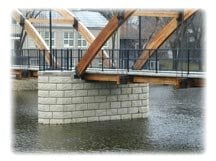
Coloration Systems, Inc.
Fiberglass
Fiberglass form liners were once quite popular, but are seldom used today since elastomeric liners are simpler to make and perform as well for most applications. "Fiberglass is slowly getting outdated," says Richards. "We had a fiberglass liner not too long ago with 8-inch relief. That's a great application for fiberglass-anything over 3 inches, but I haven't seen one in 3 or 4 years. It's an old technology, but we still offer it because every once in a while someone wants it."
Thin Bricks
Embedding thin bricks into concrete precast or tilt-up panels has been popular for several years. In 2006, though, Scott System introduced what they call Rim Snaps, a system to allow thin bricks to be cast into vertically formed walls. Thin brick sections are even available for inside or outside corners to wrap around the corner and create the appearance of normal brick. Architectural Polymers has a similar system.
Pictures and Graphics
German form-liner-manufacturer Reckli has developed a method for achieving photographic images on concrete surfaces. An image, either a photo or a graphic, is scanned and converted into 256 grey scales. Using this scan, a CNC milling machine creates various thicknesses of lines onto sheets of form liner materials. The resulting images in the concrete are remarkably detailed.
HOW TO USE FORM LINERS
Form liners are attached to the formwork in various ways, depending on the type of form. Sheet elastomeric form liners are epoxied to the form panel-either wood or steel. Elastomerics that come already mounted on plywood backing are screwed to the forms, typically from the back to keep from marring the form liner surface. Plastic form liners are screwed or stapled to the forms. One tip is to be careful what you use to patch over screw heads on plastic liners. "I always tell people not to use silicone or caulking," said Fitzgerald Formliner's Jill Richards, "use plumbers glue or ABS glue because then it's the same material as the plastic. Silicone will create discolored spots or streaks in the concrete."
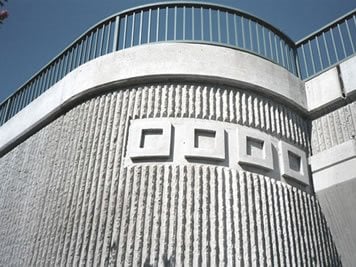
Fractured rib pattern with custom geometric graphics in Stockton, Calif. Fitzgerald Formliners
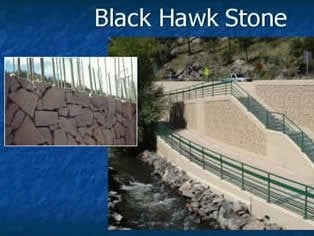
Scott System
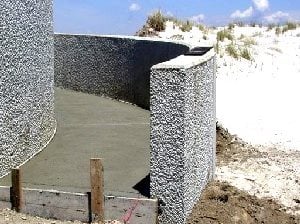
A riverbed aggregate pattern. Greenstreak
Joints between form liners require special care, since leaks at these points will create discolored concrete or honeycombing. Always seal joints. Some liners come with interlocking edges. A simpler way is to design a rustication line or a non-textured area at liner joints. Liner materials will expand or contract with temperature, so watch for this as well.
A critical step for any form liner application is properly applying the form release agent. In general, any good reactive release works well. If the concrete is to be stained, do not use any sort of diesel oil or kerosene, since it can interfere with uptake of the stain. Reactive releases wash off cleanly after stripping. Fitzgerald cautions that petroleum-based release agents or solvents can attack and destroy either elastomeric or plastic form liners. Spray and brush the release into the pattern to make sure every facet is coated.
High-slump self-consolidating concrete mixes will result in great detail and very few bugholes in form-lined surfaces. These mixes also require nearly watertight and well-braced forms. But in general, more standard mixes will also work fine, although extra effort should be made to thoroughly vibrate the concrete. Scott says to use internal vibrators that are inserted into the previous lift and to avoid vibrator contact with the form liner. Fitzgerald advises use of an elephant trunk to avoid mix segregation and entrapping of air. Paul Nasvik avoids asking contractors to use special mixes on highway jobs, where "specifying a special mix can create a nightmare for the contractor. I maintain that regular concrete is fine-it really comes down to proper placing technique."
Another consideration with form liners is the clear concrete cover over the reinforcing steel, with an indented pattern. Position the patterns and steel to maintain 2 inches of cover in order to reduce the possibility of rust stains on the wall surface.
Form liners should be stripped as soon as possible—at least within 24 hours. The longer the liner is in contact with the concrete, the tougher it will be to strip. Karlson says that their expanded polypropylene forms will stick to the concrete the first time they are used but will come off with the forms on subsequent uses.
WHO MAKES FORM LINERS?
There are quite a few manufacturers of form liners out there today. Most specialize in one type of form. Here are those that make form liners for cast in place concrete:
Arch-Crete - masonry pattern liners distributed by Symons
Architectural Polymers - various elastomeric and plastic patterns; excellent online application guide
Creative Form Liners - fiberglass and elastomeric form liners for highway department uses
Fitzgerald Formliners - wide variety of form liners and excellent detailed application guide on web site
Karlson Forming Specialties - expanded polypropylene forms in masonry patterns
Milestones - stone and masonry elastomeric liners; artificial rocks; custom rock patterns
Museumrock Products - rock patterns in single use or sytrofoam liners
Scott System - custom elastomeric form liners in nearly any size and pattern, either plywood mounted, in sheets, or rolled; excellent application guide on web site
Spec Formliners - stock
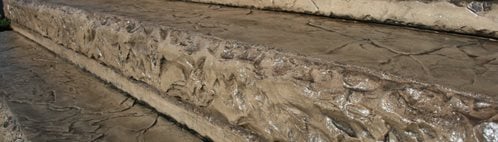 Stepping It Up with Concrete Form Liners
Learn how to take the look of your stairways to a new level using textured step liners
Stepping It Up with Concrete Form Liners
Learn how to take the look of your stairways to a new level using textured step liners
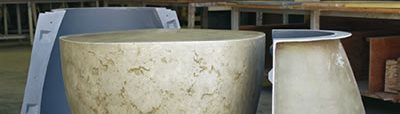 Concrete Molds
A guide to buying or making your own formwork for concrete countertops, sinks, and furniture
Concrete Molds
A guide to buying or making your own formwork for concrete countertops, sinks, and furniture
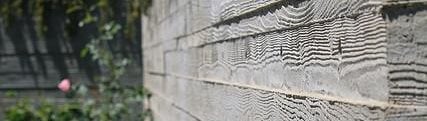 Board Formed Concrete
The roughsawn look of wood is making a come-back as a desirable finished texture
Board Formed Concrete
The roughsawn look of wood is making a come-back as a desirable finished texture


